JOHN LOCKE, ARCHITECT

  • Featured Work
  • Design Blog           
  • Photography
  • Graphic Design
  • Dept of Urban Betterment

About

Hello. I live in New York and work at The Living. I hold a graduate degree from Columbia University's GSAPP and an undergraduate architecture degree from the University of Texas at Austin. I have more than seven years of professional experience at noted architecture firms, including New York-based Rogers Marvel Architects and SOM. I also tackle freelance graphic and photography work with my partner in crime, the multi-talented Jackie Caradonio at Lion in Oil. In addition, I teach a course, Hacking the Urban Experience, at Columbia. View my CV here: CV(html). Thanks and have a nice day.

Contact

john.h.locke{at}gmail.com
310.735.3333

Architecture Portfolios

Portfolio 2002-2007 (issuu)
Portfolio 2008-2009 (issuu)

20110728 Tags: competition, fabrication | No Comments »

light it up

light_02
light_013


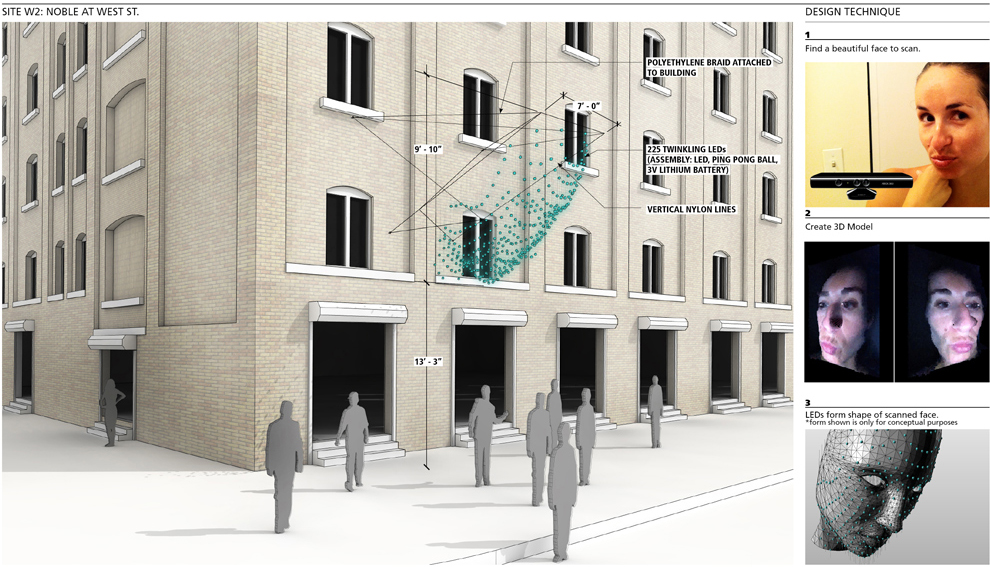
With a budget under $300, the installation is realized as a spatial prototype for how a fleeting work can provoke an increased engagement between users and public space. Built with over 200 led lights and conceived to take maximum advantage of a temporarily repurposed historic building, the work becomes as ephemeral as a passing comet, creating a new constellation in the night sky, visible from the streets of Brooklyn for one night only.

2011076 Tags: DUB, fabrication, new york, urban | 39 Comments »

DUB 002

booth_001
booth_002
booth_003
booth_004


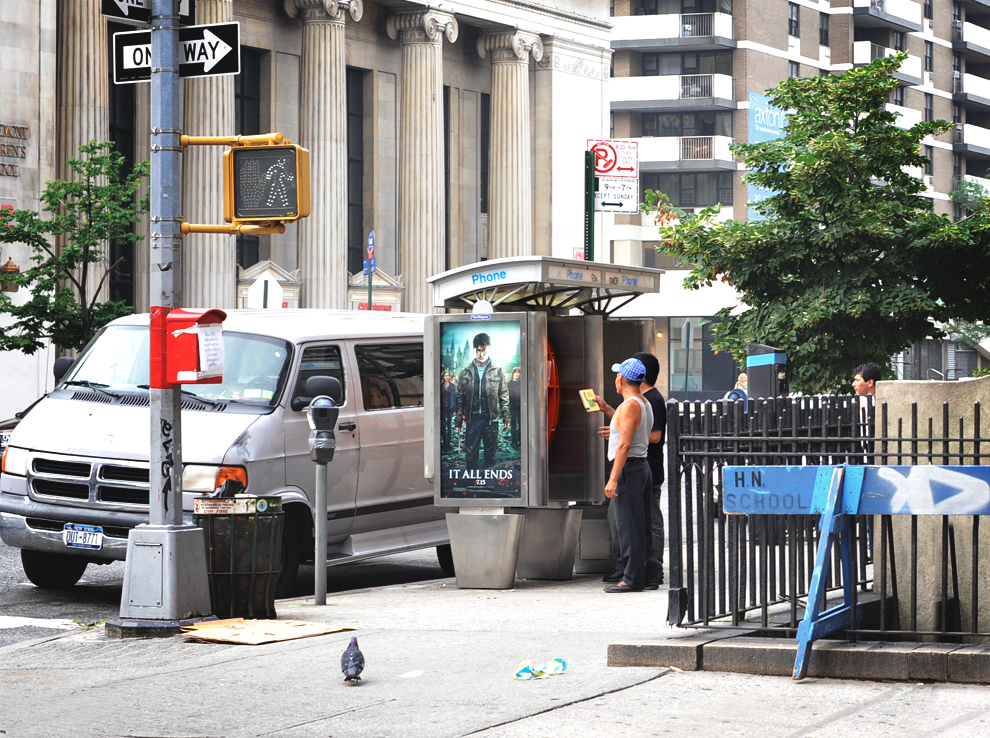
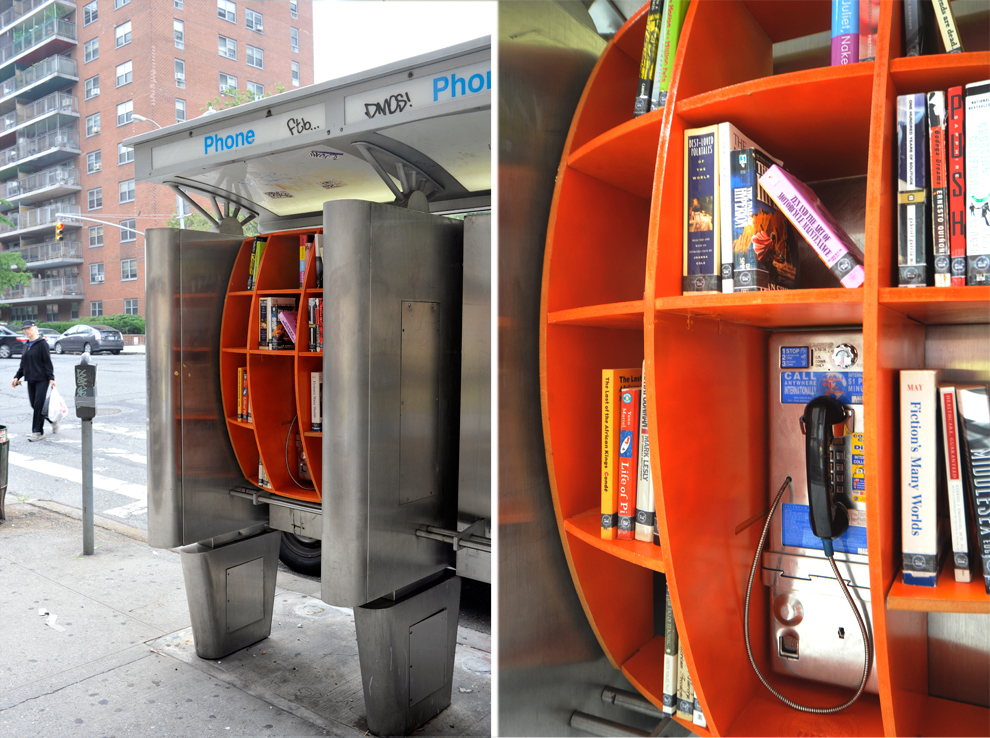
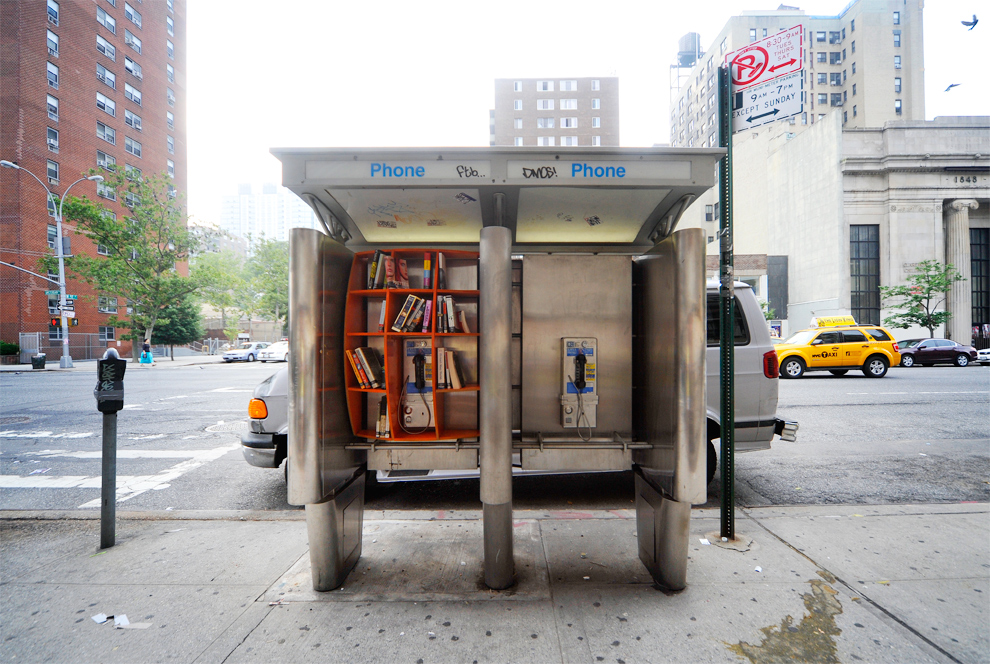
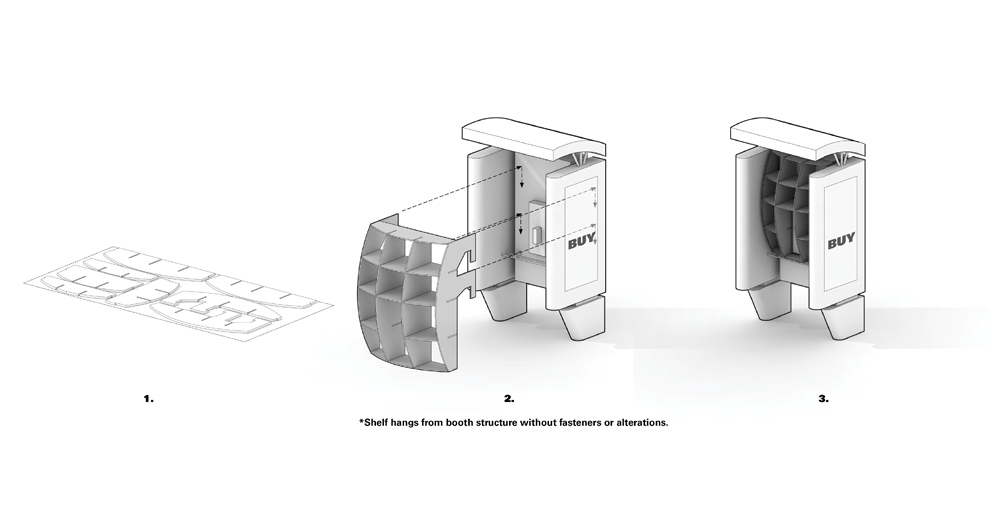
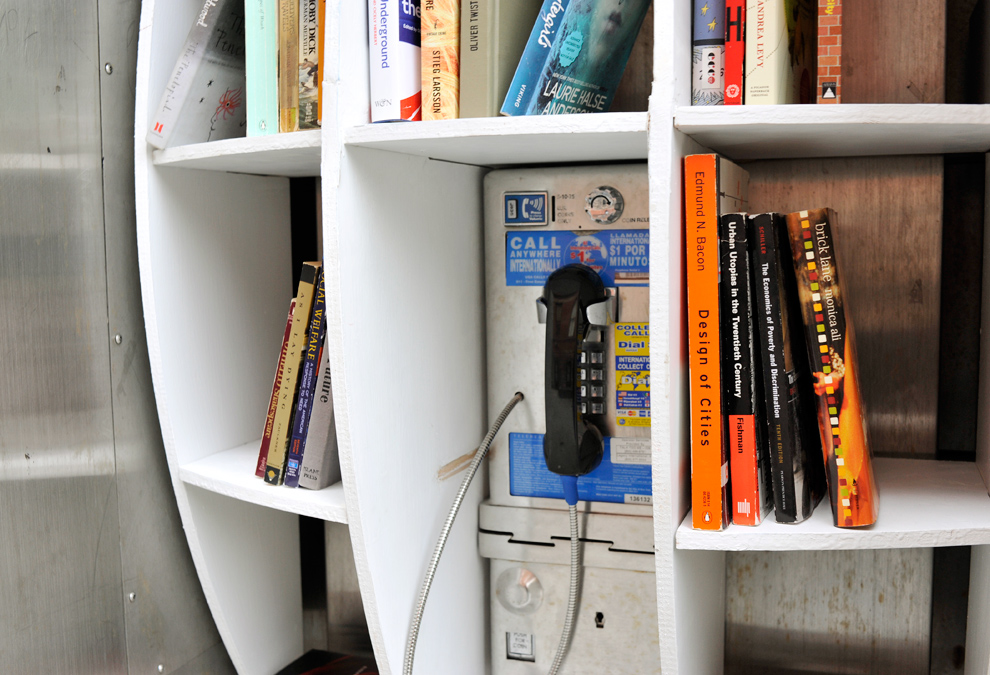
Following from the dispiriting failures of 001, 002 proved to be more successful, and not only because of it’s pumpkin orange color, but because it wasn’t cleared of books within 6 hours and the empty shelves themselves weren’t removed after 10 days. I attribute this mostly to an adjustment of tactics and location. Every block has its own subtleties and micro-urban climates, one block is boarded up with for “rent signs” while the next is a thriving pocket of activities and street-level engagement. By moving to a location 8 blocks further south, 002 was placed nearer to a major thoroughfare – 96th street – and received a more steady stream of mixed pedestrian traffic leaving the express train stop on Broadway and by virtue of being closer to street level retail (a large CVS), educational (a school and church) as well as the residential apartments along 97th street. 001 just didn’t get enough foot traffic and frankly felt deserted. I thought being near a hostel and school would generate some interest, but the hostel is an imposing Victorian Gothic structure with a decidedly prison-like bent reflecting its previous use as a nursing home for “Respectable, Aged and Indigent Females” and unsurprisingly generates little sidewalk traffic and even less urge to stop and inspect some books in a phone booth.


In an attempt to encourage sharing and free distribution of the initial selection of books, I didn’t mark the books in any way. But in lieu of the entire initial selection of 001’s books being carted off within a few hours, I tested out being more explicit and treating the books more like a library. Almost like a Dewey decimal number taped to the spine of a library book, I added a visible logo to the bottom of each spine. I hoped this would prevent the books from easily winding up in the hands of sidewalk book resellers, but I fear that the marking implies an ownership that prevents a casual exchange of taking and leaving their own books. I observed a number of people reach out and pick up a book, flip through it, but then return it to the shelf. Some even doubled back for a second look and to engage in a closer inspection of the shelves, but they still refrained from actually taking a book. Perhaps feeling hesitant to, I don’t know, steal/vandalize (irony) something that’s out in public? I can see how there might be a stigma there, to not just keep walking straight along the sidewalk with your head down, but to stop and engage with the street. I intentionally wanted to avoid any directions, like a sign that would say something along the lines of “hey this is for sharing books, you can leave some here” and I still want to avoid anything that seems overtly prescriptive, but after seeing people hesitate when confronted with 002, perhaps there is a more subtle way to gently describe an intended use.


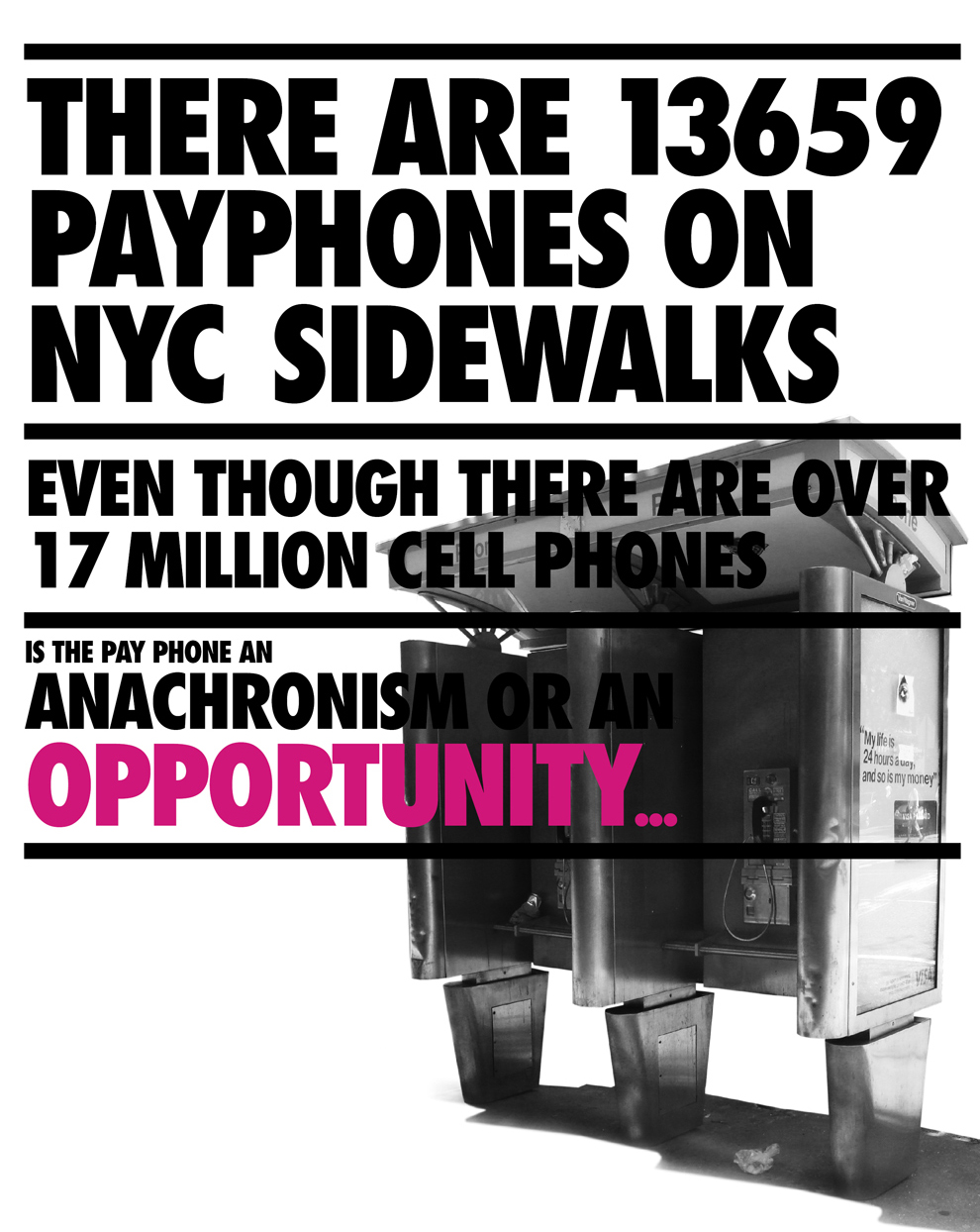
Even as they are rendered obsolete by the ubiquity of smartphones, I’m interested in pay phones because they are both anachronistic and quotidian. Relics, they’re dead technology perched on the edge of obsolescence, a skeuomorph hearkening back to a lost shared public space we might no longer have any use for. Something to be nostalgic for, in the way I can’t think about a phone booth without conjuring up images of an old, impatient woman banging on the door to one while I was inside using a calling card to ask for money. And of course they are nuisance, basically pedestrian level billboards that only blight certain neighborhoods (good luck finding a payphone in Tribeca, while there are eight separate phone kiosks on one block between 108th and 109th streets and Columbus Ave). But they can also be a place of opportunity, something to reprogram and somewhere to come together and share a good book with your neighbors.


All the books were donated by local residents and the plywood was milled by Kontraptionist.


dub_diagram
more »

2011065 Tags: evolution, grasshopper, parametric, research | 1 Comment »

bucky was right

design-space_galapagos
grasshopper galapagos
galapagos_results


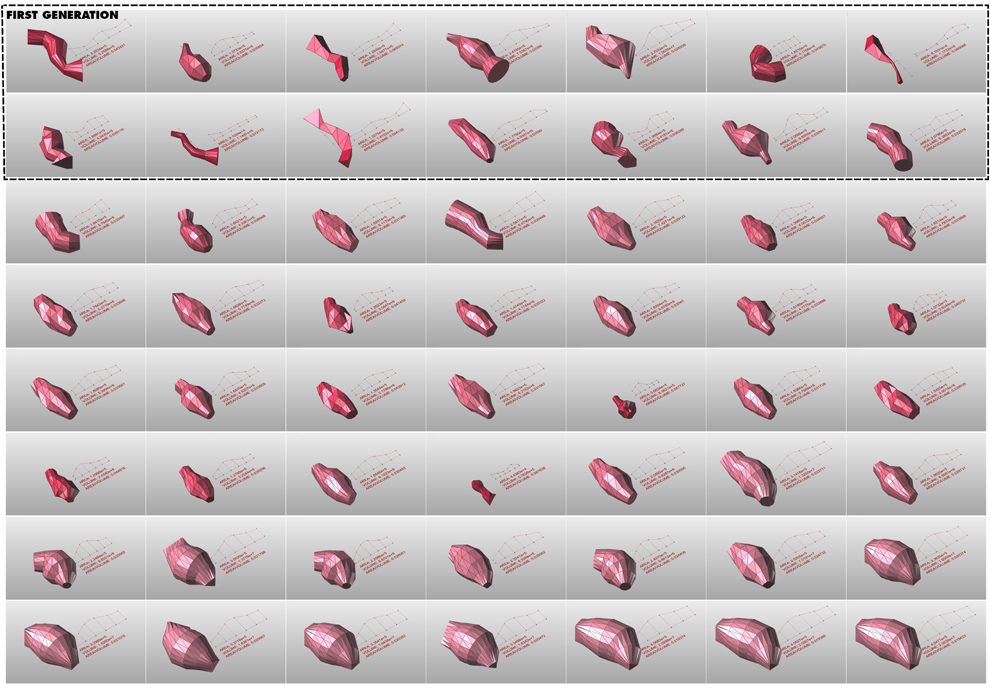
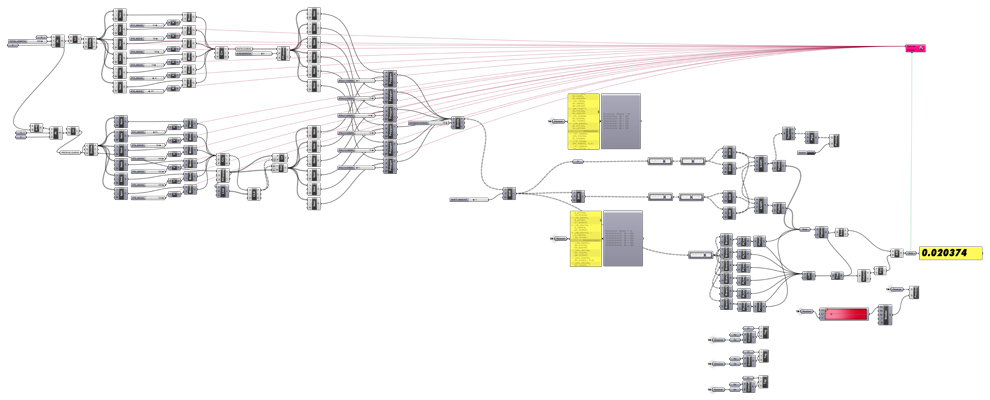
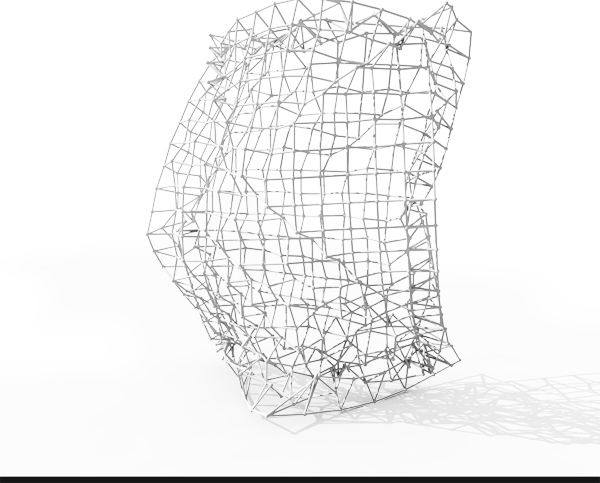
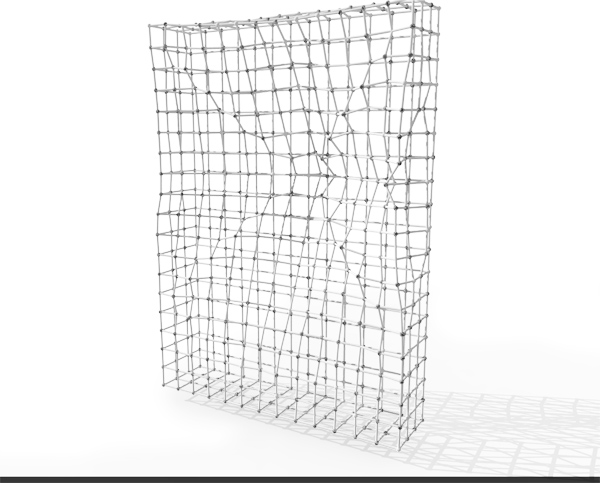
I’ve used genetic algorithms for form finding with a previous project, and that time I was using a tenuous connection between catia, modeFrontier and Robot. So I was excited to see grasshopper begin to natively implement an evolutionary solver with Galapagos. As an initial experiment I started with a classic, something simple – I wanted to find a tessellated form that would enclose the maximum volume using the smallest surface area. I’d like to think that this would produce something unexpected, but it’s pretty much the definition of a sphere. I set up the parametric model to wiggle all over the place with various triangulated densities and differing number sided polygons at each joining segment. My hypothesis was that the form would tend toward symmetry and evolve into the aforementioned spherical shape. I believed that the polygons would tend toward the most sides possible to more closely approximate a circle, later generations evolving away from a triangle toward an icosagon. (Just like on Flatland!)


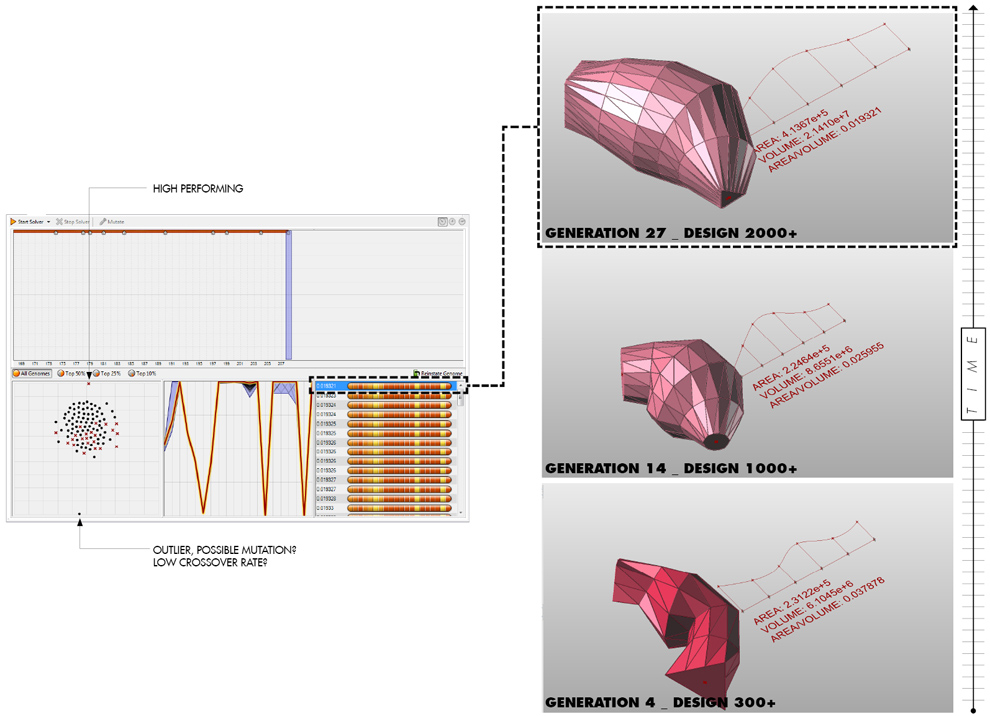
A couple of observations: Galapagos pretty quickly found the overall shape – smaller radii at the extremes and bulging in the middle – the beginning of a sphere. However, while it tended toward bilateral symmetry, it kept a kink in the first segment that prevented the shape from being perfectly symmetrical. I think the solver got stuck in a local minimum as opposed to a global minimum. Perhaps with a higher mutation level or letting it run for a longer amount it could have jumped out of this. On further checks I found that it was correct, after 30 generations and over 2500 iterations, the surviving croissant-like shape of the optimal designs did have a better SF:V ratio than a perfectly symmetrical design. Perhaps it had something to do with the setup of the parametric model or the way the facets resolve themselves at the extremities?


But in general my hypothesis was proven correct. Which leads to the initial problem with Galapagos. There are a lot of opportunities with this type of experiment and people more clever than me will surely do them, but when you can only solve for one objective it becomes difficult to create truly complex solutions. For instance, with my surface area/volume problem there is only one true pareto solution. Eventually Galapagos will find it, or with enough time and a calculator I could calculate this myself. There is one single, optimal solution, it’s just hidden somewhere amongst a number of parametric sliders. Unless you start getting into multiple, competing objectives, then the pareto point becomes a curve and there are multiple valid solutions, each one involving certain trade offs and a criteria for selection. Say you wanted to find a form with the minimum srf area:volume ratio, but also that form had to have the fewest structural members, or provide the most shade on June 21st, or spatially provide the most potential revenue stream for a project stakeholder. That’s when it gets really interesting and opens the possibility for a design space that includes high performing, unexpected results. It’s a great start, and I can’t wait to see Galapagos evolve.


Download the grasshopper definition for version 0.8.0004 here: http://gracefulspoon.com/downloads/Grasshopper_GALAPAGOS_TEST.rar

20110524 Tags: DUB, fabrication, new york, urban | 3 Comments »

DUB 001A


dub_booth_01
dub_booth_03
dub_booth_02


Reappropriating anachronistic messaging infrastructure (which are really just props for pedestrian scaled billboards) into something potentially more useful. In this case a community book drop.


diagram_05
more »

20110514 Tags: architecture, fabrication, graphic design, work | No Comments »

the future of suburbia

signs01
signs02


In a remarkable piece from New York magazine regarding the liberal world’s MVP, Paul Krugman, the author described the genesis of Krugman’s 2006 book:

When he was writing The Conscience of a Liberal, Krugman found himself searching for a way to describe his own political Eden, his vision of America before the Fall. He knew the moment that he wanted to describe: the fifties and early sixties, when prosperity was not only broad but broadly shared. Wells, looking over a draft, thought his account was too numerical, too cold. She suggested that he describe his own childhood, in the middle-class suburb of Merrick, Long Island. And so Krugman began writing with an almost choking nostalgia, the sort of feeling that he usually despises: “The political and economic environment of my youth stands revealed as a paradise lost, an exceptional moment in our nation’s history …”


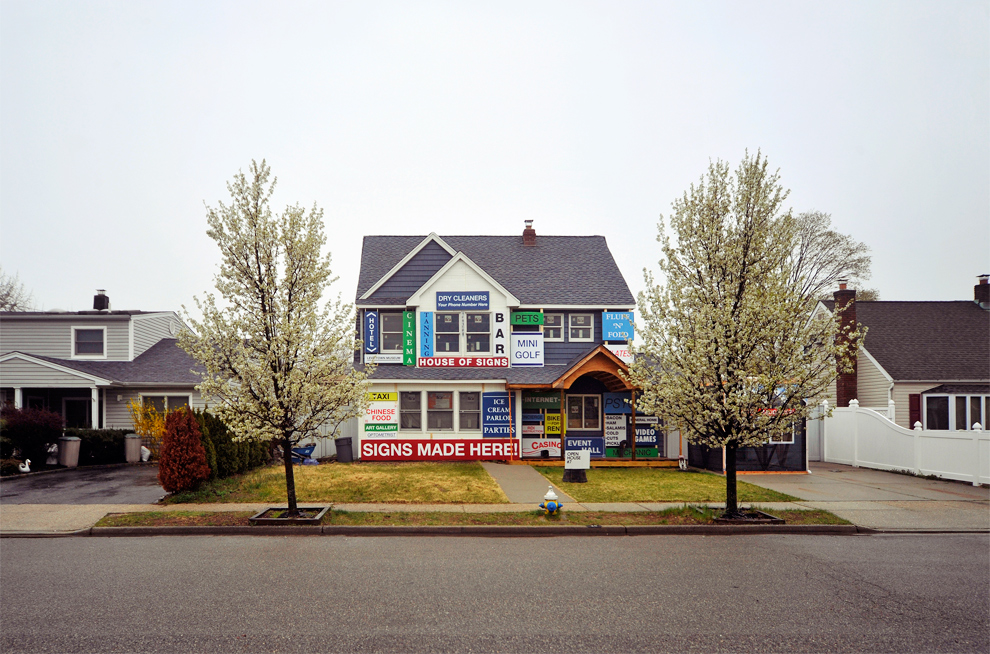
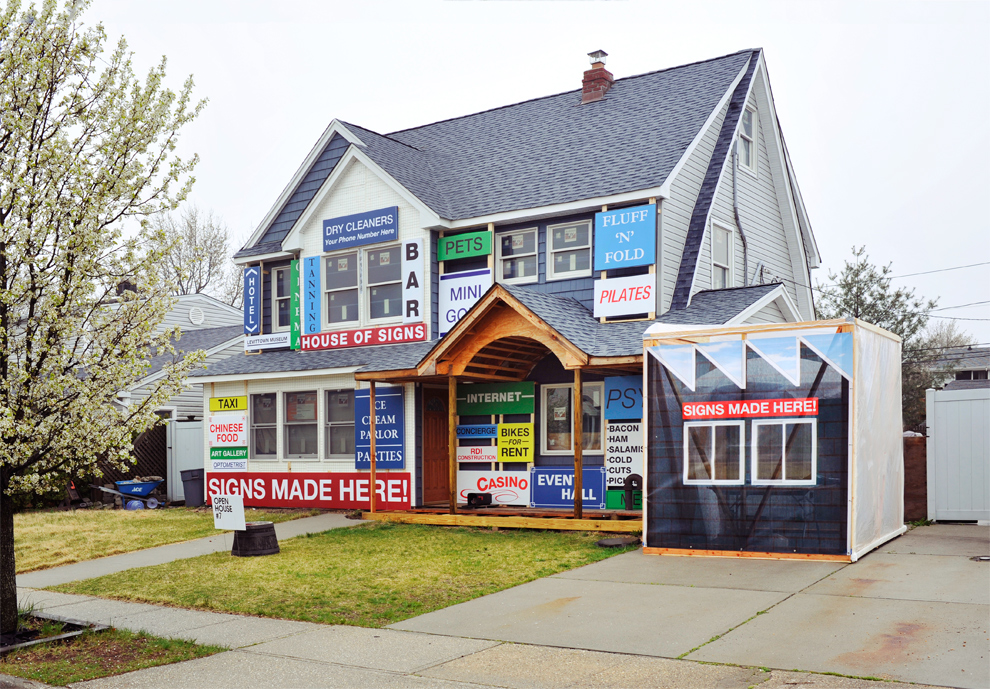
Krugman’s own vision of a lost utopia on Long Island, during that bright post-war bloom of middle class prosperity, which must have had seemed so full of limitless potential and opportunity but somehow lurched toward our current state of contraction, pulled apart and forgotten by the twin poles of unimaginable wealth disparity, was at the front of my mind when I had the awesome opportunity to manage this project from David Benjamin and the Living. This was House #7 of nine theoretical projects that comprised part of a one-day only open house installation on the future of suburbia, a what-if, hyper-fictional reality showing design’s potential to provoke and elucidate a hypothetical path forward hosted by Droog and DS&R.


Conceived with the ingenuity of hybrid housing/service industry residences seen in Tijuana and rendered with the graphic intensity of Chinatown, David’s concept called for a home that is both a store and factory for making and selling signs. The factory is an inhabitable sign in and of itself, and the facade of the house is taken over by examples of constructed signs. As more and more Levittown residences convert to self-sustaining home businesses the House of Signs positions itself as an integral piece of future suburban infrastructure. We went from concept sketch to exhibition in less than 10 days.

2011057 Tags: competition, graphic design | No Comments »

high five, or: no brushes needed

conccanvas
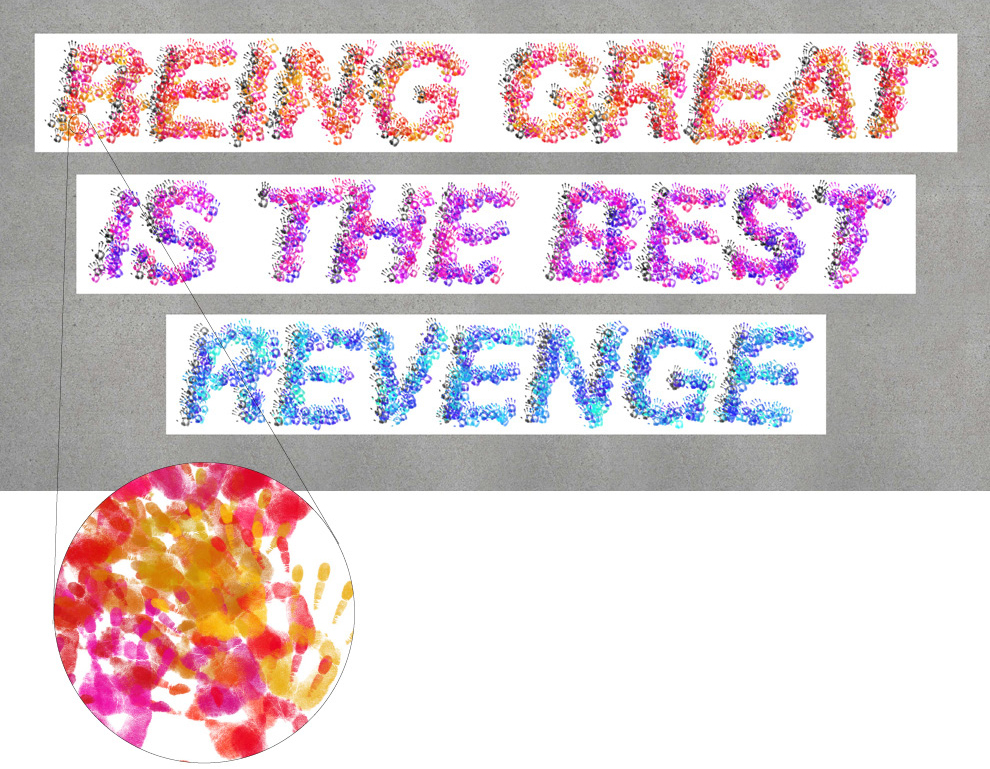
A mural designed for a competition as part of a public art/farm space in the Bronx. The design started simply enough, with a walk through the Bronx and seeing the message “being great is the best revenge” scrawled across an abandoned mattress. The sentiment seemed to aptly sum up the spirit of possibility and potential inherent in every one us that has ever been underestimated or ignored. This led to the method of application of the message – not with paint on brush, but rather by paint applied directly via the volunteer’s hand, slapped down with conviction on the concrete canvas. Each unique creator becomes part of the final composition, through an emphatic gesture that is sometimes messy, with colorful fingerprints and palmprints merging together and breaking out of the geometrical lines of the fonts. The mural and painting technique will unite all those that volunteer and create a lasting memory of community togetherness.


I finished as a finalist, congrats to Oscar Lopez for a great winning entry.

2011046 Tags: china, photography | No Comments »

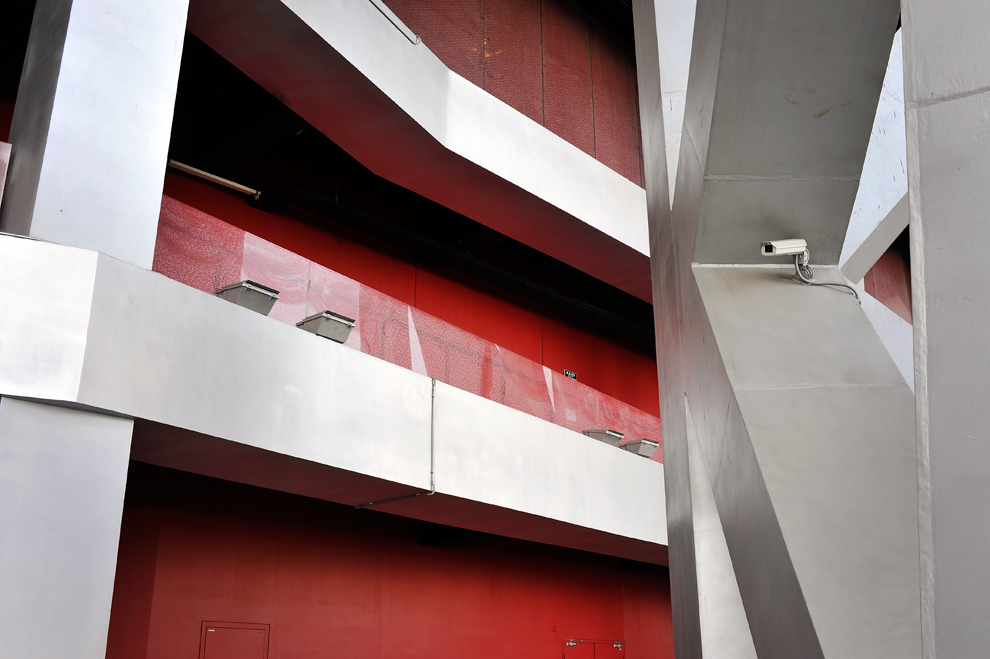
cctv @ HdeM

cctv01b
cctv02b


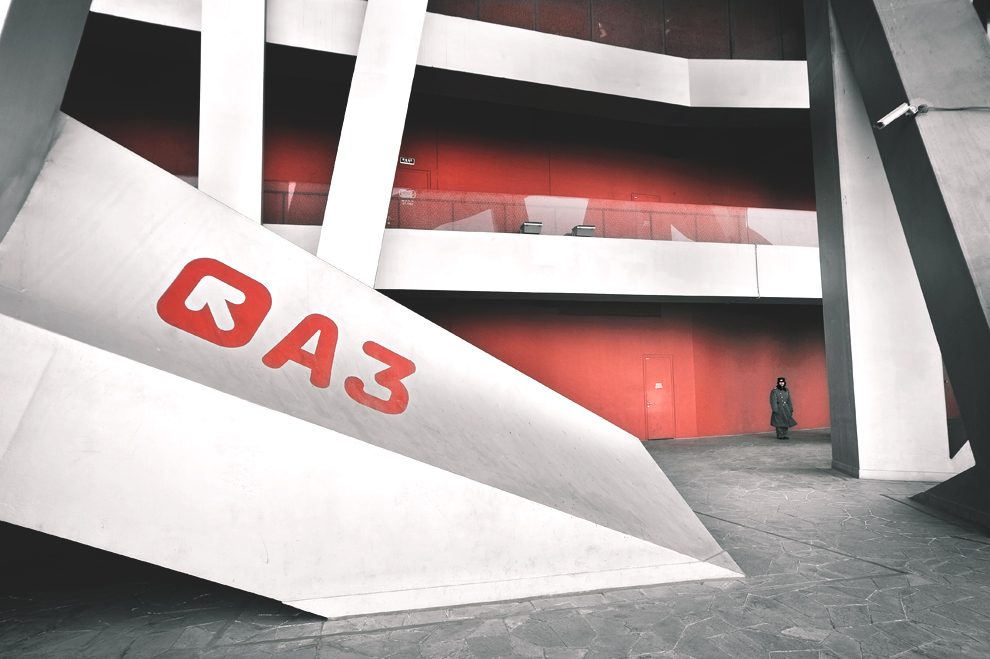
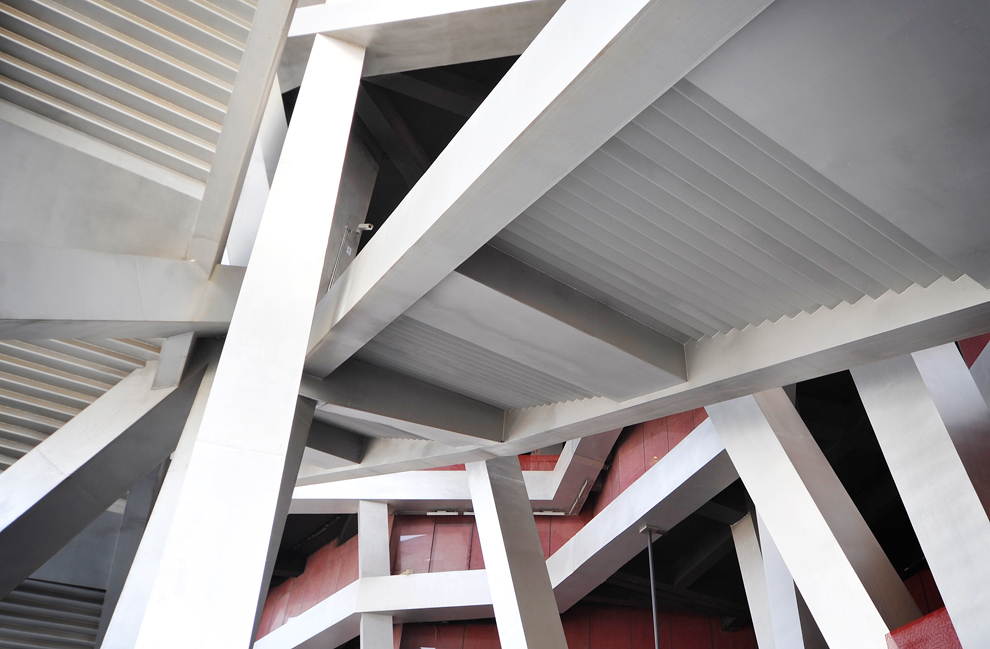
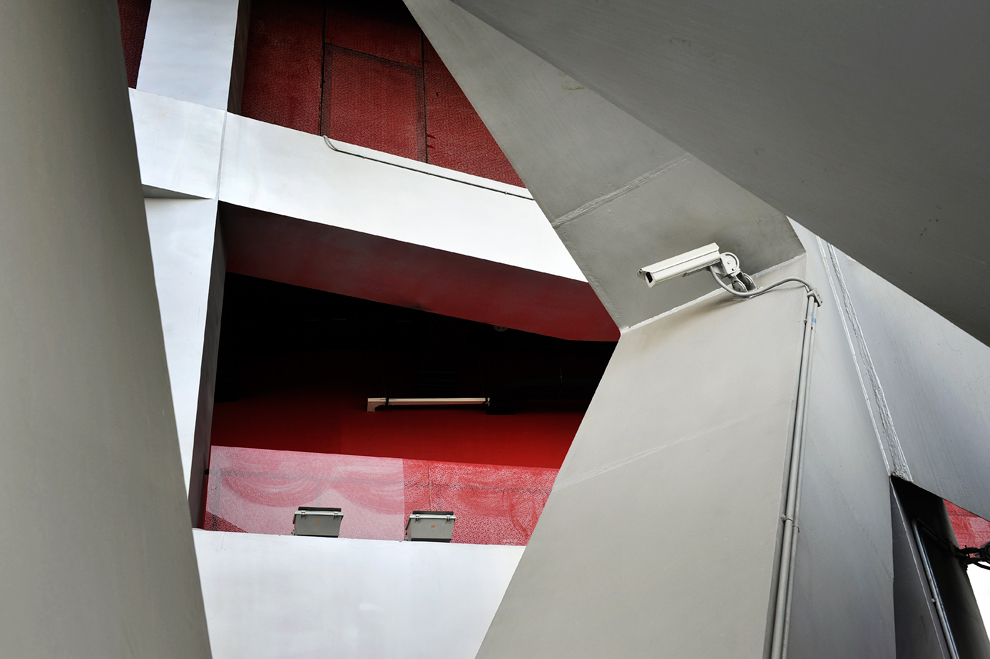
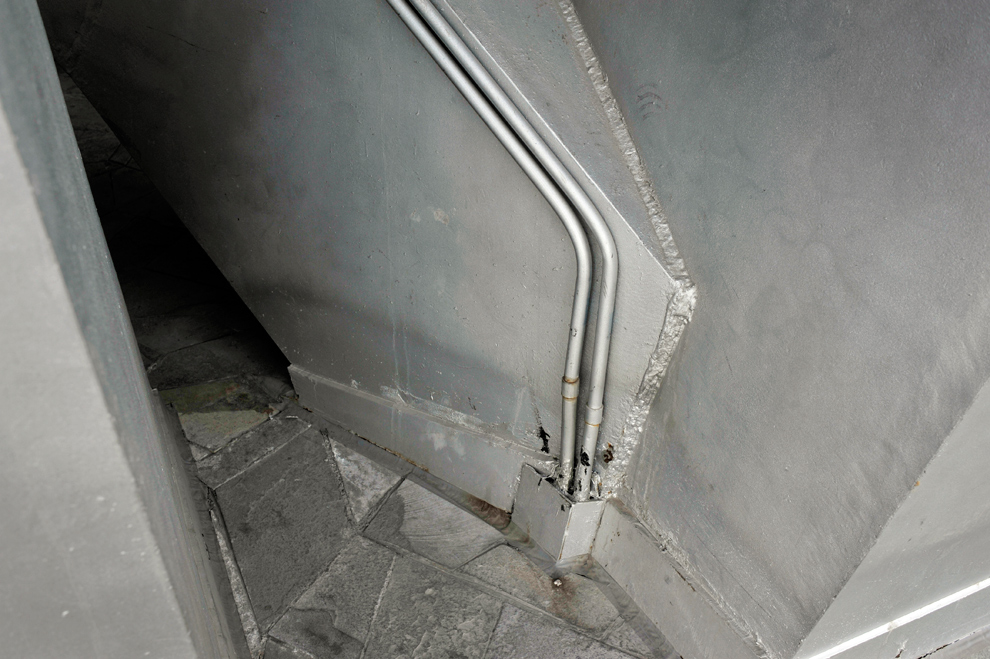
Spurred by a recent archinect post in light of the indefinite detention of Ai WeiWei, an artist who briefly collaborated with Herzog and deMeuron on the pictured Bird’s Nest in Beijing before very publicly denouncing the project (as well as the pretty much the whole Beijing Olympics show in general), it brought up Jacques Herzog’s defense of his design and accepting commissions in China, and how events have proven him to be either insufferably cynical or just hopelessly naive. I happen to lean more toward the former. His quote:

We see the stadium as a type of Trojan horse. We fulfilled the spatial program we were given, but interpreted it in such a way that it can be used in different ways along it perimeters. As a result, we made everyday meeting places possible in locations that are not easily monitored, places with all kinds of niches and smaller segments. In other words, no public parade grounds.


These images are from a 2009 trip to Beijing and show that his niche spaces can certainly have the potential to be used for alternative uses, but no matter how over-structured, complex or well-intentioned, that use will always come back around to one mediated by parasitic cctv cameras and a surplus of ever-watching, ubiquitous guards.


cctv03
cctv04
cctv05
cctv06

20110225 Tags: competition, graphic design | No Comments »

a city of private eyes

barrier011

barrier02c


For a jersey barrier competition submission, we started with an iconic New York quote from Agatha Christie as indicative of the city: “It is ridiculous to set a detective story in New York City. New York City is itself a detective story,” and played off the recurring themes of mystery and dual meanings inherent to the make-up of our city. New Yorkers strive to challenge themselves, whether by running through the park during the marathon or following their career dreams, and we wanted to elevate something that is typically a solitary challenging act pursued underground in the subway – solving sudoku puzzles – to the street level, making it a communal, shared act. The design then works simply on two levels, as both a reflection of the city, and at the smaller scale, of the acts that makes New Yorkers such apt problem solvers.


The design will be quick to apply. Using only a limited color palette and a repeating stencil system, we will be able to economically create a bold, colorful graphic statement that will encourage all those that walk, bike, and run by the barrier to think about and interact with their great city.

20110225 Tags: grasshopper, kangaroo, parametric | 9 Comments »

kangaroo tests

spaceframe012

spaceframe011

spaceframe02

spaceframe03

drop01

drop02

drop03


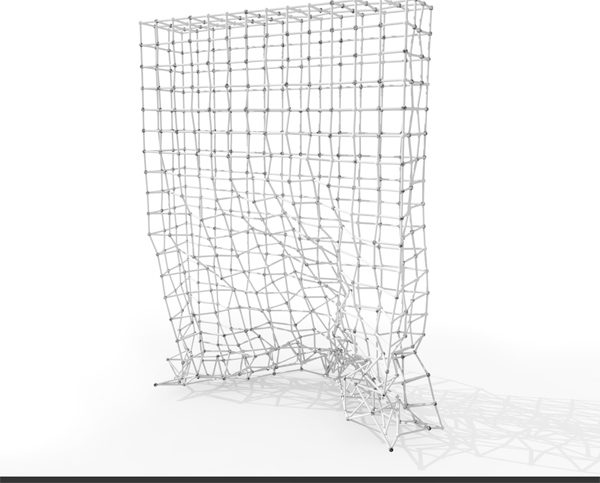
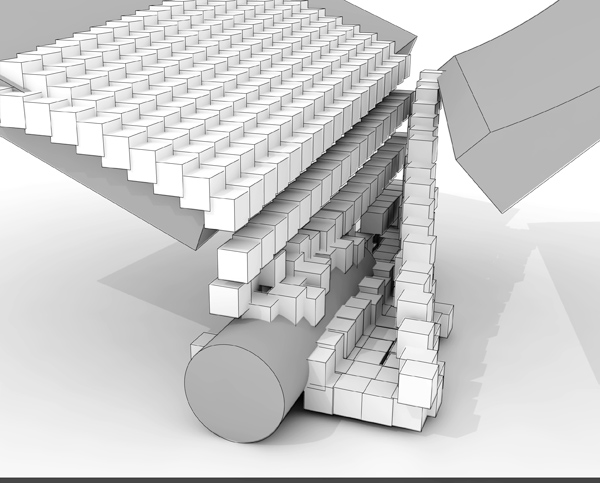
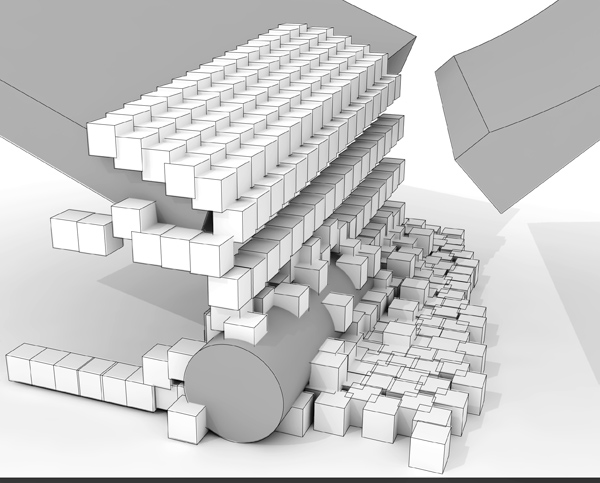
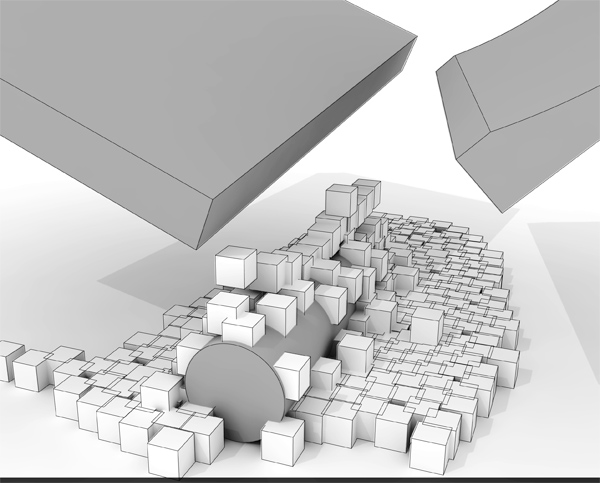
Spent the better part of the day playing around with the incredibly cool Kangaroo, the live 3D physics engine for Rhino, developed by Daniel Piker. Images are poor substitutes for showing just how fun this tool is to experiment with, so to get a better idea of the program’s potential see Daniel’s great vimeo page. The above images were part of a series of experiments in dropping a series of cubes through an obstacle course, and pulling points around on a 3D space frame. They were based on tutorials found at the always helpful and inspiring Kangaroo google group page.


more »

20110211 Tags: korea, photography | No Comments »

my visit to the dmz

dmz01
Corporal Casiano pointing out the Bridge of No Return and the site of the 1976 axe murder incident, in which two US Army Officers where killed by DPRK troops.


dmz02
The Bridge of No Return with North Korea beyond. The Poplar Tree which led to the axe murder incident is off frame to the right.
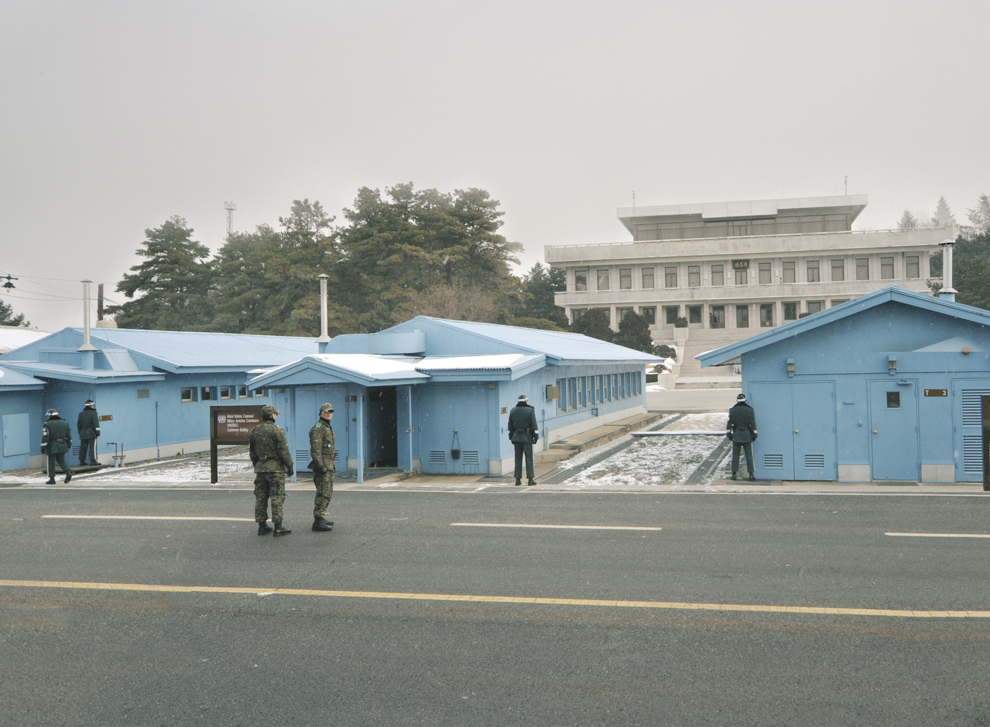
 

dmz04
The Joint Security Area(JSA) on the site of the former village of Panmunjom in the DMZ. The buildings straddle the demarcation line and this is where the 1953 Korean Armistice Agreement was signed by General Nam Il and Lt. General William K. Harrison. The North Korean building Panmungak is in the background. The short concrete threshold delineates the border.
 

dmz05
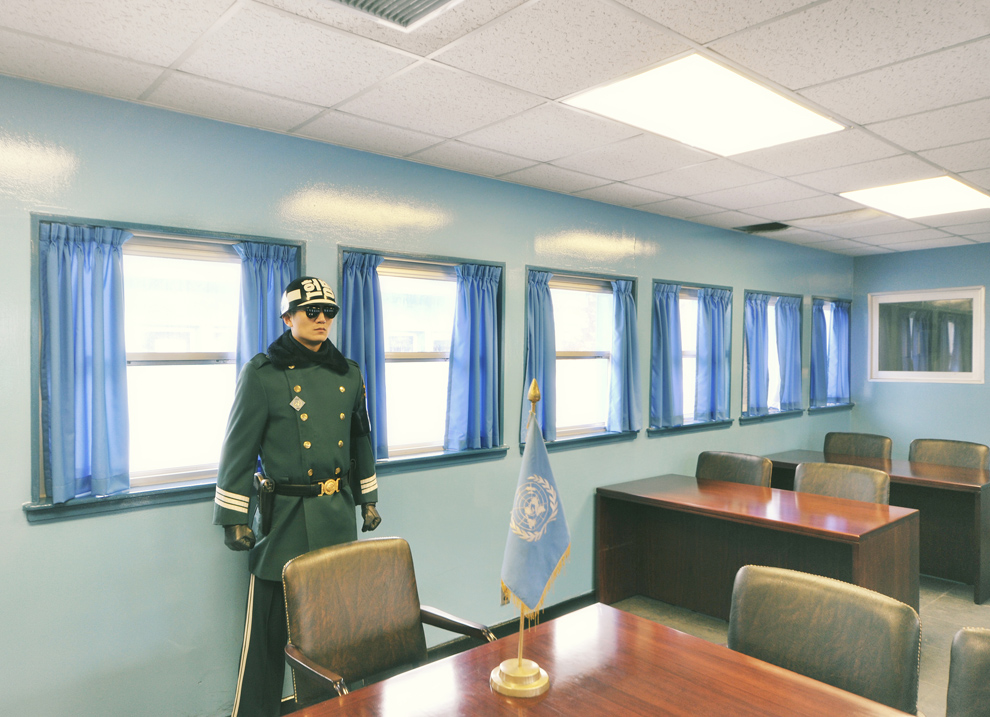
We were warned not to make any sudden moves around the ROK Soldier, though photos with him were encouraged.
 

dmz03
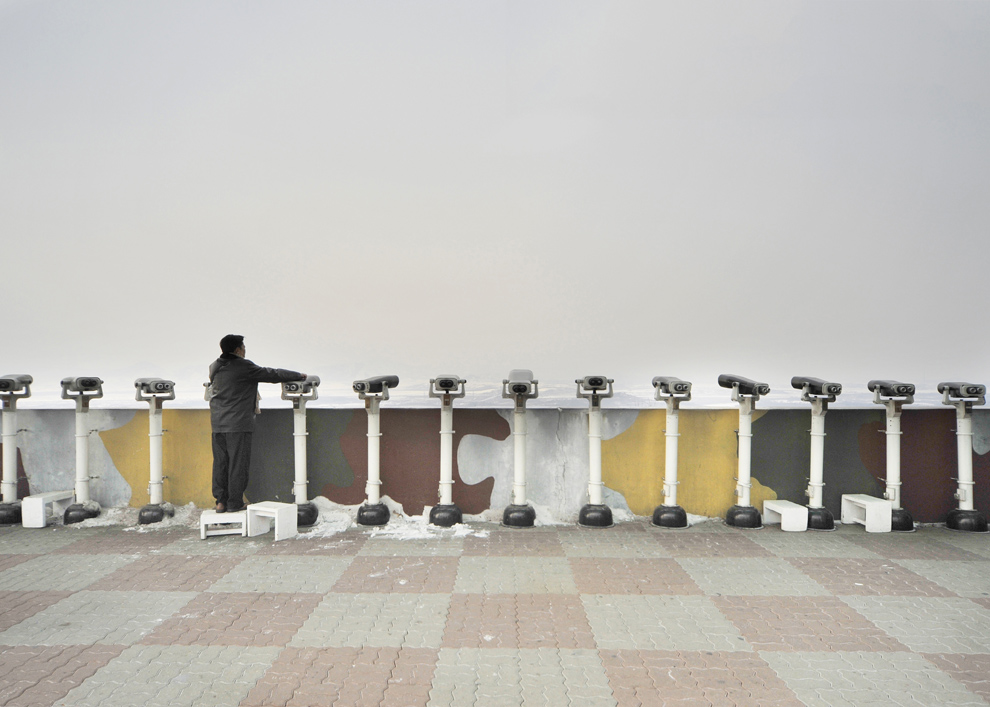
A Chinese tourist viewing North Korea from ROK Dora Observatory Station.


I confess to a certain fascination with the DMZ. Not only because this is the closest I can get to a tragically bizarre, nuclear-armed, anachronistic relic of the Cold War. But also because it so perfectly epitomizes the fuzzy boundaries between militaristic imperial might, happy smiley faced tourism (the last stop on the US base is a gift shop!), and an untouched nature preserve (except for all the minefields and whatnot). This is one of the most heavily militarized zones in the world and also one of the loneliest. The military motto at the DMZ is “in front of them all,” but there’s no longer anyone standing behind them. Forgotten between the great decisive wars of the United States, this is neither victory nor defeat, just an uneasy, quickly forgotten ceasefire. Something to be shunned not celebrated. Disregarded by popular US history, and willfully forgotten by a new generation of Koreans who are forbidden access. After awhile it was less awkward to just stop mentioning to Seoulites that we were going to the DMZ after they either dismissed the place as frivolous – “that’s just a tourist area for foreigners” – or they saw it as an embarrassing, painful reminder of just what the country has spent 60 years trying to get away from – “that’s not the real Korea.” This was more than just a 90 minute bus ride from Seoul, this was a world away from that glittering metropolis to the South. Trenches, bunkers and minefields still manned and maintained for fielding a conventional army in a world where that no longer exists, rendered obsolete by nuclear-tipped missiles and aircraft. Going through the motions because any alternative is too difficult to comprehend.


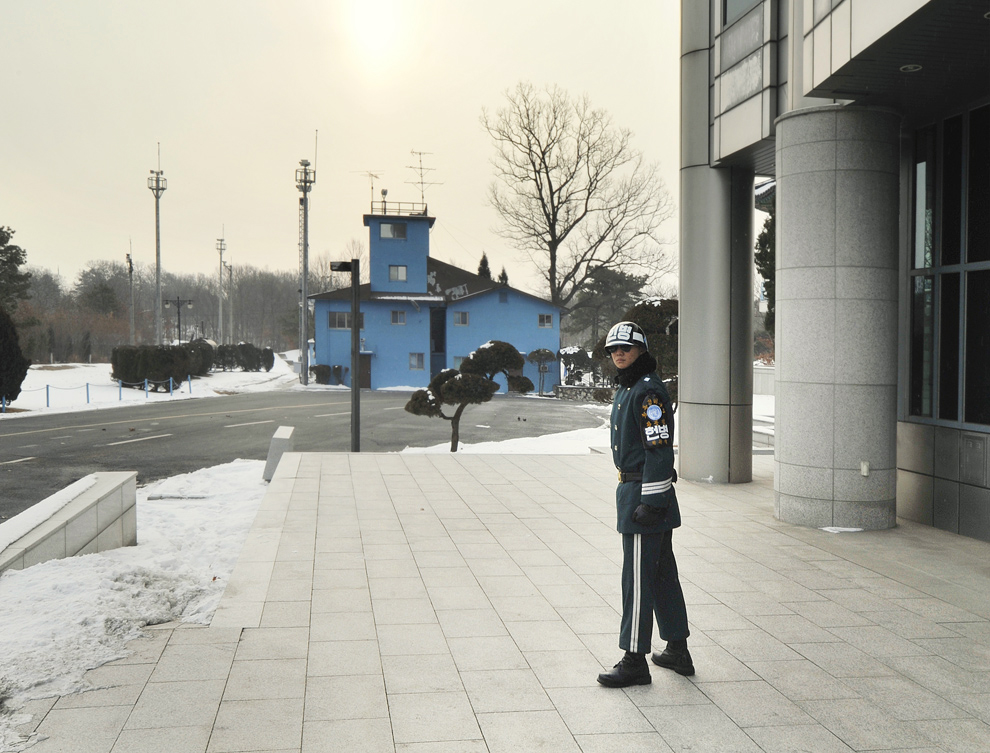
I grew up along another arbitrary border, and wanted to see if there were any lessons from the nomadic, aterritorial space that I’d experienced as a kid that could be applied to the DMZ. But that one is porous, barring physical access but allowing an open trade in culture and economic goods. Sure, the DMZ was fun and touristy, with campy videos and we all took photos with the ROK guards, and everyone rode around in a big bus, but it’s still a real thing. Clinton wasn’t lying when he called it “the scariest place on earth.” And that contradiction is what I can’t understand because it’s not my country, I don’t feel the danger, but it’s there. Two years of military service is mandatory for Korean males. One of our last nights, drinking late into the night, we were interrupted by loud singing of patriotic songs and practice military drilling. There were two young guys, one was starting his service the next day, the other was seeing him off. Scared, trying to be brave, drunk as hell they wandered off into the night. I imagined him up there at the JSA, clenched-fist, standing stoic behind mirrored glasses, one eye on the crowds with cameras, and the other on the men with guns across the line.
 

dmz06b

20110211 Tags: work | 3 Comments »

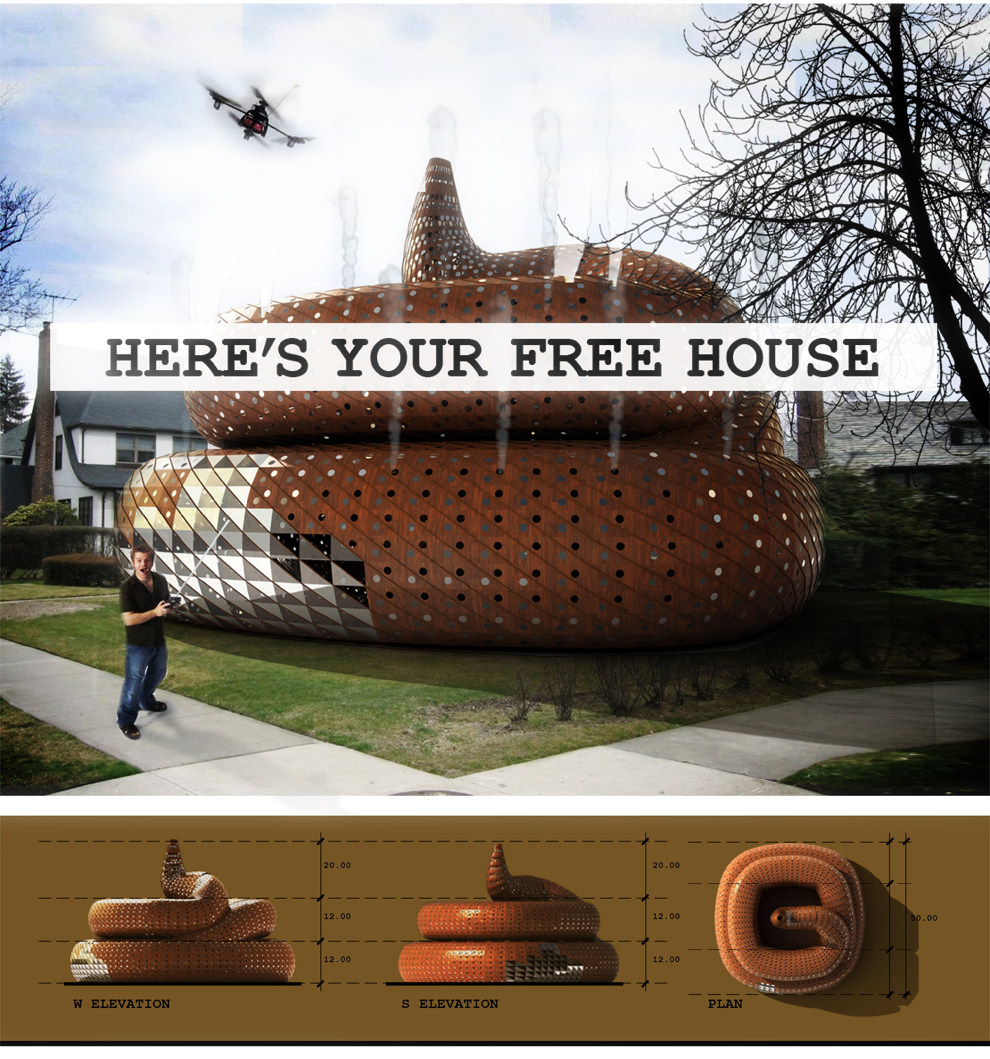
house designed for a guy on craigslist who doesn’t want to pay architects

thepoophouse


After perusing a recent discussion post on archinect aptly titled: architects getting f’d on Craigslist (or: truth, bitterness and self-pity together at last), I was reminded of my own unfortunate craigslist encounter. It pains me to say it, but true story, last year, my final grad semester, I was cruising craigslist looking for some freelance architecture work. Now, granted, jobs on craigslist are typically posted by the most bottom-feeding, scum-suckingest of elements that greedily prey on the desperate, naive or unemployed, (at the time I equaled all three) at a frequency that beggars belief. So I knew I was wading into an unregulated seller’s market, but we’ve all been in tough positions before and compromises are made and pride may or may not survive intact. I had managed to wade through the obvious red flags which typically fall into one of two categories: including the clearly insane (“This is your first impression and demonstrates your ability as a designer. Use care in selecting the paper, the font, and the organization of text on the page.”) or the unnecesarily pretentious (“hip and prestigious award-winning design firm now accepting interns…”). So it was not without a healthy dose of skepticism that I reached out to one seemingly innocuous post, “Long Island Resident Looking for Architecture Services.”


Unfortunately it didn’t take many email exchanges before it quickly became obvious that “Long Island Resident” – a dentist – held a depressingly all-too-common view on what the role of an architect should be during difficult economic times and where on the scale of respectability he held the design services sector of the construction process. Basically LIR had a plot of land and wanted someone to design him the house that would sit on it for free. Or rather that familiar old standby, work for free in exchange for “something to put in your portfolio.” This wasn’t one of those situations where you’re just trying help out a friend or family member with a garage, or doing some pro-bono volunteering for those in need, or just being an adjunct. No, not at all, this guy had the means and was looking to browbeat someone into submission. In all fairness LIR thought a full set of documents, about four months of work, shouldn’t be free, but rather could be had for the princely sum of $350. I had no idea where the $350 number came from, possibly it was the number that allowed an apparently well-off dentist to salve his own conscience at demanding such massive concessions from a poor, young architect all in the name of The Greatest Recession Since the Great Depression. But I don’t know. Look, obviously life isn’t fair. People aren’t infallible and when given the opportunity will take advantage of those that can’t or won’t defend themselves. Opportunism is a leach on any creative profession, especially architecture, where self-doubt and masochism run rampant.
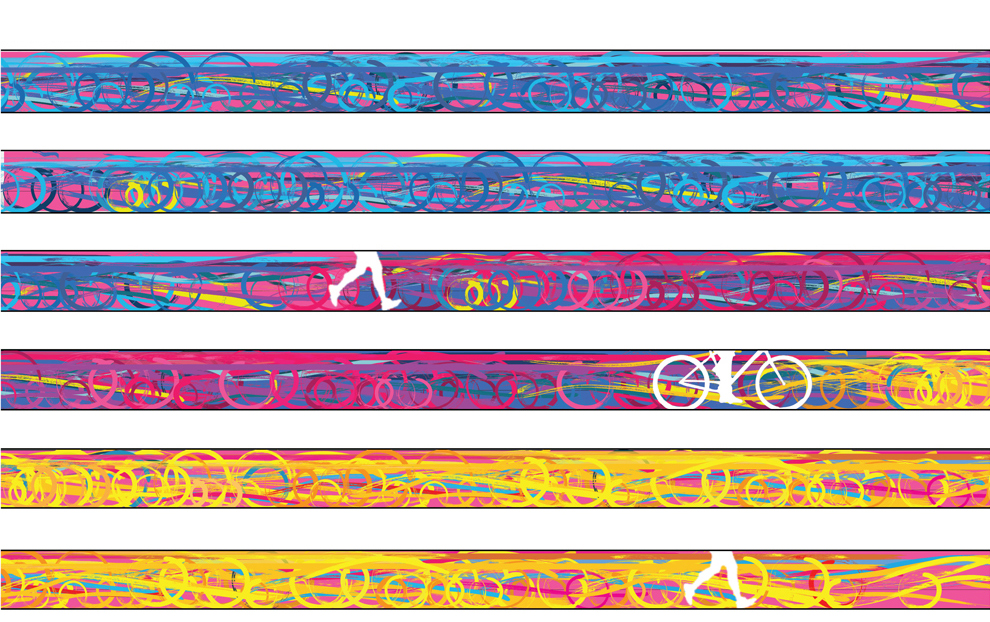
 

As a firm believer in the you-get-what-you-pay-for principle, I took a few hours off from my finals, and sent off the above image to LIR. My counter-offer was that I would design and document a house for free, everything, on the one condition that he in no way interfers with my creative vision (see img above). I argued passionately and apparently in vain that the house I designed for him would be a sustainable marvel, 100% post-consumer recycled materials, it would utilize a unique geothermal process for harnessing energy from deep within the bowels of the earth that would create a custom steam-exhausting microclimate around his residence, and at the very least would be widely published. All for free. I thought he’d bite at it, but here I am some 21 months later, sitting and waiting. But in the meantime, the offer still stands and is extended to any other random, affluent craigslist poster out there looking for a house and doesn’t want the burden of having to pay a designer.


So in parting, keep your eyes open, and if you start to see a number of Massapequa Park Steamers dropping all over a residential neighborhood near you, you can be assured of two things: a) there are some very satisfied architects out there and b) their fee was $0.00.

20110117 Tags: gsapp, korea, seoul, work | No Comments »

living light

livinglight01


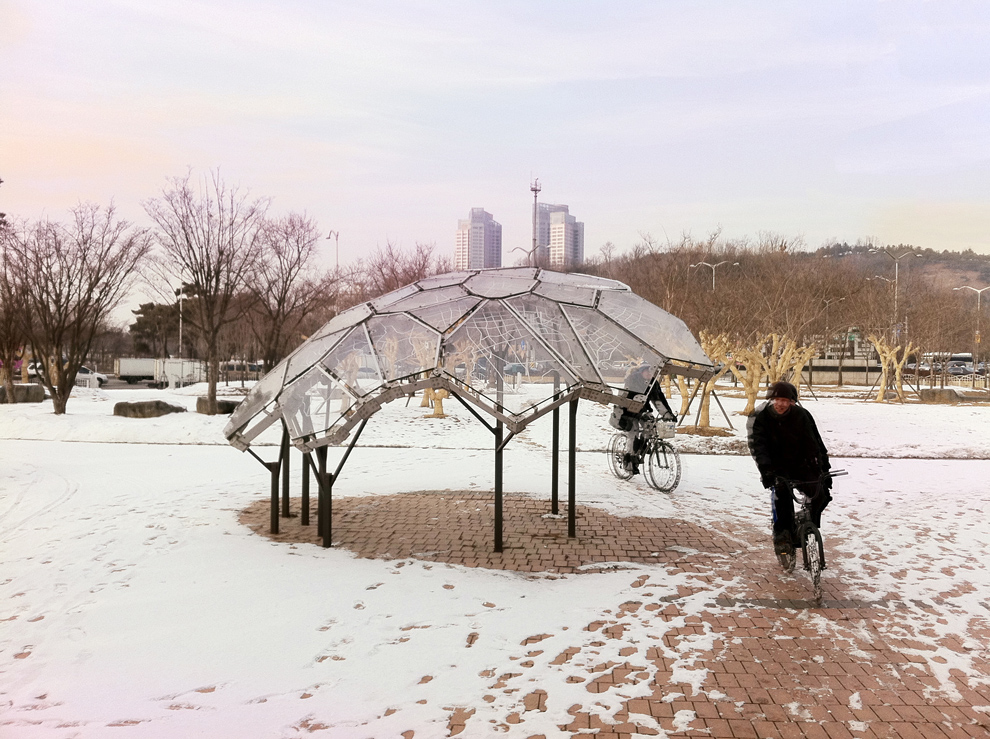
Last year I had the great opportunity to briefly work with David Benjamin and Soo-in Yang of TheLiving by assisting on this project in Seoul’s Peace Park. Their ideas about new, collaborative avenues for architects to pursue using sensor technologies – amongst others – made their courses some of my favorite at Columbia, and it was an inspiration to see this pavilion come together. When I found myself in Seoul last week, this was on my list of sights and it was a true pleasure to experience the work in person.


Described on their project site, as such:
“Living Light is a permanent outdoor pavilion in the heart of Seoul with a dynamic skin that glows and blinks in response to both data about air quality and public interest in the environment. Citizens can enter the pavilion or view it from nearby streets and buildings, and they can text message the building and it will text them back.”

20101211 Tags: camouflage, graphic design | 1 Comment »

Bomb The Drone

drone_bomb_01
The New Flesh


drone_bomb_02
The Destroyed Buddha of Bamyan


Some drone bombing interventions made for DEMILIT as part of their “minor (open-source) act of insurgent citizenship and imaginative transgressions” against the pilotless drones that we increasingly rely on to fight the the good fight (and sometimes not so good) in Afghanistan.
#demilit #bombthedrone

2010117 Tags: competition, graphic design | 2 Comments »

jersey barrier mural

web05a

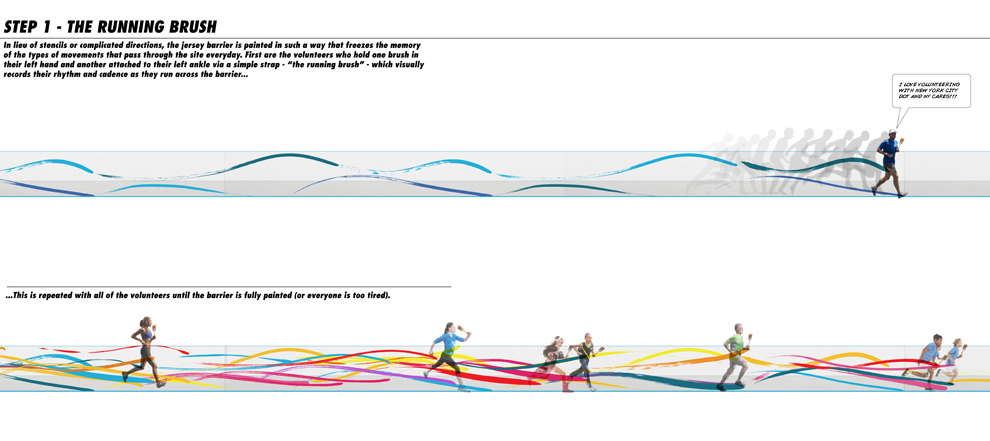
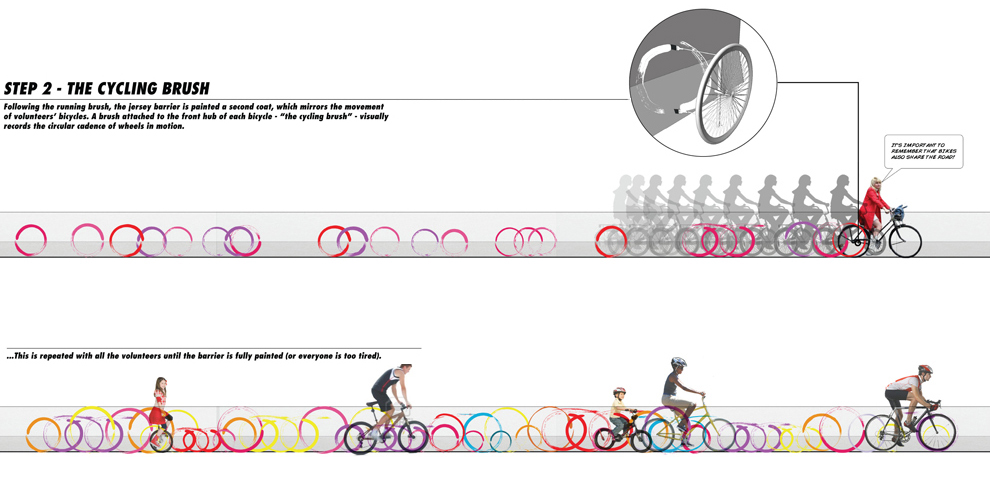
A quick competition entry Jackie and I put together for a mural to be painted on a jersey barrier somewhere in the city. The murals are painted by a dedicated group of volunteers over one beautiful NYC fall day, so instead of specifying a fixed design, we proposed a set of instructions that the volunteers could perform relating to the types of gestures that are associated with travel and roads, turning the act of painting the mural into a type of game. We designed new types of brushes that are attached to runner’s legs, bicycle wheels and extended from automobiles to create an abstract layering of movement vectors.


Running


Running


more »

20101026 Tags: photography | No Comments »

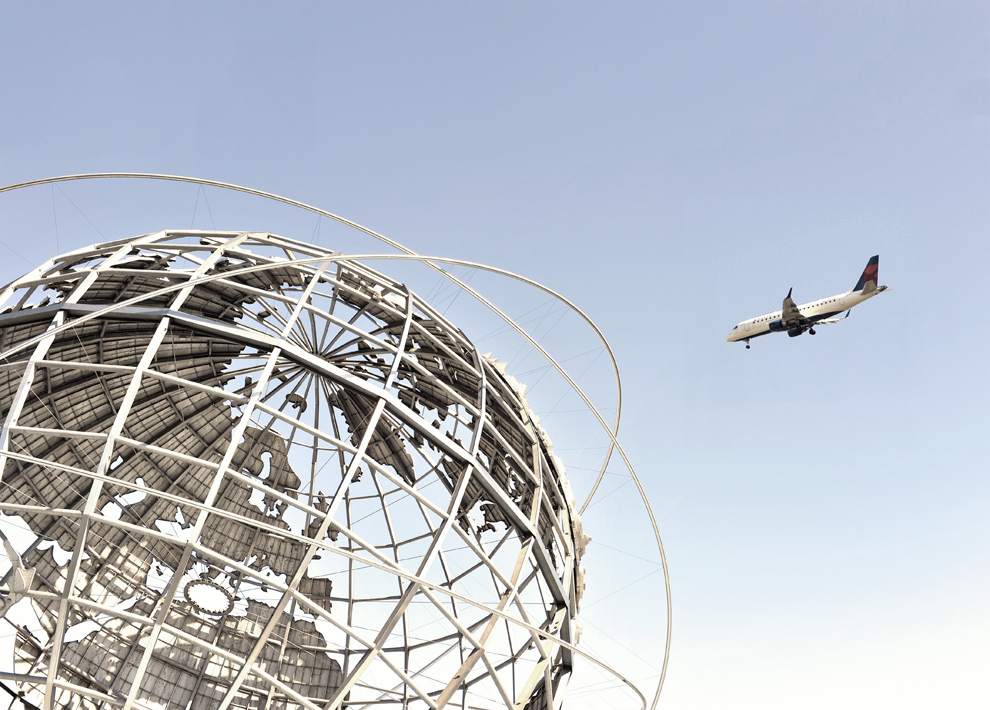
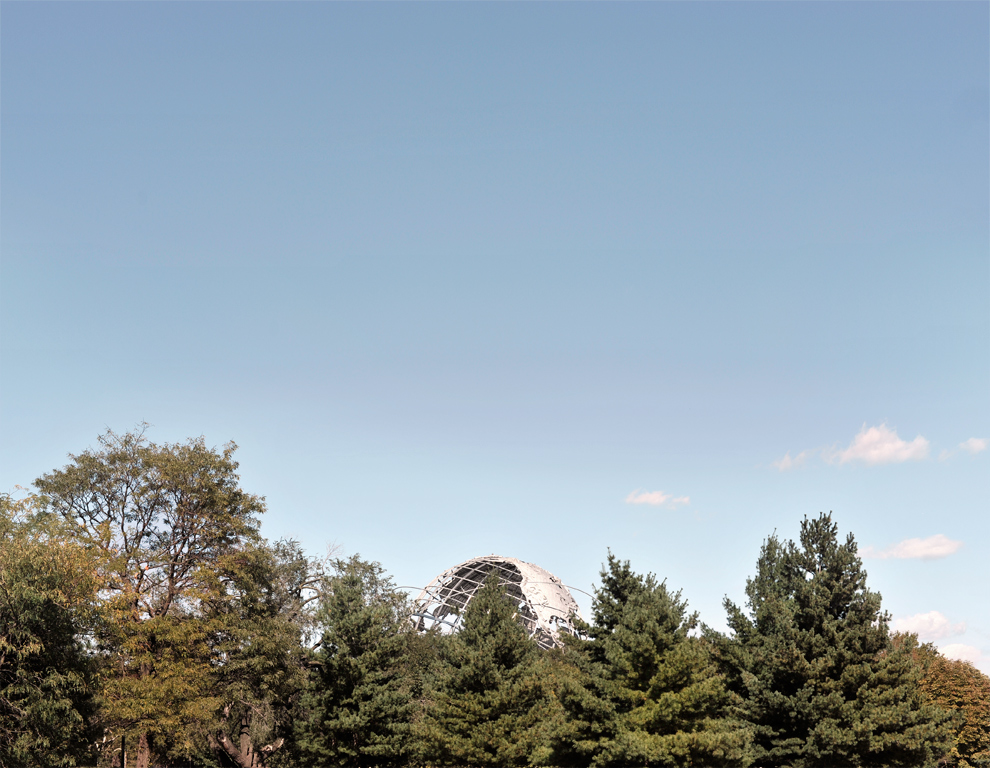
“Man’s Achievements on a Shrinking Globe in an Expanding Universe”

_dsc4591c

flushing_01


One of the consequences of living in a city as massive and historically rich as New York is that it’s easy to feel a little overwhelmed at times. Which is why it’s so nice when once a year Open House New York lifts back the curtain and opens up the inner workings of the city to the curious. At heart New York is a friendly place, and OHNY does a good job expressing that in a frantically popular weekend (so popular that the tour of the in-progress 2nd Avenue subway tunnel filled up near instantaneously) . A thoroughly pleasing free weekend began with a trolley tour of the remaining structures from the 1964 Word’s Fair in Flushing, Queens. Where we found out about Robert Moses’ last folly and that there is such a thing as an urban park ranger, and they are in fact very nice.


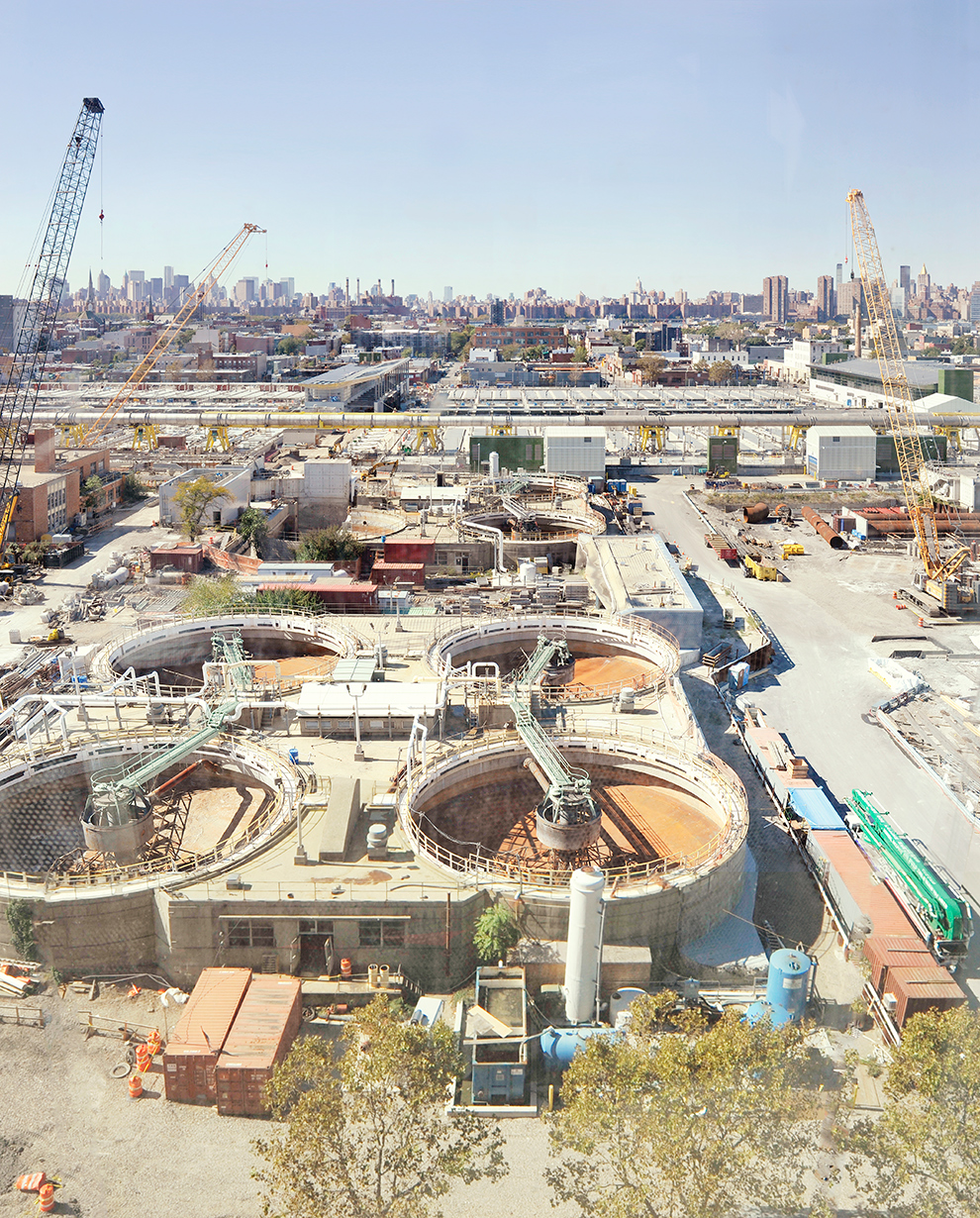
The next stop was a tour of the digester eggs at the Newtown Creek Wastewater Plant in Brooklyn. The iconic cathedral to infrastructure that processes 310 million gallons of wastewater generated by approximately 1 million city residents. Converting solid waste into a sludge mix (a substance which after extensive churning leaves the digesters in what could commonly be compared to the consistency of a hearty marinara sauce – or so we were told), and is then loaded on to a steady stream of sludge boats that head to points north. The view from the silverly bulbous digester eggs (designed by Polshek Partnership) is one of the best in the city, eminently worth the mildly sulfurous price of admission.


The eggs are best described from a 2008 post by the Times:

What goes on inside the digesters is slightly more prosaic, but vital to processing millions of gallons of waste water every day. Sludge, which is removed from sewage, is broken down within the digesters into more stable materials: water, carbon dioxide, methane gas and digested sludge, which can be formed into dry cakes and then, after additional processing, used as fertilizer. The shape of the egg helps concentrate grit in the bottom of the tank and gas concentrations at the top. Each egg holds three million gallons of sludge. Four began operating May 23. The rest should be in service by the end of the year.


Our last trip was a historic walking tour of the lower Manhattan waterfront, which was surprising and mildly disappointing in that it was neither historic nor even all that interesting. Lessons learned for the next year.


newtown_creek1

From the top of the southern digester egg

 
« Older Entries
Newer Entries »

COPYRIGHT © 2004-2015 \ JOHN LOCKE \ ALL RIGHTS RESERVED (RSS)

TOP OF PAGE

last update: 20150721:2100