JOHN LOCKE

  • Featured Work
  • Design Blog           
  • Photography
  • Graphic Design
  • Lion in Oil

About

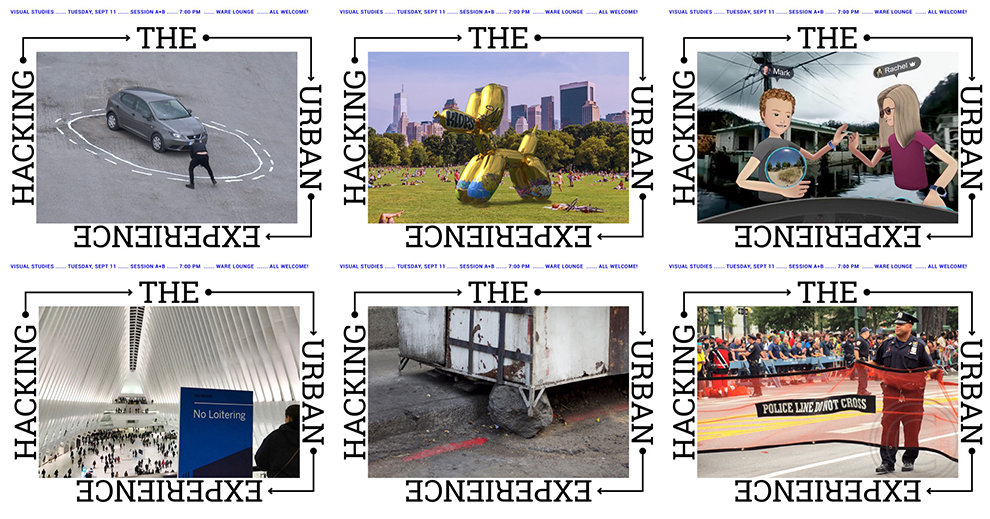
Hello. I live in New York and work at RMA. I hold a graduate degree from Columbia University's GSAPP and an undergraduate architecture degree from the University of Texas at Austin. I have more than six years of combined professional experience at both SOM in New York and Randall Stout Architects in L.A . I also tackle freelance graphic and photography work with my partner in crime, the multi-talented Jackie Caradonio at Lion in Oil. In addition, I teach a course, Hacking the Urban Experience, at Columbia. View my CV here: CV(html) or CV(pdf) . Thanks and have a nice day.

Contact

john.h.locke{at}gmail.com
310.735.3333

Architecture Portfolios

Portfolio 2002-2007 (issuu)
Portfolio 2008-2009 (issuu)

Loading

The Twitter?

20130616 Tags: grasshopper, parametric, research | No Comments »

Extrude Mesh Faces


In conjunction with a form-finding exercise in Kangaroo, I was searching for a way to render a single, closed mesh as if it were an inflatable form made of individual, stretchy panels – think soccer ball. Since I was already starting with a mesh, I needed something that could extrude and manipulate individual mesh faces normal to the face centroid with a certain degree of flexibility. I couldn’t find much online, so I put together a super basic, simple grasshopper file. Aside from some of the typical drawbacks with using meshes in Rhino (which have actually become a lot more workable in Rhino 5), I think it’s reasonably clean.
Download here: http://gracefulspoon.com/downloads/EXTRUDE_MESH_FACE-NORMAL_FINAL.gh

20130520 Tags: fabrication, gsapp, interaction, new york, research, teaching, urban | No Comments »

HACKING THE URBAN EXPERIENCE III – STUDENT WORK


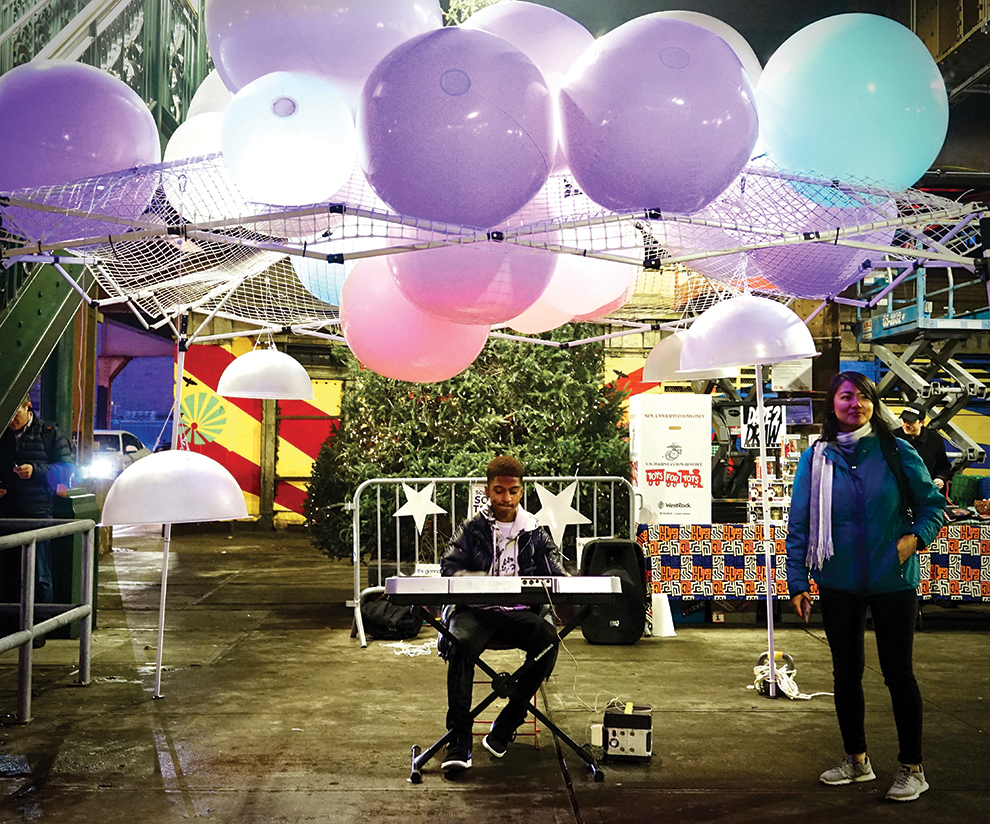
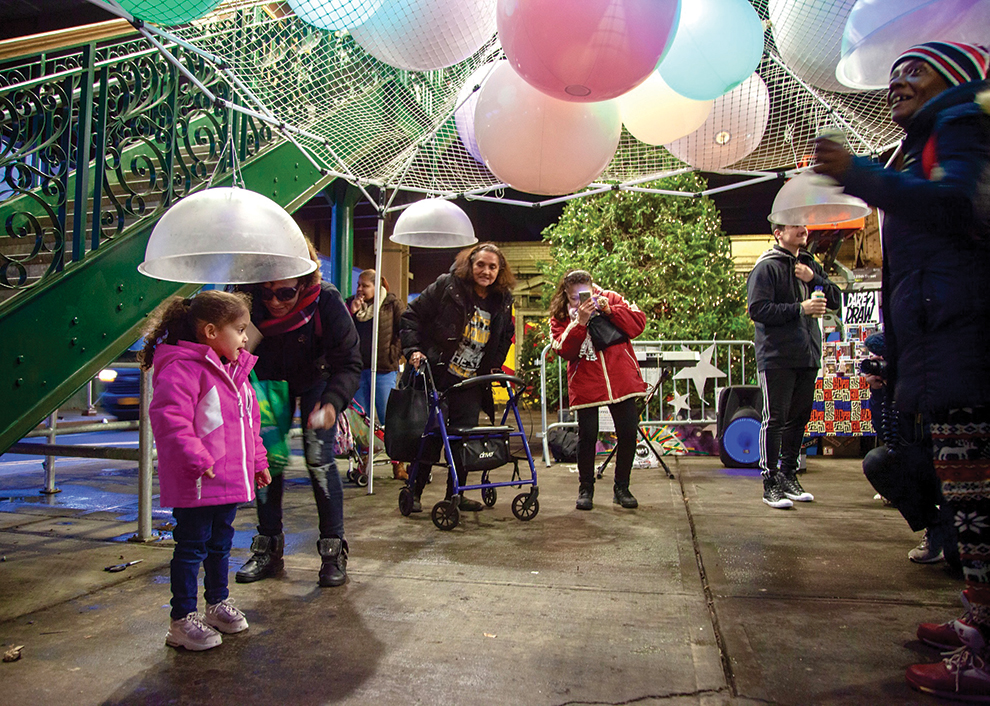
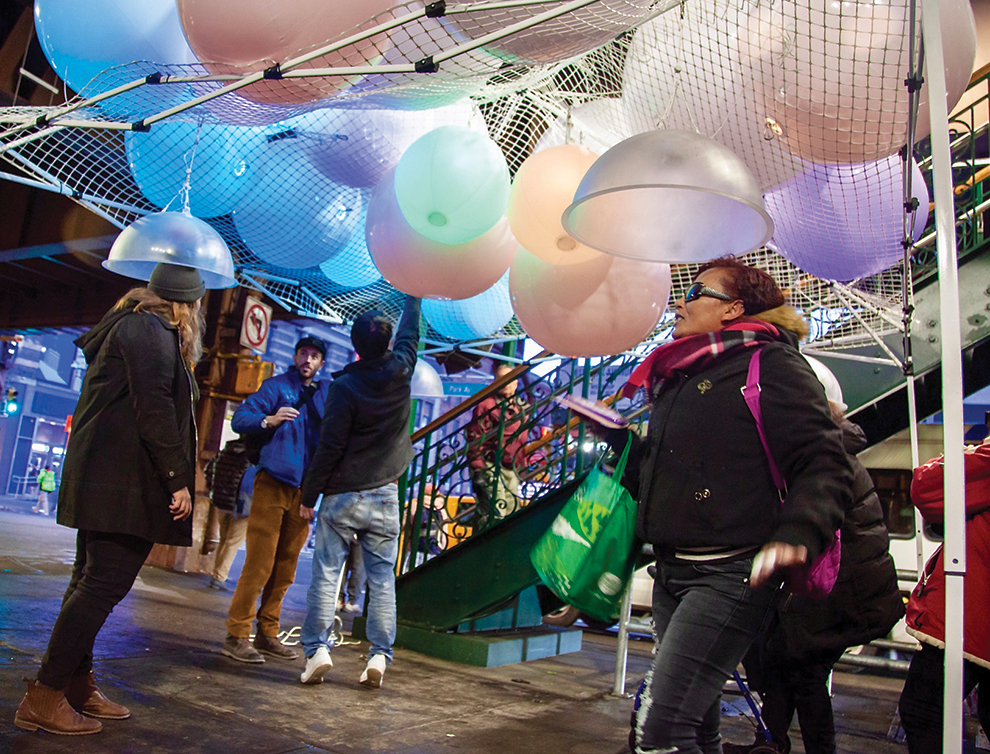
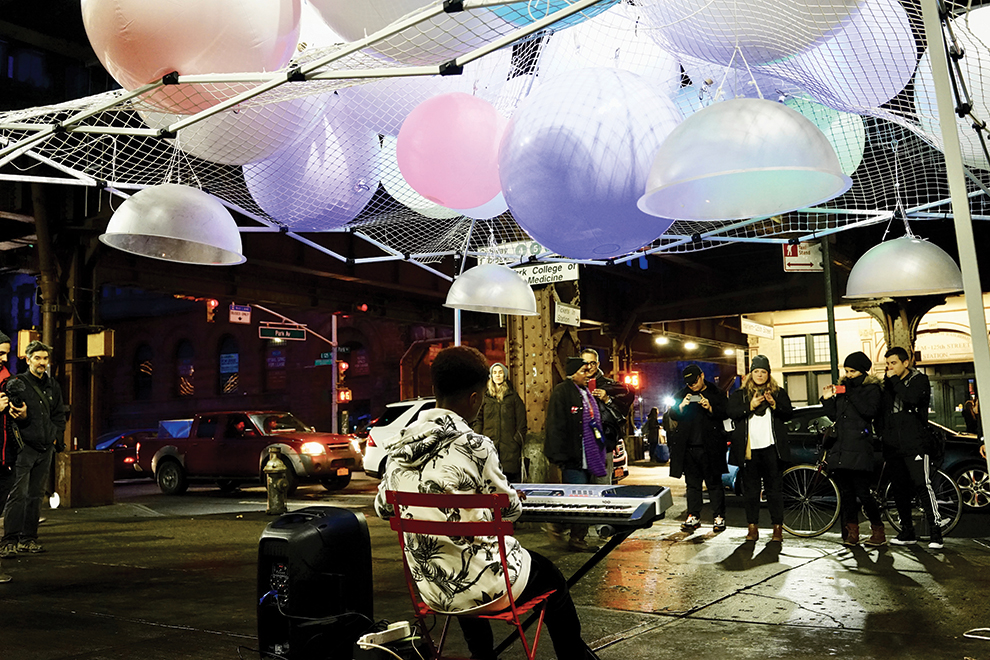
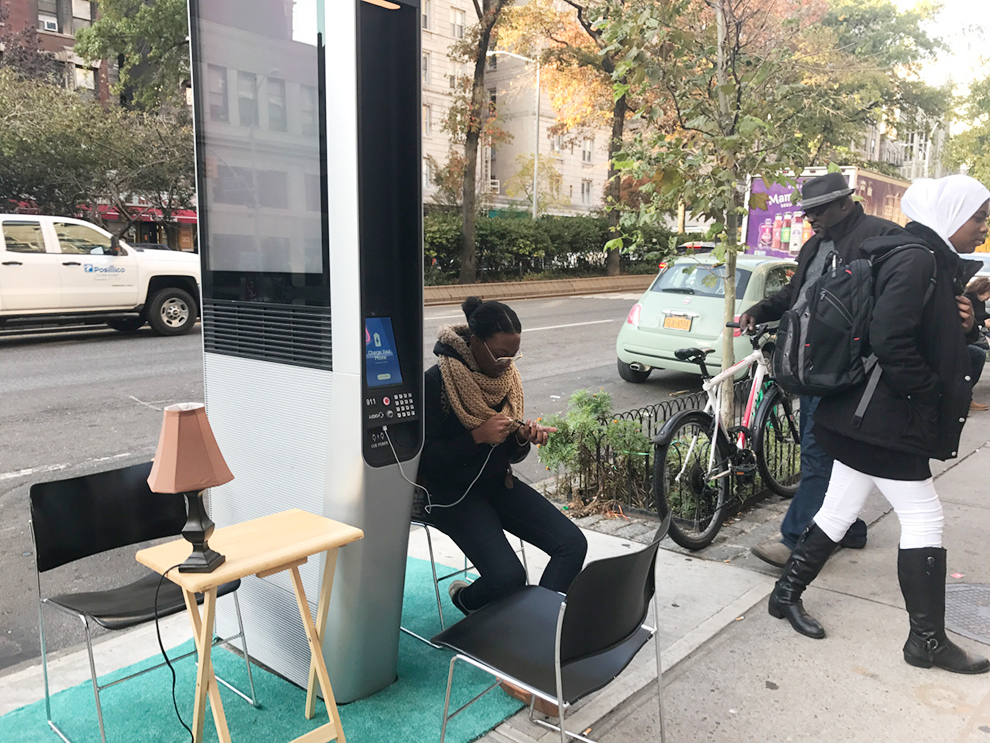
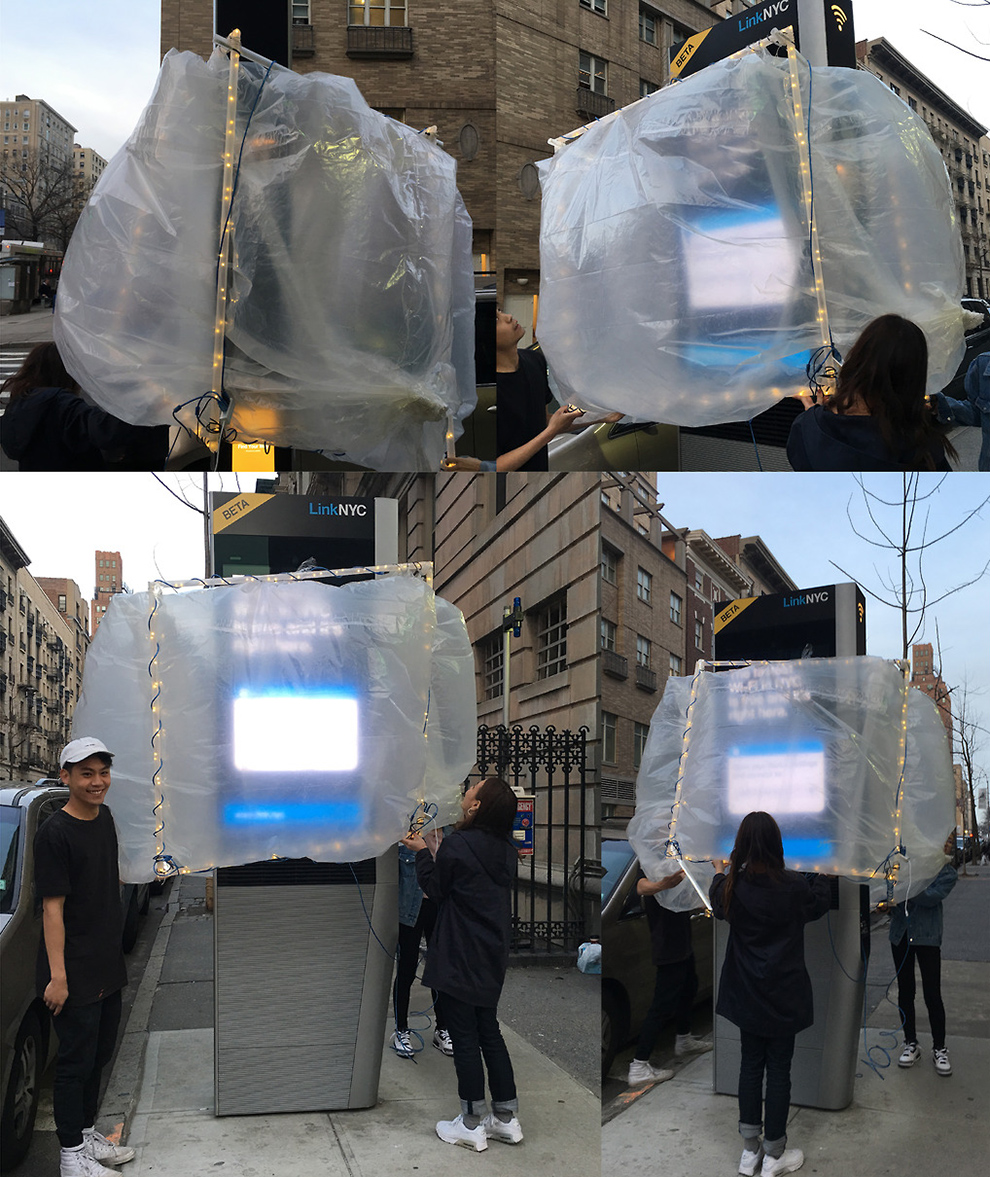
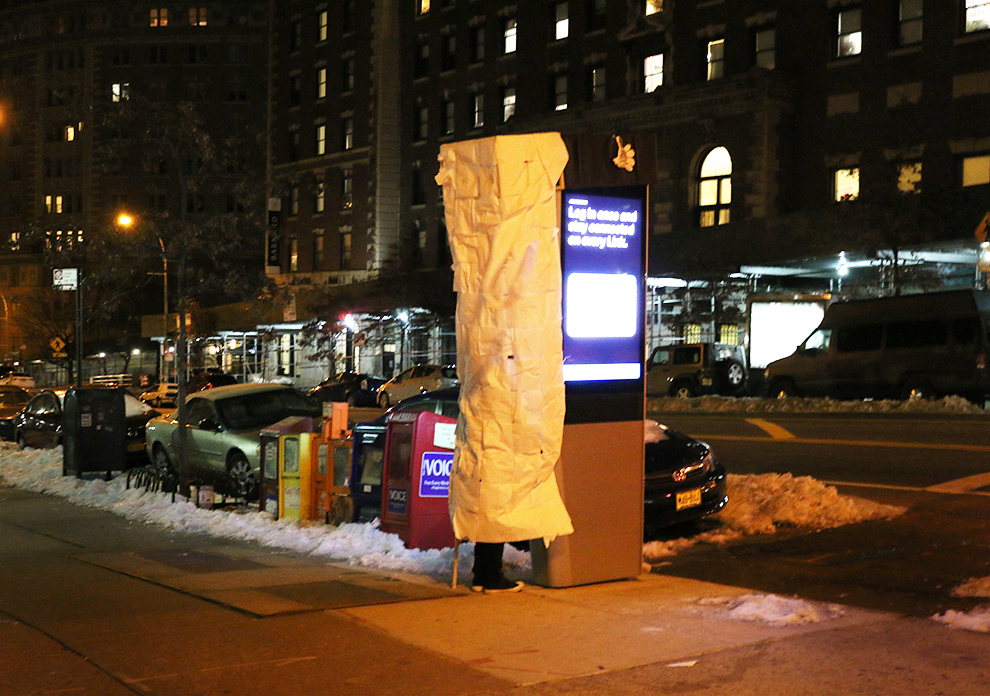
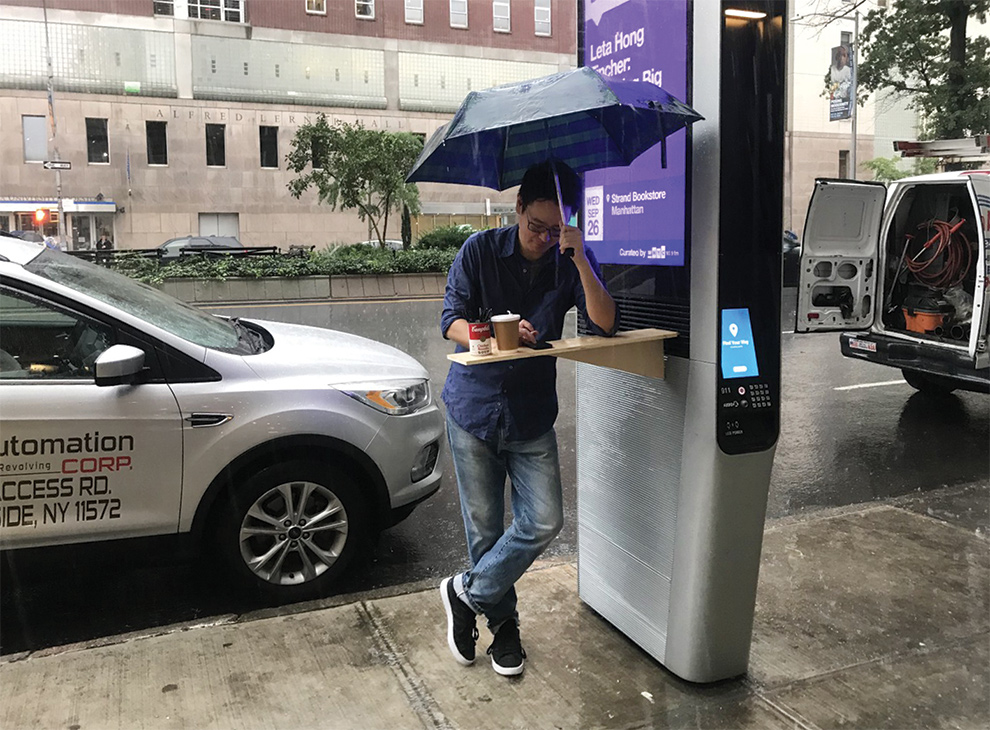
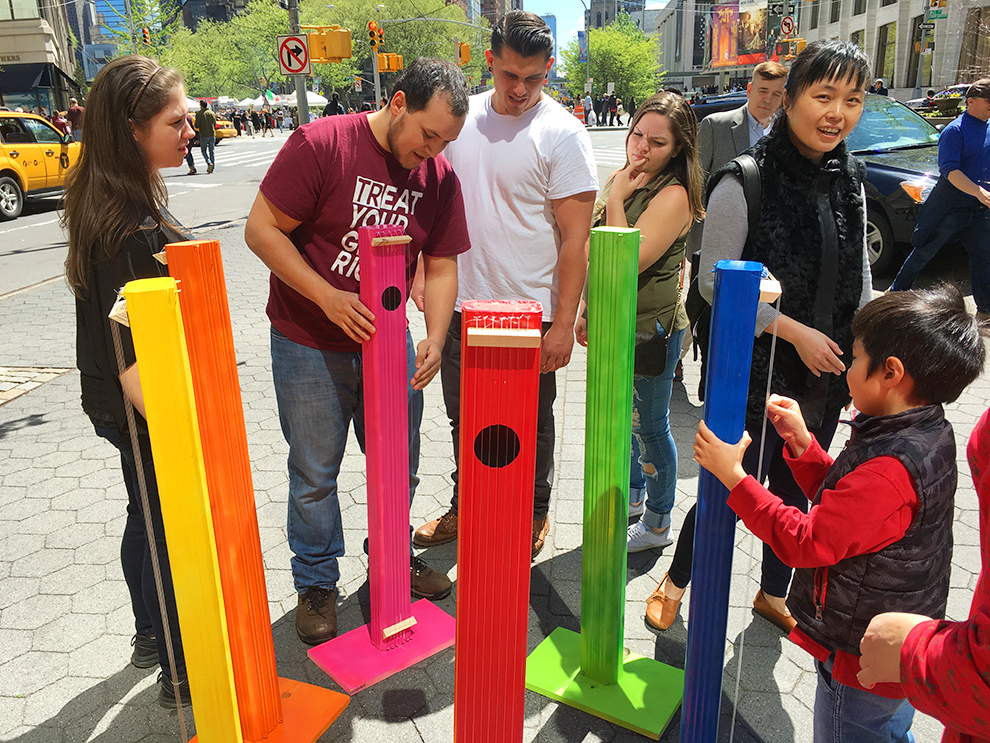
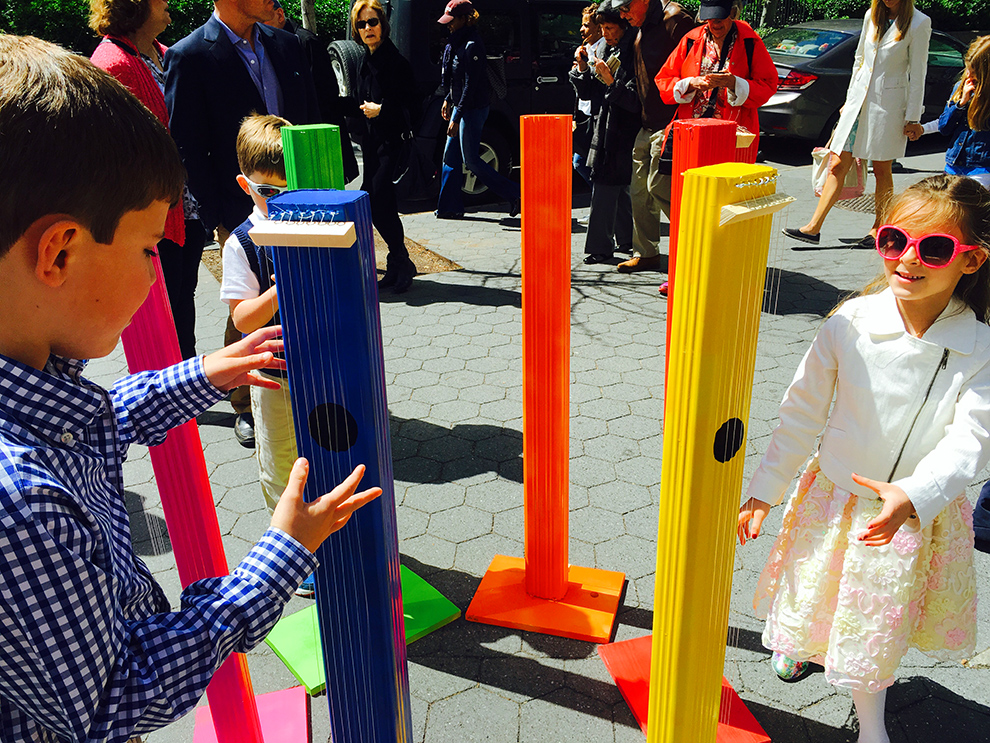
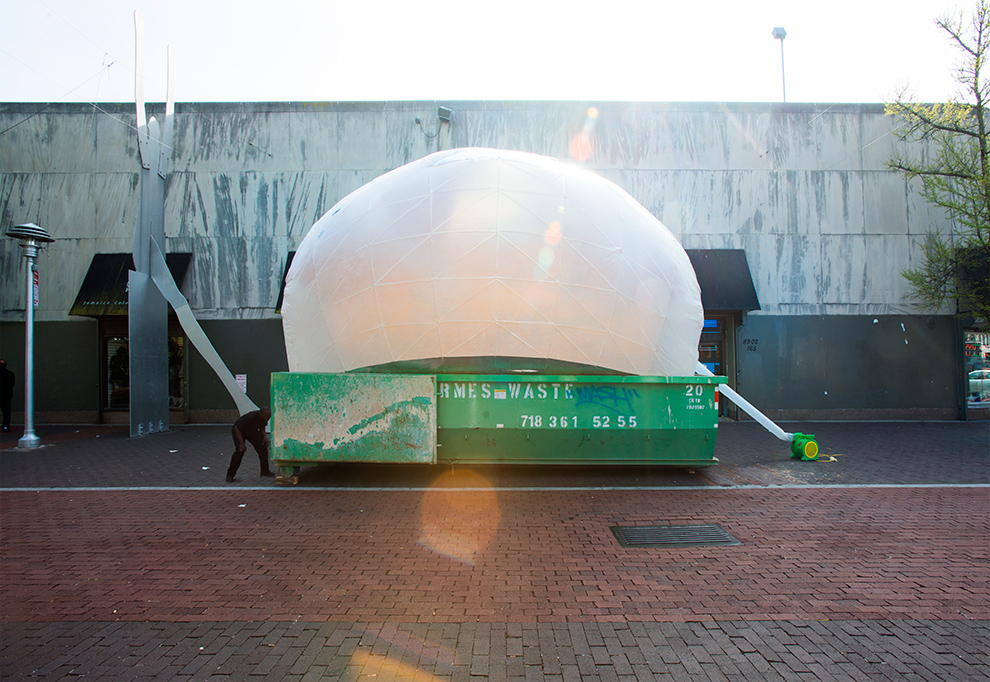
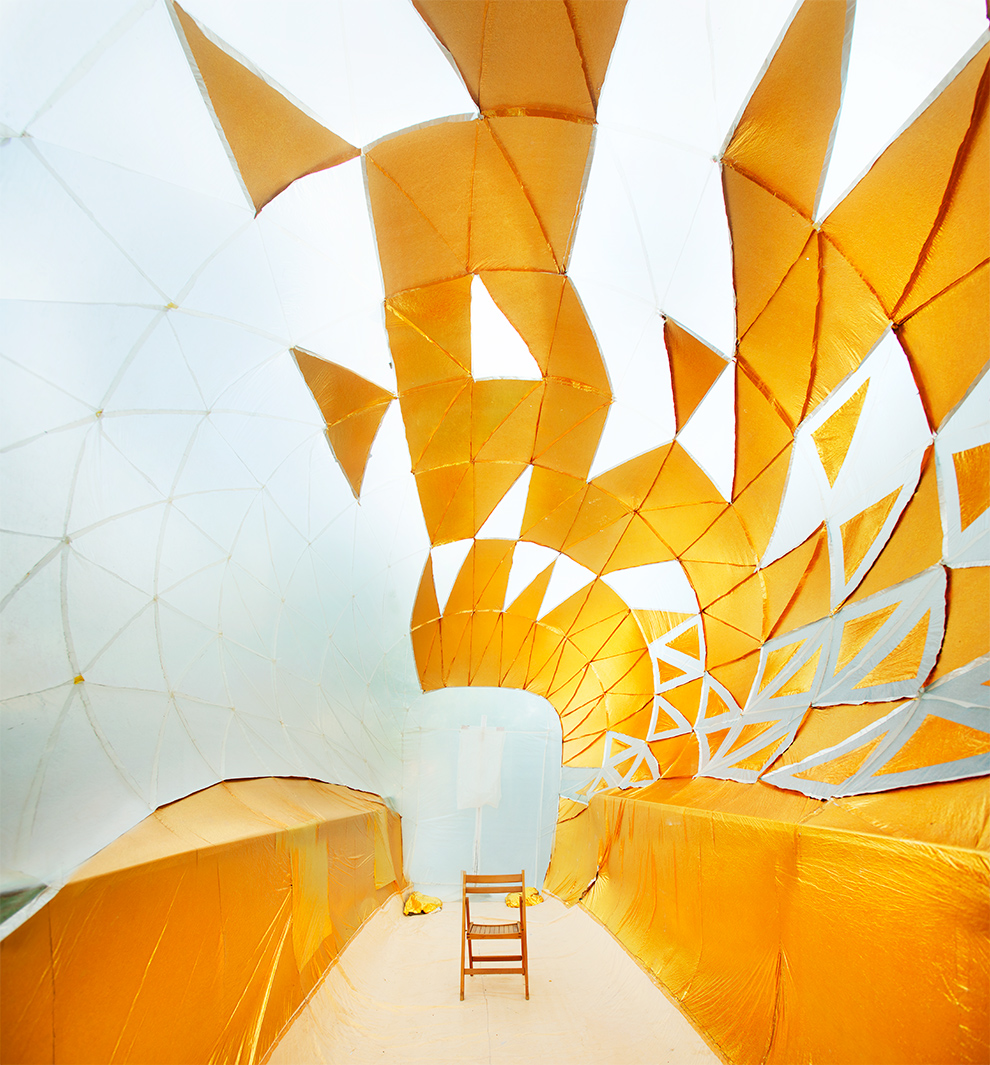
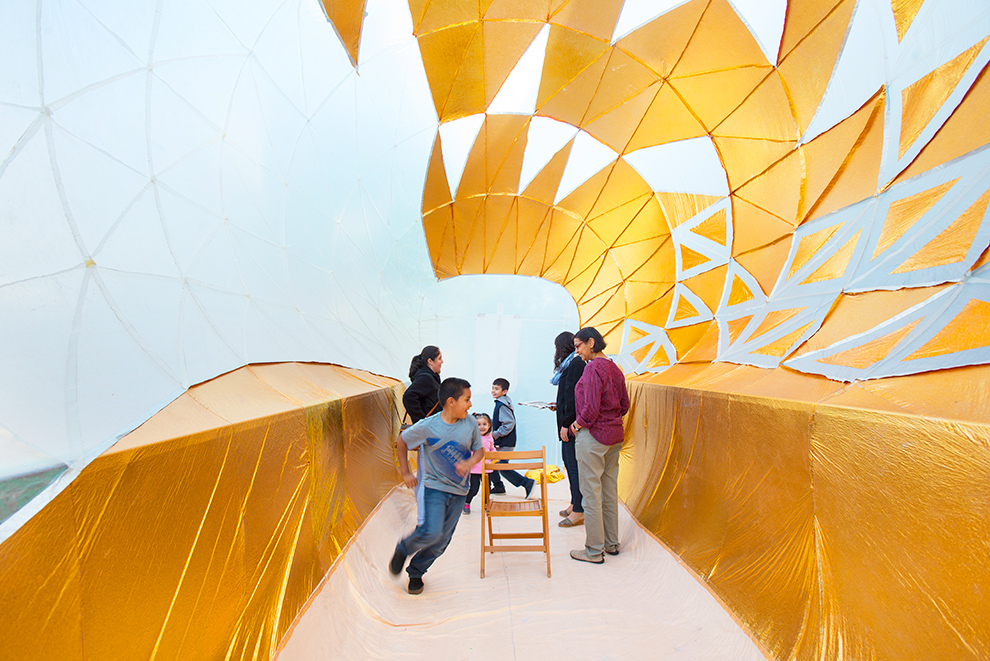
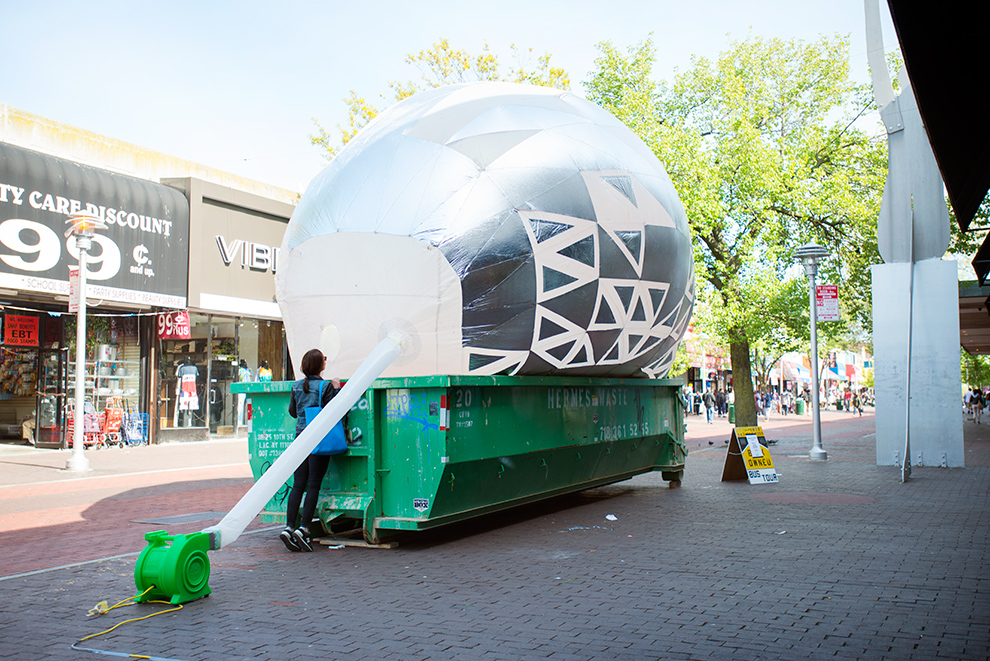
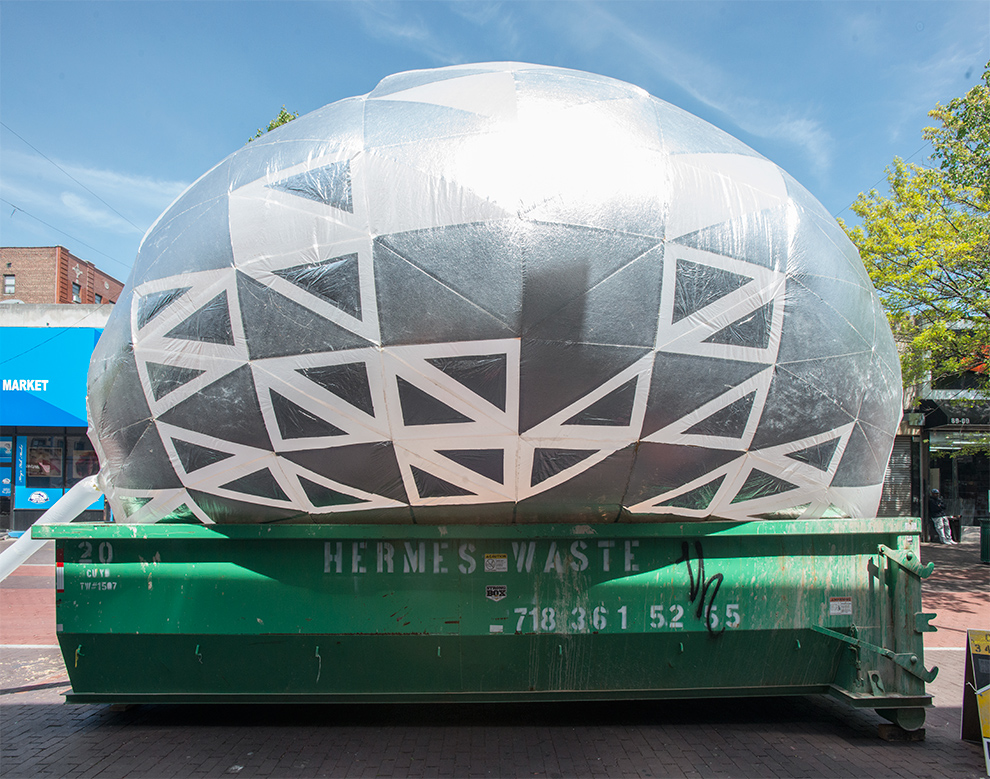
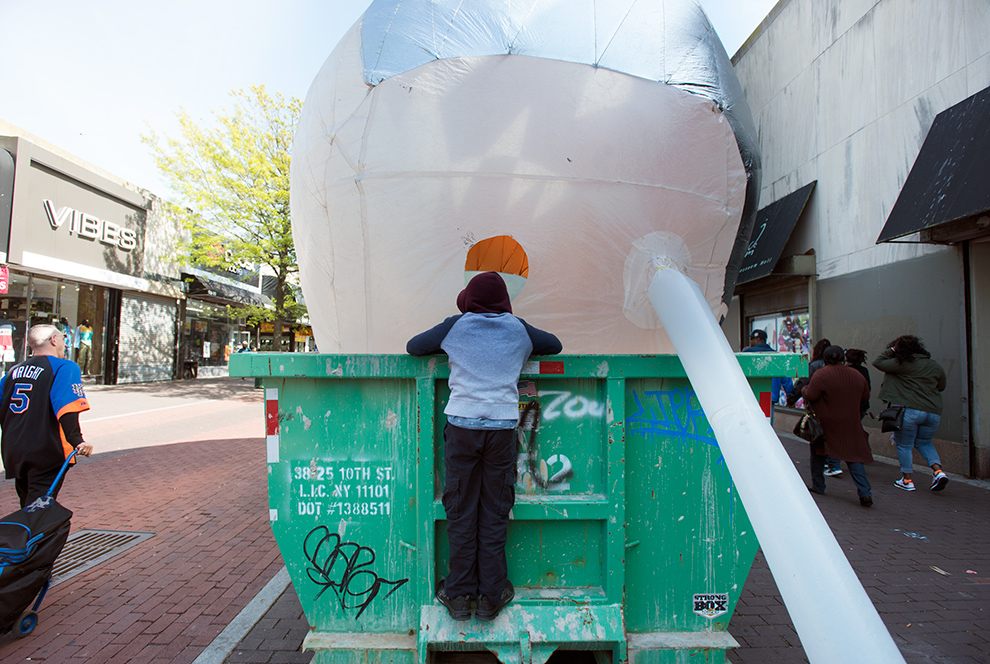
While my natural tendency can lead toward convolution, in the interest of concision here is my attempt to sum up the course objectives in one sentence: “to self-initiate and identify a problem statement relating to the urban environment, and then manifest a possible solution through a public, physical object, while confronting the myriad issues associated with that decision.” Problems addressed included the notion that strangers occupying proximate space are too disconnected – how can you encourage interaction? As well as the problem of physical space inducing a heightened sense of agitation during a stressful time (finals on a college campus) – how can a space be created that produces an alternately playful, soothing affect for passersby? So with that, here’s a sampling of self-initiated work from the third iteration of HTUE.


See previous work and extensive course descriptions here:
Hacking the Urban Environment II – Student Work
Hacking the Urban Environment I – Student Work


All images and work by students Amir Afifi, Hanxiao Yang, Marielle Simone Vargas, Wilbur Lee and Will Chen


Assignment 01 – PARASITES


Assignment 02 – LIGHT PROJECTION


Assignment 03 – FINAL

20130511 Tags: architecture, competitions, fabrication, graphic design, urban | No Comments »

This space could be…


To generate interest and excitement for our BLOQ PARTY proposal, we wanted to start a conversation by showing how the program elements we produced could potentially activate the competition site. Competitions, design proposals and urban space planning oftentimes fall under the radar of the actual users of the site who are both unaware that a competition is taking place and then have no voice in the process or outcome. The plastic signs are intended to link the digital proposal to an actual physical space – less obscure websites and more public posters. It also helped to see how our space division laid out on the actual site, we had treated the eastern, narrower plaza area as space for movement and dynamic interaction – biking, running, skating. The western, more generous plaza was designed for slower, more spontaneous meeting areas. We hope the signs can begin to create a diaglogue for the best use of the space including potentially new and different program ideas that can eventually bring the space to life in a vibrant manner for all.

2013053 Tags: architecture, competitions, graphic design, urban | No Comments »

BLOQ PARTY


Designed with Mark Bearak and Yuval Borochov


What began as a competition for a temporary rehabilitation of an existing chain link fence along two blocks – adjacent to a pair of parking lots – quickly became a more encompassing proposal as we realized the latent potential of the two narrow, un-programmed plazas bordering the modest chain link fence. Located at the Delancey Street connection to the Williamsburg Bridge, the site acts as the symbolic gateway to the Lower East Side for those leaving and entering Manhattan, and as such, displays a great wealth of untapped design opportunity. As a temporary proposal of less than 5 years duration, we identified a variation of possible plug-in nodes that could be used to test ideas for the site and generate community engagement by bringing the scattered, diverse collection of LES attractions together at the fence, displaying the street-level density and multiple, overlapping functions that have historically characterized the LES. Budget and business plans were also developed to illustrate the feasibility of a more ambitious program at the site through a variety of funding and sponsorship options.


PROJECT DESCRIPTION:
The possibilities of programming a BLOQ are endless, ranging from a bike repair station, to a satellite location of a Lower East Side business, to a concert venue stage. Each block will have its’ own identity, but share geometric cues from its neighbors. In our proposal we will aggregate 16 BLOQS that will serve as a gateway to the LES while also providing an oasis of attractions within the neighborhood.
The site will consist of two city blocks and each section will have its own identity. We call the Eastern section the PIT-STOP based on its adjacency to the Williamsburg Bridge and its planned programmatic functions. The BLOQS located in this section will serve as a way station for pedestrians heading to Brooklyn or entering the LES. This section will have BLOQS with services such as bike repair, coffee and skate gear.


We call the Western section the CHILL space and we will treat it as more of a destination. The width of the site allows for larger gatherings of people who can congregate into the farmers market or catch a drink at the pop-up bar. Our proposal represents a handful of potential BLOQS; over the life of the project there are endless possibilities for temporary and permanent installations.


Further exploring the actual BLOQS, each zone will be defined by a fence which will act as a billboard for the community and patterns placed along the ground. Each section of fence will be a billboard representing an actual block of the LES. The design of each section of the fence will be a series of parallelograms that advertise local businesses within the represented blocks of the LES. The parallelograms will be colored based on following four categories: Shop, Eat, Explore & Nightlife. The adjacent ground will be a continuation of this theme containing patterns unique to each BLOQ.


The most liberating feature of the BLOQS will be created when the fence is used as a jumping off point to an architectural installation. We will bend, fold, cut, extend and warp the fence to accommodate the unique functions of each BLOQ. In some cases the drama of the gesture will be relatively modest; in the case of the market the fence will simply be extended horizontally to create a canopy to protect the produce. In more complex situations, structure and furniture will be built off of the fence to create a space suitable to host large groups of visitors. One of the largest BLOQS will be composed of a bar, stage and viewing area built within the distinct vocabulary of the installation.


The main purpose of the BLOQ installation is to activate the space. The BLOQ will not only serve as a gateway to the LES, it will serve as a destination for all New Yorkers. The project will never be static and its potential can be tested over time as the project evolves to suit the changing needs of the community. Eventually the project will not only be a representation of the vitality of the neighborhood, it will also serve as a benchmark for the evolution of the Lower East Side.


http://newyorkcity.arthere.org/art/bloq-party-2/
http://lesbloqparty.com


Existing Site

20130329 Tags: graphic design, grasshopper, parametric | No Comments »

=)


Parametric facade apertures on swooping surfaces are out, parametric emoticons are in. A quick experiment using the image sampler node in Grasshopper to parametrically control the relative ecstatic to furious expression of an emoticon. A sampled pure white pixel on the original background image produces full-mouthed, googly-eyed happiness, while a sampled black pixel will unleash furrowed-brow, pursed-mouth rage. Grayscale pixels produce the range of conflicted emotions in between. Grasshopper definition can be downloaded here, works with any image, but simpler images with fewer colors tend to produce more legible results.
20130113 Tags: architecture, competitions, fabrication | No Comments »

Continuous Contour


Looking North from the Sculpture Park


Assembly Diagram


Elevation Looking West


Site View


Typical Connection Diagram


Quick Project Description
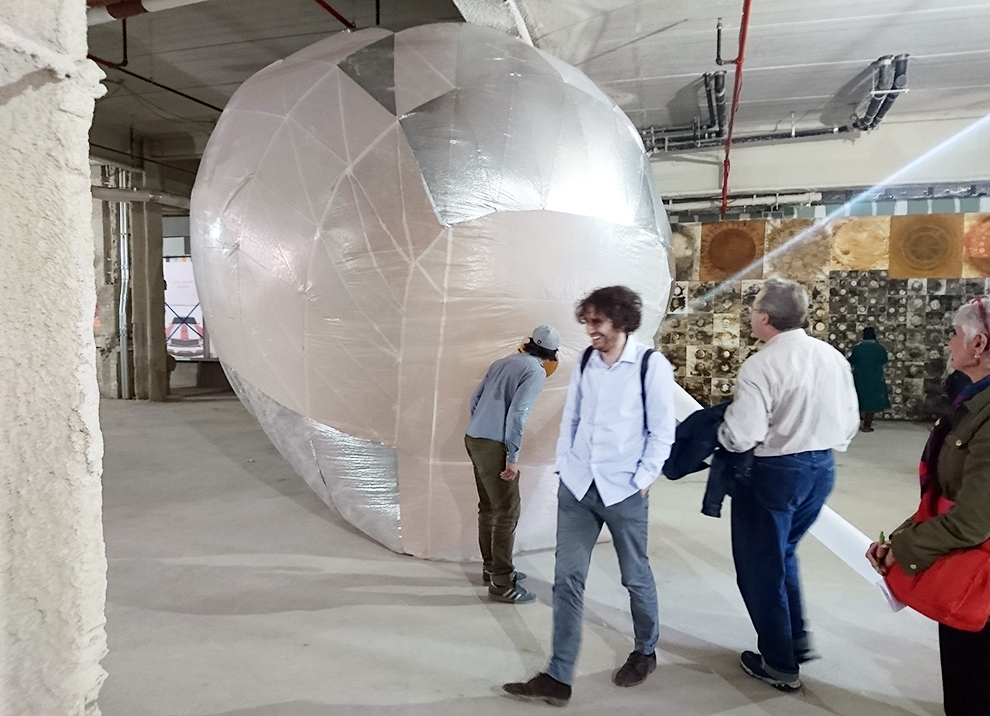
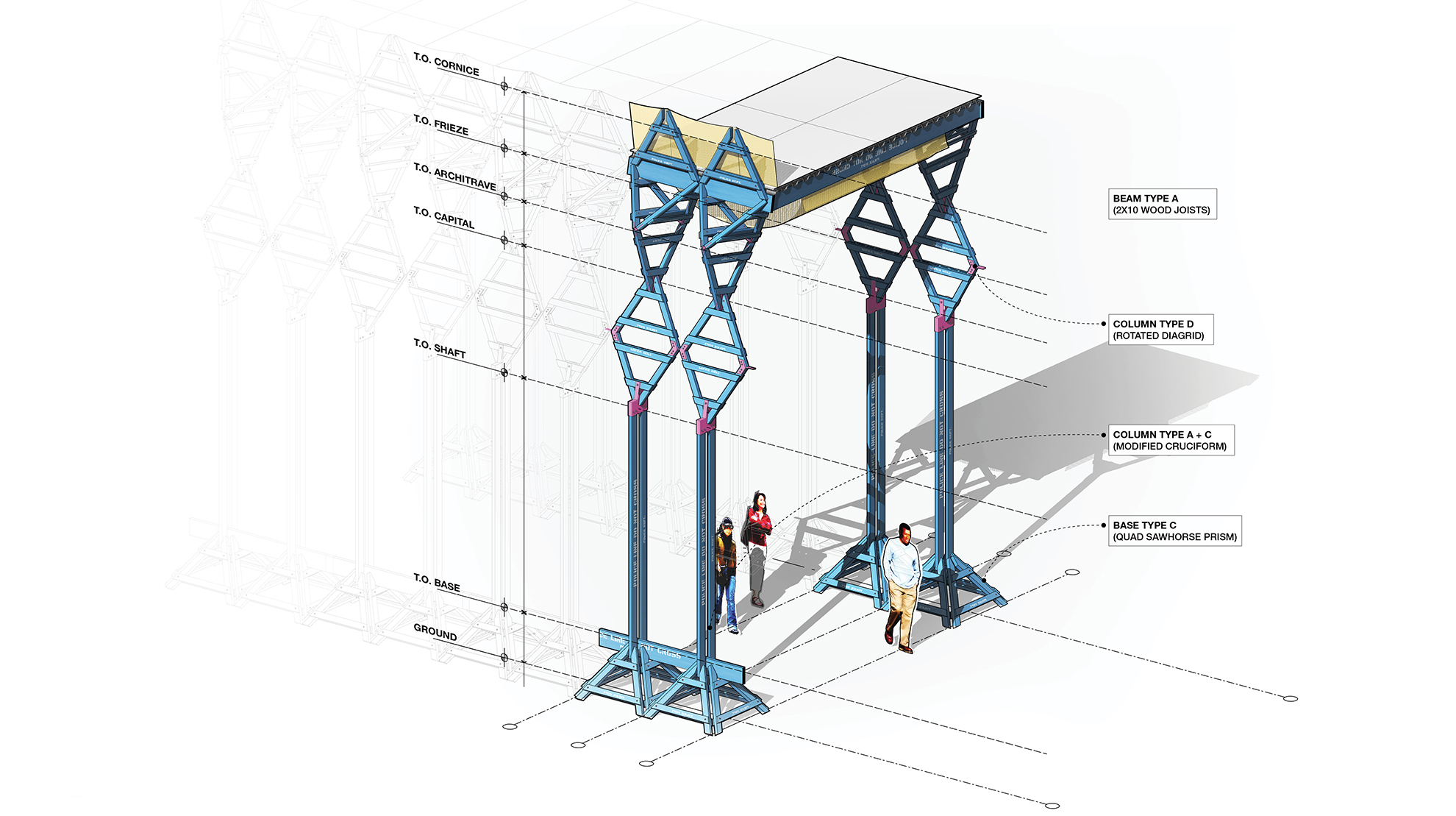
Continuous Contour is a folly built from one single 1050’ length of rope – sourced in Long Island City and hearkening back to the area’s historical role as a center of nautical manufacturing – as well as a series of guide wires and steel rings. Evoking a contour drawing where the pencil never leaves the paper, this rope becomes a continuous, eccentric line that winds its way through a series of metal rings to transform into a phantom geometrical construction, capturing space with visible boundary lines while still remaining imminently temporal and open. The folly proposal comments on architecture’s attempt to force order on the natural world by highlighting the impractical tension between the rigid, recognizable cubic forms and the seemingly chaotic guide wires that connect to the naturally occurring trees that circumnavigate the site. This forms a contradictory structure that is both delicate – being able to sway along with trees and grasping hands – but also completely in tension and dependent on each node to remain standing.
 

Description
The folly Continuous Contour is constructed from a number of locally manufactured and off the shelf materials. Long Island City was once a hub of naval construction and the area still retains some capabilities for producing nautical components, cotton rope primary amongst them. This became the basis for the design proposal and the main feature becomes a single, continuous line of dyed rope facilitating an investigation into the latent possibilities inherent in the material’s strength for flexibility and manipulation.


Architecture school begins with drawing, and one of the first methods taught in the development of a young architect is the contour drawing method, essentially a line drawing that traces the outline of a given subject – a simple means of emphasizing mass and volume on a flat two-dimensional surface. In Continuous Contour the subject becomes spactial and is manifested in a three-dimensional construction that forms the outline of a number of cubic forms that tumble about the sculpture park appearing to take flight as they near the water line. A canvas or plastic tarp is affixed to one side of the forms to potentially provide shade or a projection surface while further emphasizing the geometry. The single approx. 1000’ strand of the rope winds through a series of metal rings, back in on itself and then away again to form a unified decorative agglomeration. The eye can delight in following the eccentric path of the rope, tracing its voyage as it weaves through the park, transforming from a material that connotes a coiled, resting mass into a temporal folly that is now slightly recognizable as something structural. The folly defines space, both within its individual forms and within the park, defining zones of play and contemplation. However, as the folly is merely an outline – the graphical representation of space constructed from a linear material – it is inherently empty and creates a dramatic tension from the play between the two contradictory notions of void and outline.


The rigid, recognizably intentional geometric forms are held in place by a delicate system of guide wires attached to the park’s trees and a minimal number of ground anchoring points. The guide wires are constructed from flexible steel rope and a number of standard connection systems, amongst them stainless steel rings and carabiners. The folly comments on architecture’s ambition to manipulate forced, ordered forms out of the chaos of nature by emphasizing the seemingly chaotic web of guide wires required to stabilize the cubic volumes that appear to hover above the ground. The overall structure of the folly becomes delicate in one sense, in that it gently sways in the breeze in tune with the supporting trees, while the effects of someone tugging on the rope on one end are felt and seen as a rippling throughout the overall system. The folly is then at once elaborate and extravagant, necessitating a detailed site survey for tree locations and a complex system of guidewires in tension to form the node points, while it is also built from modest, common materials.


After the exhibition ends all of the materials can be easily reused and recycled into a number of alternate uses. Due to its softness to the touch, cotton rope is frequently used in railings and could become woven together in a net or other shape to make a wonderful addition to a number of city playgrounds. Likewise, steel rope is frequently used for railings and other tensile applications, but can be easily melted down and recycled.

2013014 Tags: architecture, fabrication, interaction, new york, research, teaching, urban | No Comments »

HACKING THE URBAN EXPERIENCE II – STUDENT WORK

I spent a second semester with a great group of young architects, urban designers and planners teaching a course at Columbia. The class was titled “Hacking the Urban Experience” and was about a number of things I’m interested in, specifically how to fabricate, repurpose and interact with urban space. It was a very good short semester and I was super proud of all of the student’s work. I thought the ideas went deeper and successfully built off the earlier semester. All lectures and process work are archived on the class tumblr: http://hackingtheurbanexperience.tumblr.com. Classes typically took the form of lectures on precedents and concepts, a discussion of student work and tutorials on materials or software techniques as required. Topics during the semester included overviews of unsolicited architectural proposals, building-scale light projections, inflatable materials, urban siting opportunities and community/crowd sourced funding.


Course Description
The course goals haven’t changed dramatically since the last semester, the course still seeks to assert the relevance of the fabrication tools at our disposal as potentialities for social and environmental relevance. Through the re-appropriation and re-imagining of existing urban conditions, the student will design and fabricate a working prototype that embraces the messy reality of our city and promotes community involvement. The student will begin by identifying a quality of the urban condition that includes the latent capability for improvement and work toward fabricating an adaptive, responsive and environmentally viable solution. Specific emphasis will be placed on testing and exploring through hands on research the possibilities of detailing and fabricating connections using unorthodox materials. At the conclusion of the course the student will produce a full scale urban intervention and observe and document their relevant successes or failures.


Workshops were conducted to introduce the students to the possibilities inherent in new material technologies, through production and detailing techniques, and the proper use of fabrication techniques. Material workshops encouraged students to explore with everything from dynamic, variable surfaces using latex and silicone to parametric agglomerations using quotidian materials.


The first investigation was the creation of the connection detail. It was encouraged that this be a parametric joint that breaches the gap between the existing streetscape and the student’s intervention. Flexibility, safety, durability, adaptability will all be tested while exploring different possibilities for a potential synthesis with existing urban forms, examples of which can include: will the student’s intervention clamp on to a lamppost, hang from a phone booth, project from an existing building or rest in a parking lot?


By attempting to capture a broader audience for architectural interventions, a number of questions presented themselves and the student was challenged to anticipate possible eventualities – how will it be used? Can its use be changed? Is it durable? Is it waterproof? Can it safely stand up? Fabrication was considered less from a formal quality, and more from a use, durability, improvisation and public participation viewpoint.


Ultimately the student should have come out of the course with a healthy respect for two core concepts: Firstly, an increased skill in the use and applicability of the fabrication machines we have at our disposal for solving design issues using unorthodox materials in unconventional settings; and two, that there is an opportunity for architects to regain lost relevance by inserting themselves through unsolicited proposals into the public consciousness as steward’s of urban well being.


Assignment 01 – PARASITES
Part of the Atlas of Urban Connections project (TBD), the first assignment involved designing and fabricating a joint to connect something, anything, to a vertical street extrusion (such as a tree, street sign, light pole, etc…). The members of the Public Works Department in NYC are masters of improvisation, you can see it walking down any street here, and there is a lot to learn from their successful and not-so successful techniques for attaching to existing sidewalk infrastructure. This assignment was prepared to introduce the student to the capacity to breaching the gap between the pedestrian and existing streetscape objects, with the goal to test flexibility, safety, durability, adaptablility while exploring different possibilities for potential synthesis with existing urban forms.


Tom, Aaron, Max, Kevin


ChunChun, Yuri, Shuang, Rubing, Renwick


Assignment 02 – INFLATABLES
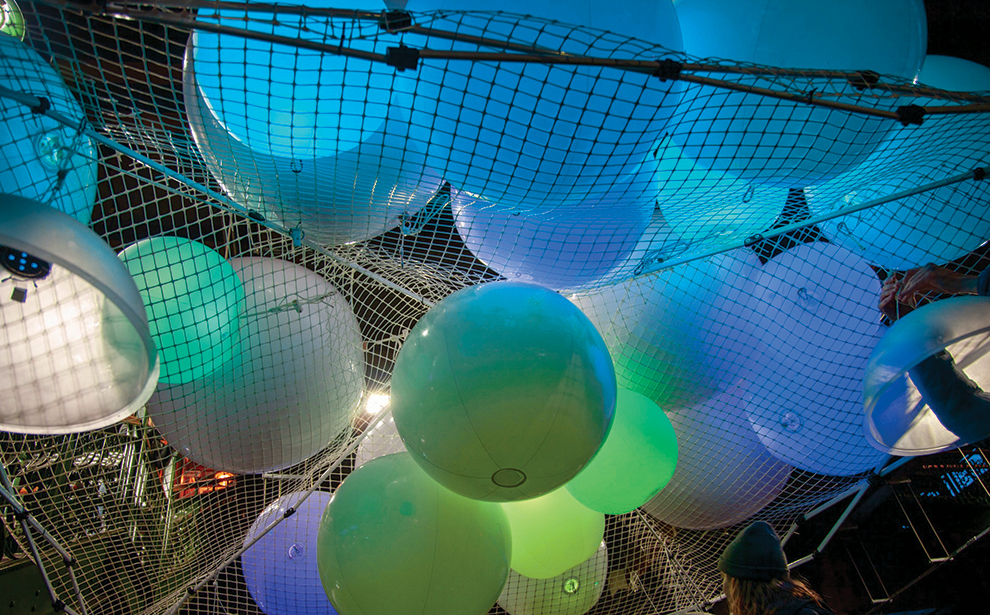
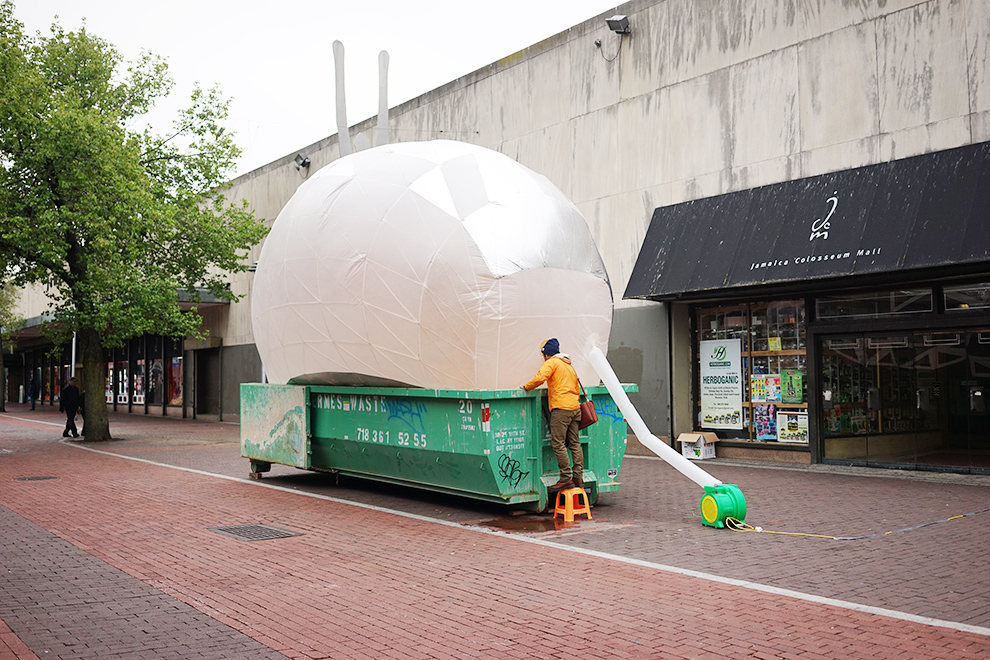
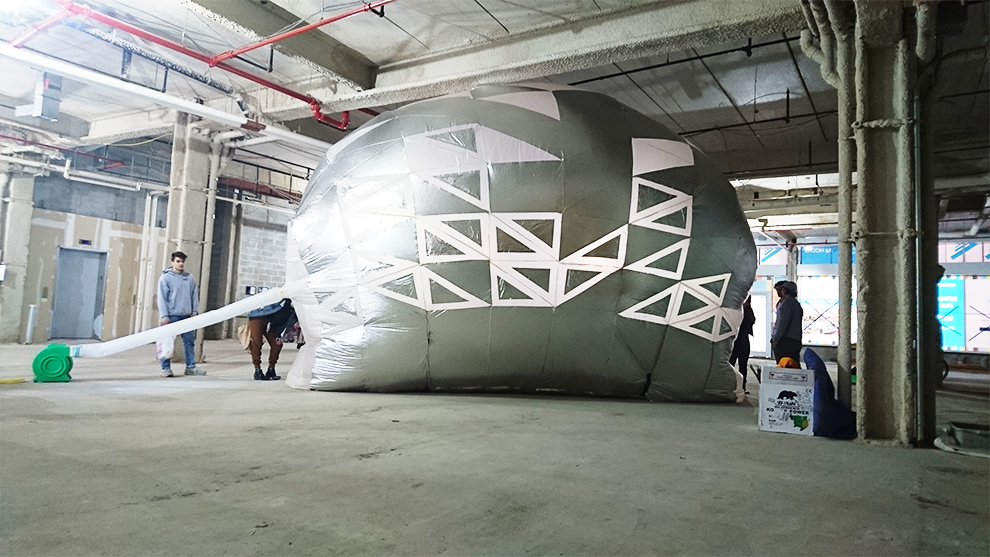
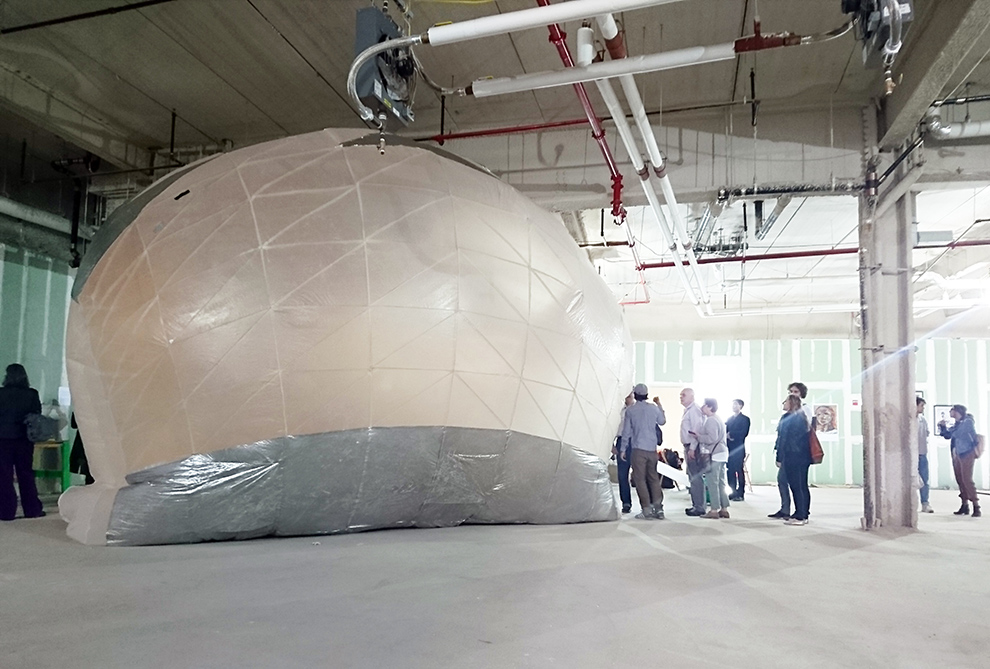
Hurricane Sandy played hell with our first few weeks, and necessitated that the initial assignments were bundled together. However, we still had a chance to look at inflatables and the material qualities inherent in cheap polyethylene of different mil thickness. Using an iron, tape and plastic, quick inflatable bladders were constructed and tested. The students were tasked with creating an inflatable, mobile “seating” system that was either self-supporting or used a site’s natural currents to inflate.


ChunChun, Yuri, Shuang, Rubing, Renwick


Ni, Mengna, Darian, Juan, Ying


Assignment 03 – LIGHT PROJECTION
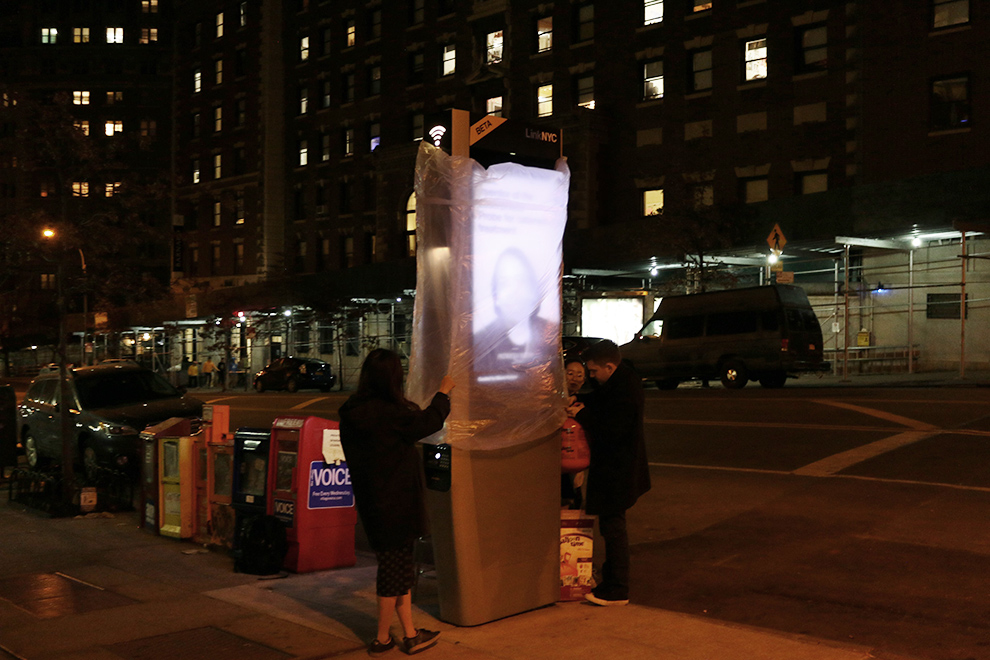
Using Graffiti Research Lab’s projection bombing tutorial at Instructables, the class set up a mobile power station using a 75V marine battery, and set off around the neighborhood near Columbia to experiment and throw up some interactive light projections.
The last year has seen some truly inspiring displays of the potential light can have as an interventionist tool, and the class studied this problem using three main strategies: 1) messaging independent of site, i.e. you only need a blank wall, 2) site dependent projections, like those following the curving, horizontal bands on the Guggenheim, and 3) flexible projections that can adapt and interact to a number of different sites, taking advantage of the unique characteristics of each. Care was given to create projects that both actively and passively engage those passing by the site. Each group’s projects was able to successfully confront one of these strategies.


Ni, Mengna, Darian, Juan, Ying


ChunChun, Yuri, Shuang, Rubing, Renwick


Tom, Aaron, Max, Kevin


Kaz, Greg, Ella


Assignment 04 (FINAL)
Building off the previous assignments, the final assignment sought to synthesize the work and concepts of the class into a larger installation that could still be completed in our very tight time frame, but started to explore the core ideas of the course, in effect becoming a proof-of-concept, working model. By attempting to capture a broader audience for architectural interventions, a number of questions presented themselves and the students were challenged to anticipate a range of possible eventualities – how will it be used? Can its use be changed? Is it durable? Is it waterproof? Can it safely stand up? Fabrication was considered less from a formal quality, and more from a use, durability, improvisation and public participation viewpoint.
Ultimately, A successful project would accomplish three things: 1) display ingenuity in fabrication technique and material 2) re-imagine or re-design a specific urban site/condition to take advantage of its hitherto hidden potential, and 3) have a performative component, in that the intervention has a temporal quality that while engaged promotes public interaction.


ChunChun, Yuri, Shuang, Rubing, Renwick


Kaz, Ella, Greg


Tom, Aaron, Max, Kevin


Ni, Mengna, Darian, Juan, Ying

20121117 | No Comments »

Magnetic Texas Bats


Continuing the animal theme and testing out how magnets work.


more »

2012111 Tags: DUB, fabrication, newyork, urban | No Comments »

DUB 004


See more here.

20121029 Tags: africa, photography | No Comments »

Congo Landscapes II


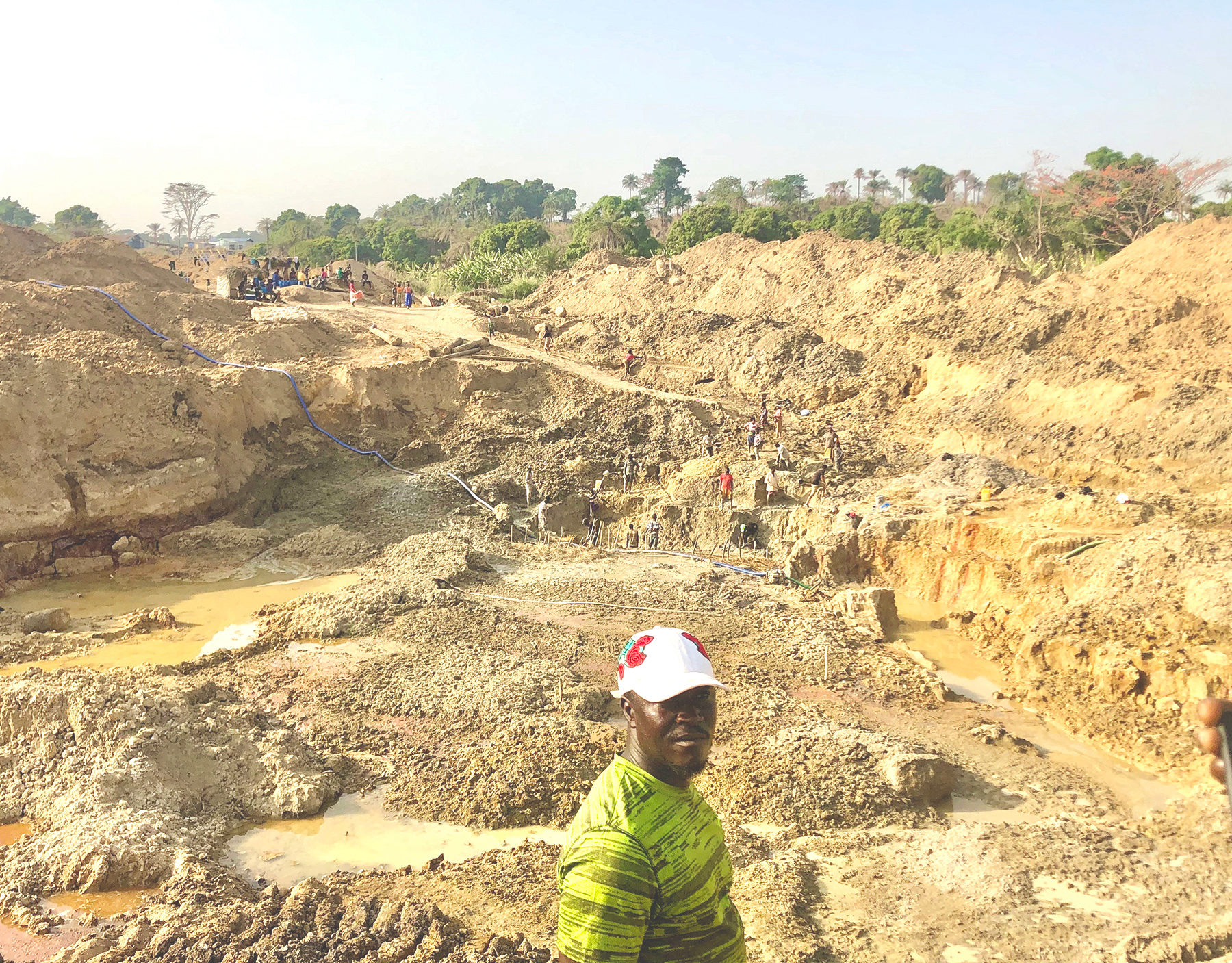
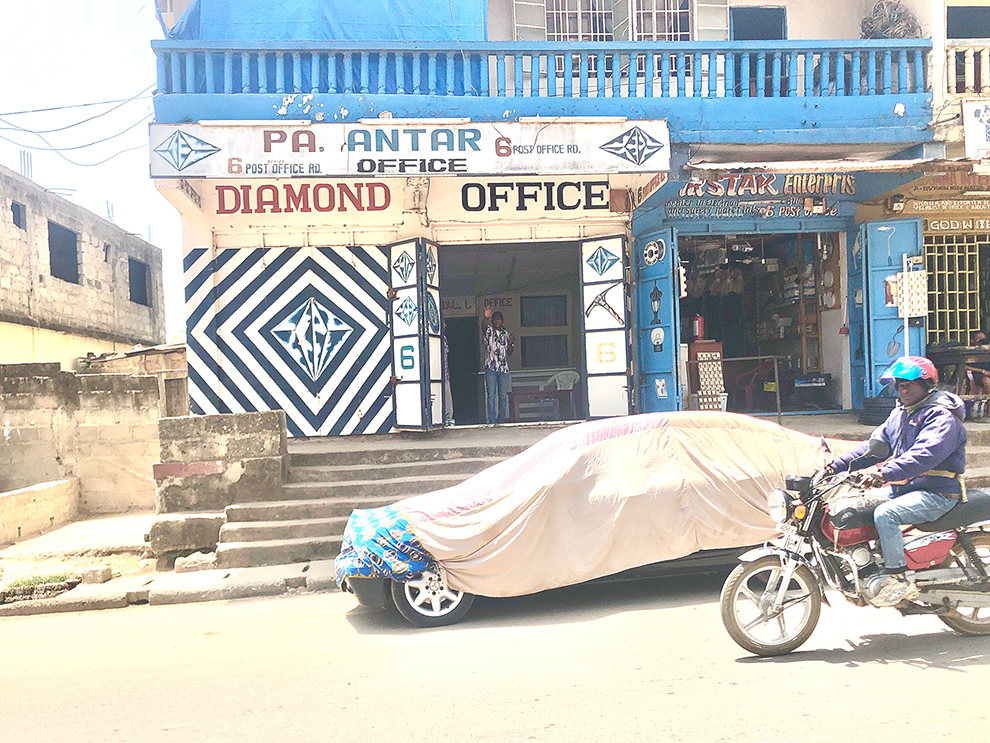
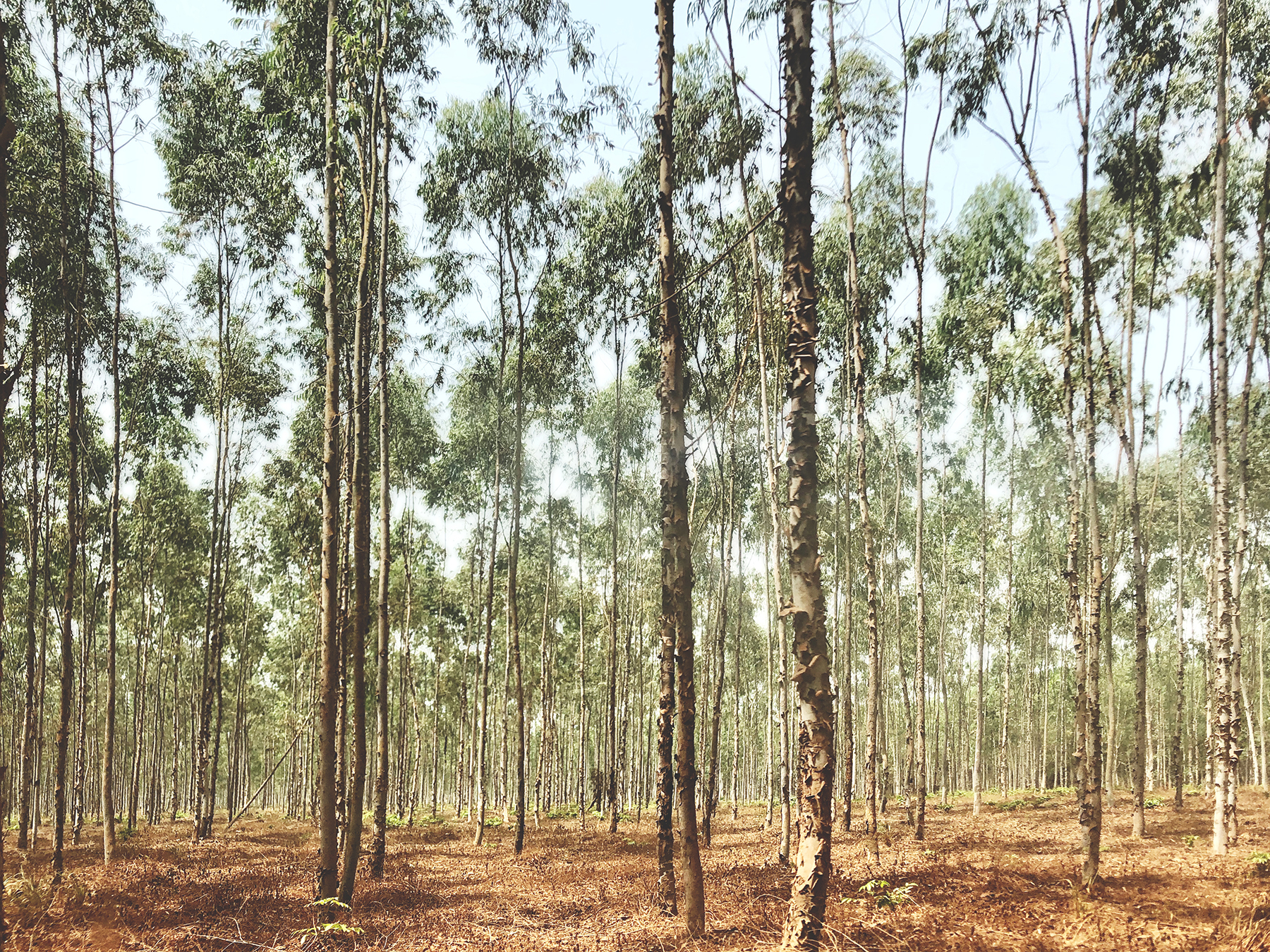
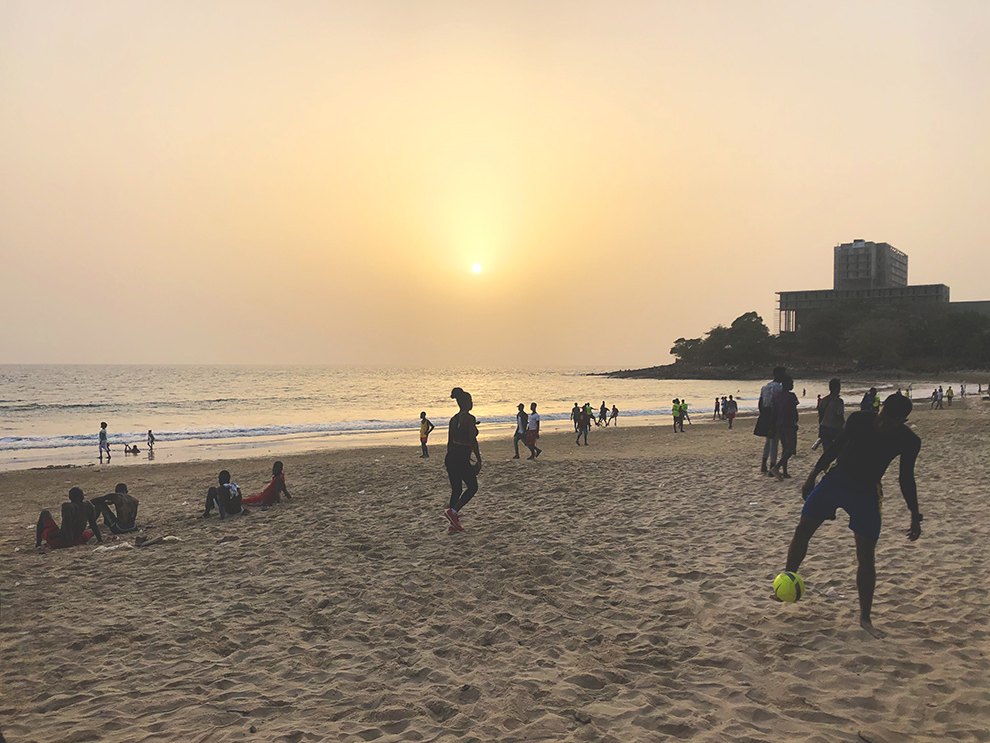
My shoes saw more action in the seven days in the Congo than the previous five years combined. They held up and held on admirably, never once giving in to the powerful suctioning force of the soft, squishy ankle-deep muck that seemed determined to send me back to camp barefoot; or so much as let a single lace loosen when they were conspicuously – and admittedly clumsily – splashing along a winding, seemingly endless stream (though their awkwardness at river treading should most likely be attributed more to user error than anything else). From the dry dust of the savannah to the persistent, humid darkness of the rain forest, my beat-up trainers soldiered on, and – aside from an unfortunate and uncleanable encounter with elephant dung – remained unchanged. Perhaps that’s why I didn’t trust them.


Paraphrasing Congo enthusiast and noted biologist/cryptozoologist Roy Mackal, the Congo Basin is an evolutionary oddity in that at least since the close of the cretaceous period it has remained static, the area has ceased to undergo further climatic and geophysical changes. Animals evolve and survive in response to changes in their external environment, while conversely, in the absence of external drivers, when conditions are stable, ancient creatures can thrive and survive unchanged, see: crocodiles.


Entering the jungle can seem like an escape, where you can quickly find yourself in a mesozoic state of mind, confronted with the terrifying – over 2000 strains of skin diseases, to the sublime – gorillas! A place where our evolutionary cousins can be found with relative ease, 400lb primates gently lazing in the trees around us, smiling, sunning themselves, and generally behaving in a relaxed manner that quickly evolves from frighteningly exotic to frighteningly familiar before giving way to pure joy. There’s a sense that anything is possible, running the gamut from the merely curious to the genuinely horrible, the giant Gambian rat that prefers to defecate upside down, to a virus that liquefies your internal organs. Anything could be just around the corner. So it’s easy to sympathize with the original early 20th century English colonial officers, their imaginations astir, seduced by crude Pygmy drawings scribbled in the forest floor of a four legged sauropod, and later taken up by Mackal and various other cryptozoologist expeditions, searching in vain for Mokele-mbembe, that last, illusory dinosaur, an evolutionary dead-end, too isolated to realize he was extinct. But the actuality was enough for us, a Congo so full of life and wonder where the overwhelming reality was all the phenomenon that could be endured.

20121020 Tags: africa, photography | No Comments »

Congo Landscapes I


Scenes from our honeymoon in northern Congo.

20120911 Tags: competitions, fabrication | No Comments »

Light Caryatids


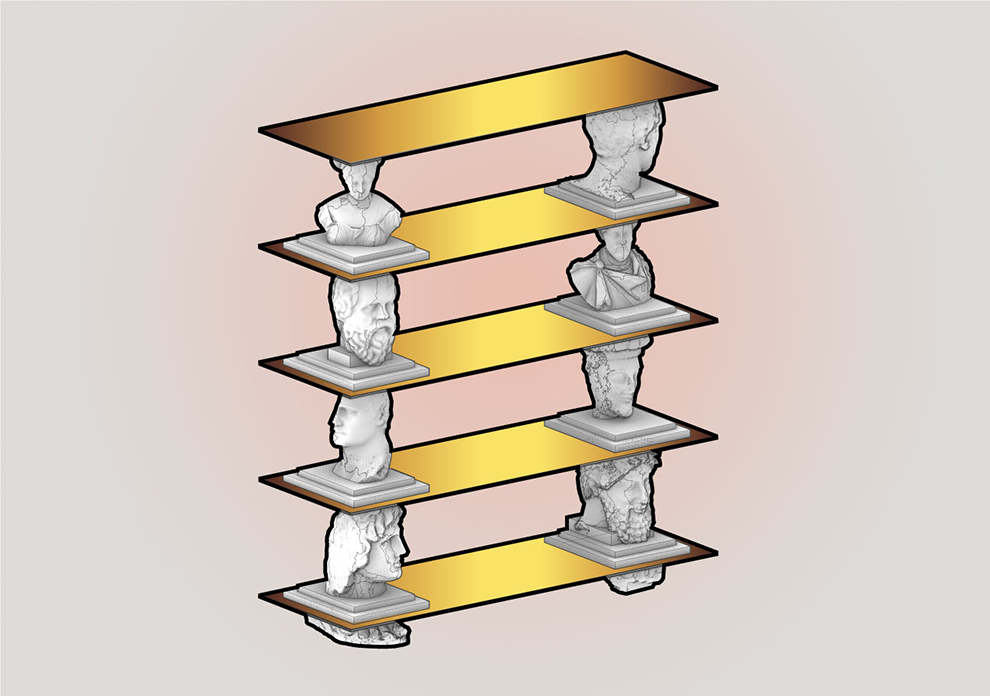
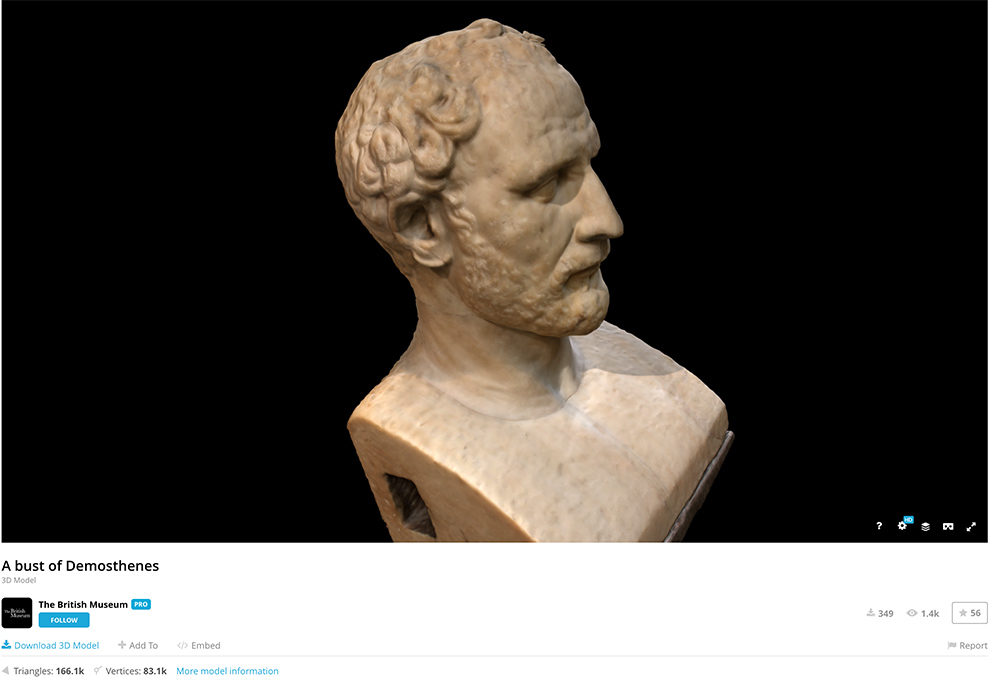
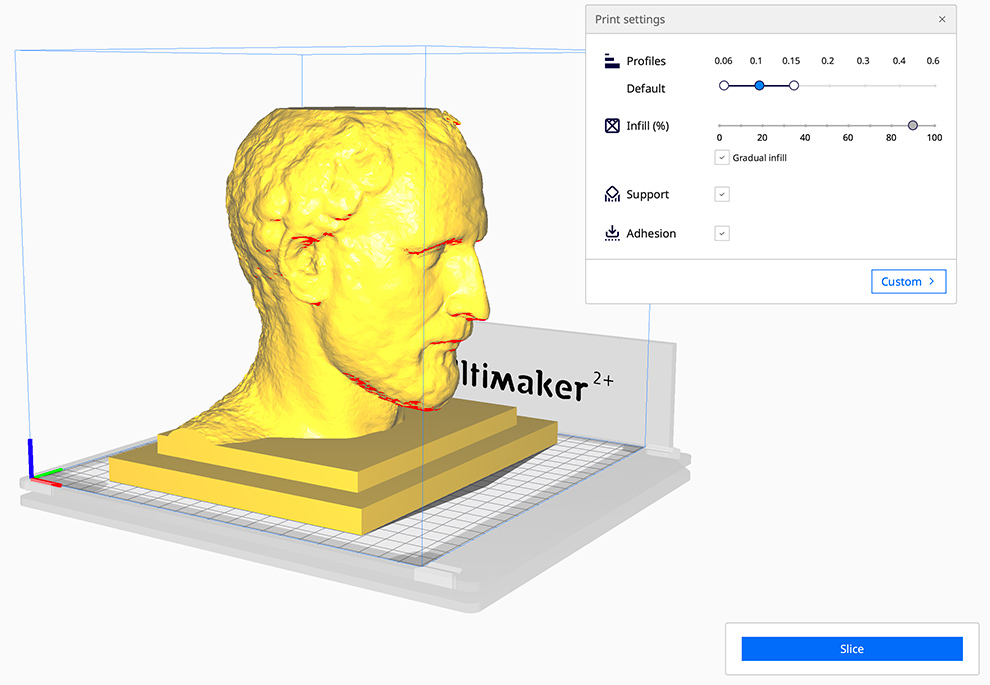
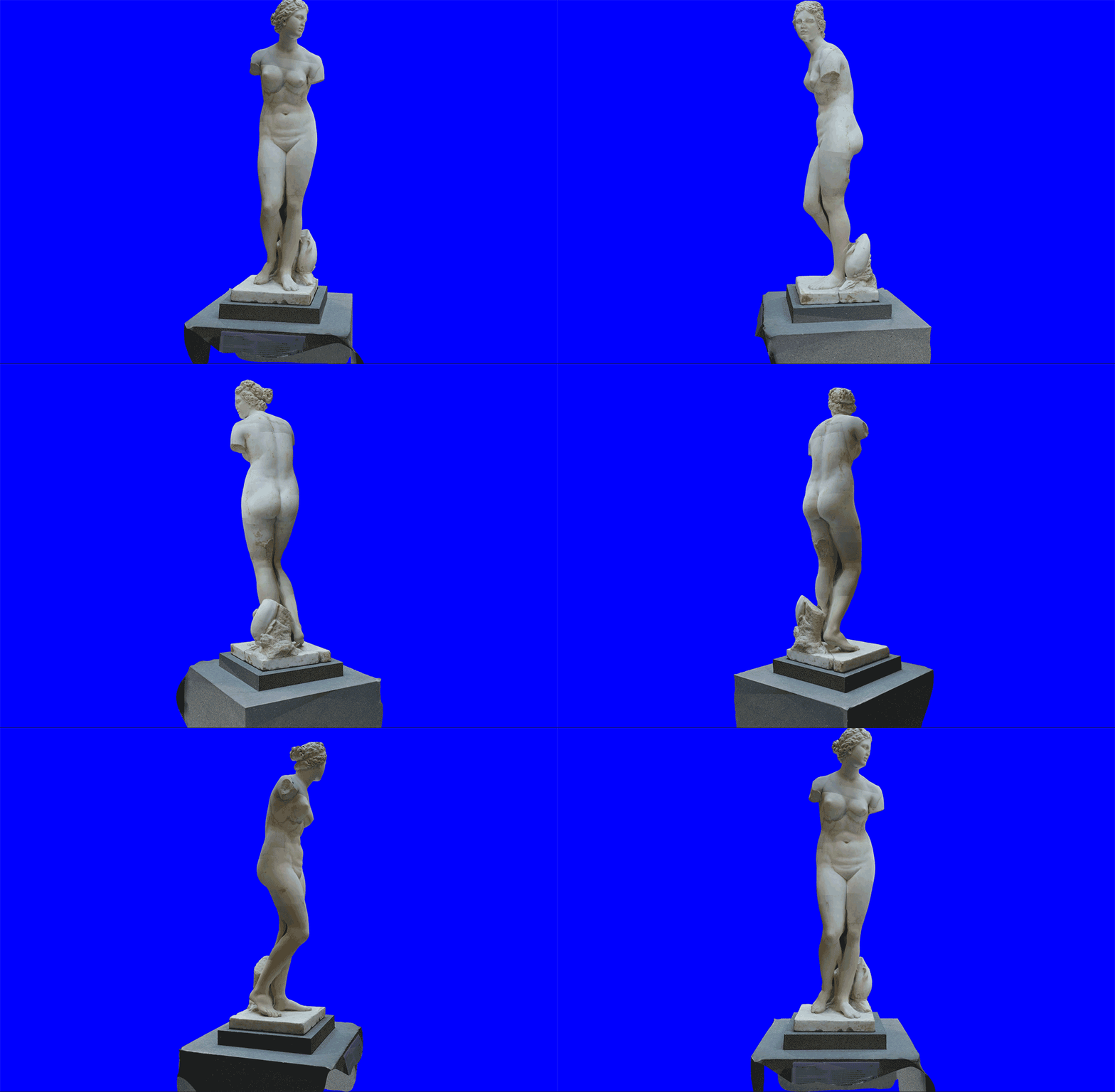
3D model of the Caryatids at the Temple of Erechtheion, constructed from flickr images and Autodesk’s 123D Catch. A little buggy, but close enough.


Sited at the corner of India and West St. in Greenpoint, the project situates itself as a gateway, a ceremonial entrance to Pier 11 and the East River Ferry. The four Caryatid models are milled out of standard Dow rigid foam insulation.


Activating the fluorescent lights allows wattage to bleed through where the foam material is thinnest, illuminating the ghostly forms of four of the maidens. The four foam panels match the rhythm of the warehouse windows above and reveal themselves as non-loadbearing elements, while still taking the expected position of structural elements – placed under the building’s overhang. Here light takes on volumetric properties, giving life to the caryatids and briefly rendering them in an effervescent glow that contrasts with their current Hellenistic confinement, hewn from Grecian stone and forever supporting the Porch’s entablature above.


Projected budget: $415

20120724 Tags: DUB, fabrication, newyork, urban | 1 Comment »

DUB 003


Located on the NW Corner of 87th and Amsterdam Ave Google Map link


With some slight modifications from the previous iteration, a new version popped up on 87th over the weekend. The only significant changes were the addition of some slight suggestive text: “take a book,” “leave a book,” and removing additional shelf material to expose the sides of the actual phone mechanism. I had been tipped off by a telephone repair technician that the likely cause of the prior shelf disappearances could be attributed to the tech’s inability to access the locking mechanisms on either side of the phone, requiring him to remove and probably toss the shelves. Further observation will be required to see if this version can outlast the former’s 5 weeks of operation.


The intersection here is part of a pretty interesting area with a diverse mix of pedestrian traffic. 86th street acts as a strong east-west thoroughfare that effectively splits the northern portion of the neighborhood from the rest of the upper west side, and predictably there is also a visible, distinct change in scale when looking south versus north. The site is a mixing chamber of sorts with four quadrants that come together here: the chain retail stores to the south and west along Broadway; the Innovative Diploma Plus High School and P.S. 334 to the southeast; an eclectic mix of housing scales to the northeast and a growing dining and leisure strip taking off to the north. The goal here is to try play to all those users, and create a community focal point of nearby residents, commuters on their way to and from the train, diners, and spillover from the large retail stores.


It was great to spend a few hours observing how people interacted with the shelves. Even at 9am on a Sunday morning, it quickly became a point of attraction on the sidewalk, at one time hosting a queue of six random strangers waiting to get a closer look. The addition of subtle instructions seemed to help, as this time there were two separate occasion when people left holding a book. It still remains to be seen whether anyone begins leaving their own and adding to the collection, but it will be certainly be interesting to find out.


After further observation of this iteration, I’ll post the cut files if anyone wants to make their own. Let me know if interested.


Made possible with generous support from the following:
Materials and Fabrication:
SFDS Fabrication and Design Shop, Brooklyn, NY


Book Donation:
Mrs. and Mrs. Moon
Housingworks Bookstore
Kay Gardiner
Residents of 951 Amsterdam Ave.


Photography:
Jackie Caradonio


more »

2012072 Tags: competition, graphic design | 1 Comment »

crystal camouflage


Continuing my love of camouflage and painting jersey barriers in a way that is probably too heavy on the new aesthetic vibe, but sill enjoyable nonetheless.


Related: Satellite map images with missing or unclear data

20120624 | No Comments »

Interview with World Literature Today


Technology’s unapologetic march toward a slimmer, sleeker, sexier experience—dominated, and prefixed with, an all-powerful i—has turned payphones into what New York architect John Locke calls “a detriment to the urban experience.” His solution involves another technology he says is on the cusp of obsolescence.


John Tyler Allen: How did the Department of Urban Betterment (DUB) begin, and what ideals drive and guide it?


John Locke: Basically the project, and DUB, began by identifying and trying to exploit potentially underused streetscape spaces. In other words, the first place I looked was the phone booths that litter my neighborhood. I consider the booths a detriment to the urban experience in that, spatially, they both reduce the available sidewalk width and they also occupy the street as pedestrian level billboards. And of course, in a world of ubiquitous mobile communication devices, their original function has disappeared. Most neighborhoods in lower Manhattan have very little phone booth coverage, but here, where I live in Morningside Heights, they are surprisingly common; some streets have as many as five booths on one block. So, the project really began with that idea of how can we turn something obsolete and a net negative for the neighborhood into something worthwhile that would hopefully encourage community involvement and provide a sense of connection with neighbors over something shared.


JTA: Was it important to you to choose a project centered around books?


JL: The idea of creating the project around books is just one solution to that question. As an avid reader and owner of way too many physical books, I was immediately drawn to that as being a potentially workable solution, and I personally believe that a world with more books in circulation is pretty nice. What’s more common than sharing a good book you’ve read with a friend? But at the same time, I can envision a number of other valid solutions. In Beijing phone booths have been converted into Internet hot spots, and in Austin a group of artists converted a payphone kiosk into a seesaw. But could they also function as other sorts of community communication devices, ways to locally transmit information and data? Those are the things I’m most interested in.


I was also drawn to the technological, and maybe even psychological, symmetry between physical books and phone booths. I think there is an innate feeling of loss toward both, in that one has already been rendered obsolete by a new technology—cellular phones—and the other is seemingly on the cusp of obsolescence as well, both through the proliferation of e-book readers and the general waning of literature as being part of the wider cultural discussion. And I think there is always a sense of hesitation, maybe even nostalgia, when something that once seemed so prominent and important begins to disappear.


Read More Here

20120516 Tags: architecture, fabrication, interaction, new york, research, teaching, urban | No Comments »

HACKING THE URBAN EXPERIENCE – STUDENT WORK

I had the pleasure to teach a course this semester with a great group of young architects and urban designers, titled “Hacking the Urban Experience” at Columbia. I couldn’t be more proud of all the hard work and the high level of engagement with which the students approached the class. All lectures and process work are archived on the class tumblr: http://hackingtheurbanexperience.tumblr.com. Classes typically took the form of lectures on precedents and concepts, a discussion of student work and tutorials on materials or software techniques. Topics during the semester included overviews of unsolicited architectural proposals, building-scale light projections, inflatable materials, urban siting opportunities and community/crowd sourced funding.


The course sought to assert the relevance of the fabrication skills at our disposal as potentialities for social and environmental relevance. Through the re-appropriation and re-imagining of existing urban conditions, the students designed and fabricated working prototypes that embraced the messy reality of our city and promoted community involvement. The students began by identifying a quality of the urban condition that included the latent capability for improvement and worked toward fabricating an adaptive, responsive and environmentally viable solution. Specific emphasis was placed on testing and exploring through hands on research the possibilities of detailing and fabricating connections using unorthodox materials. At the conclusion of the course the students produced a full scale urban intervention and observed and documented their relevant successes or failures.


Material workshops were held to encourage the students to explore constructions from inflatables to parametric agglomerations using quotidian materials. Ultimately, the goal was for the students to come out of the course with a healthy respect for two core concepts: firstly, an increased skill in the use and applicability of the fabrication skills we have developed for solving design issues using unorthodox materials in unconventional settings; and secondly, that there is an opportunity for architects to regain lost relevance by inserting themselves through unsolicited proposals into the public consciousness as steward’s of urban well being.


Students:
Jared Dignanci, Farzin Lofti-Jam, Ehsaan Mesghali, Katerina Petrou, Paul Tran, Wassim Shaaban, Maryam Zamani


Assignment 01
Part of the Atlas of Urban Connections project (TBD), the first assignment involved designing and fabricating a joint to connect something, anything, to a vertical street extrusion (such as a tree, street sign, light pole, etc…). The members of the Public Works Department in NYC are masters of improvisation, you can see it walking down any street here, and there is a lot to learn from their successful and not-so successful techniques for attaching to existing sidewalk infrastructure. This assignment was prepared to introduce the student to the capacity to breaching the gap between the pedestrian and existing streetscape objects, with the goal to test flexibility, safety, durability, adaptablility while exploring different possibilities for potential synthesis with existing urban forms.
Wassim, Katerina, Paul


Jared, Farzin, Ehsaan, Maryam


Assignment 02
Using Graffiti Research Lab’s projection bombing tutorial at Instructables, the class set up a mobile power station using a 75V marine battery, and set off around the neighborhood near Columbia to experiment and throw up some interactive light projections.
The last year has seen some truly inspiring displays of the potential light can have as an interventionist tool, and the class studied this problem using three main strategies: 1) messaging independent of site, i.e. you only need a blank wall, 2) site dependent projections, like those following the curving, horizontal bands on the Guggenheim, and 3) flexible projections that can adapt and interact to a number of different sites, taking advantage of the unique characteristics of each. Care was given to create projects that both actively and passively engage those passing by the site.
Wassim, Katerina, Paul


Ehsaan, Maryam


Jared, Farzin


Assignment 03 (FINAL)
Building off the first two assignments, the final assignment sought to synthesize the work and concepts of the class into a larger installation that could still be completed in our very tight time frame, but started to explore the core ideas of the course, in effect becoming a proof-of-concept, working model. By attempting to capture a broader audience for architectural interventions, a number of questions presented themselves and the students were challenged to anticipate a range of possible eventualities – how will it be used? Can its use be changed? Is it durable? Is it waterproof? Can it safely stand up? Fabrication was considered less from a formal quality, and more from a use, durability, improvisation and public participation viewpoint.
Ultimately, A successful project would accomplish three things: 1) display ingenuity in fabrication technique and material 2) re-imagine or re-design a specific urban site/condition to take advantage of its hitherto hidden potential, and 3) have a performative component, in that the intervention has a temporal quality that while engaged promotes public interaction.
Wassim, Katerina, Paul


Maryam, Jared, Farzin, Ehsaan

20120317 Tags: fabrication, teaching | No Comments »

predator bear


A rare spotting in the wild. Assignment 01, build a parasitic attachment to a vertical streetscape extrusion.


more »

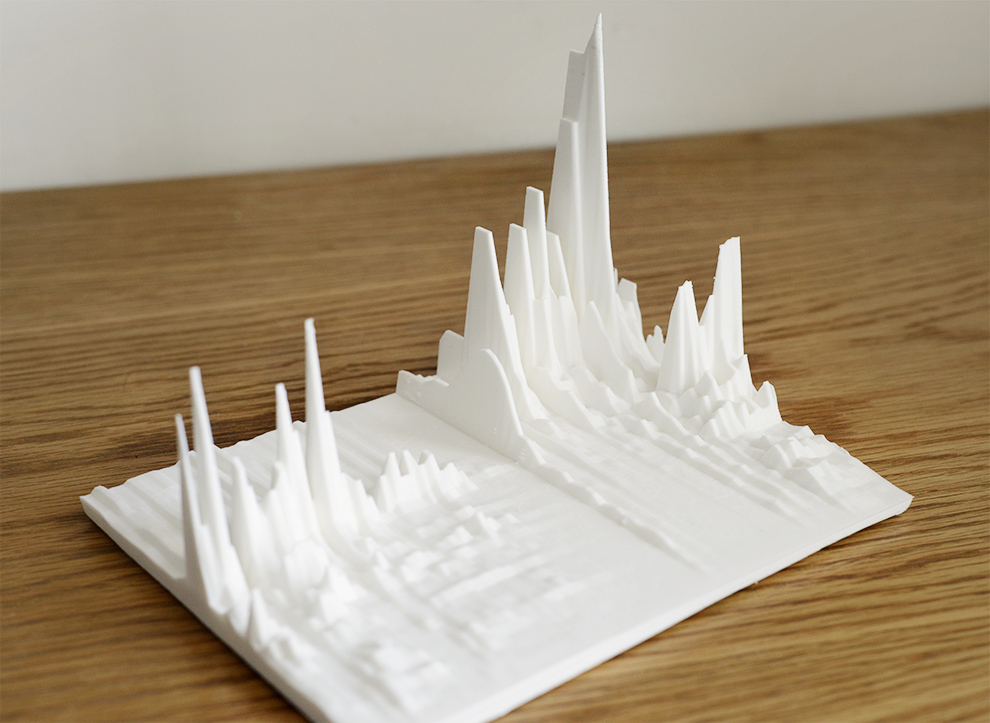
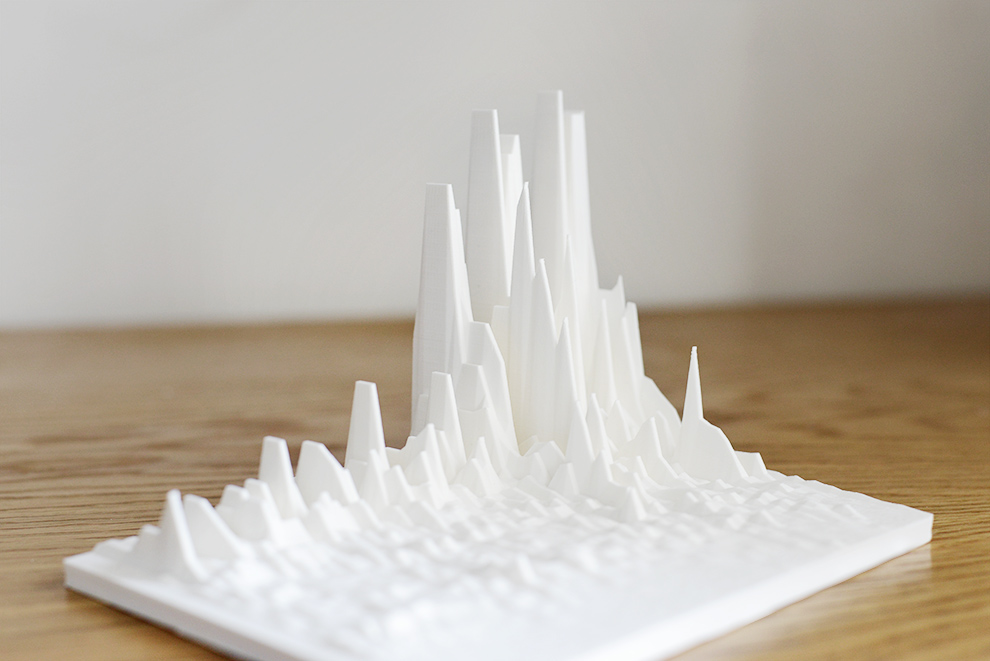
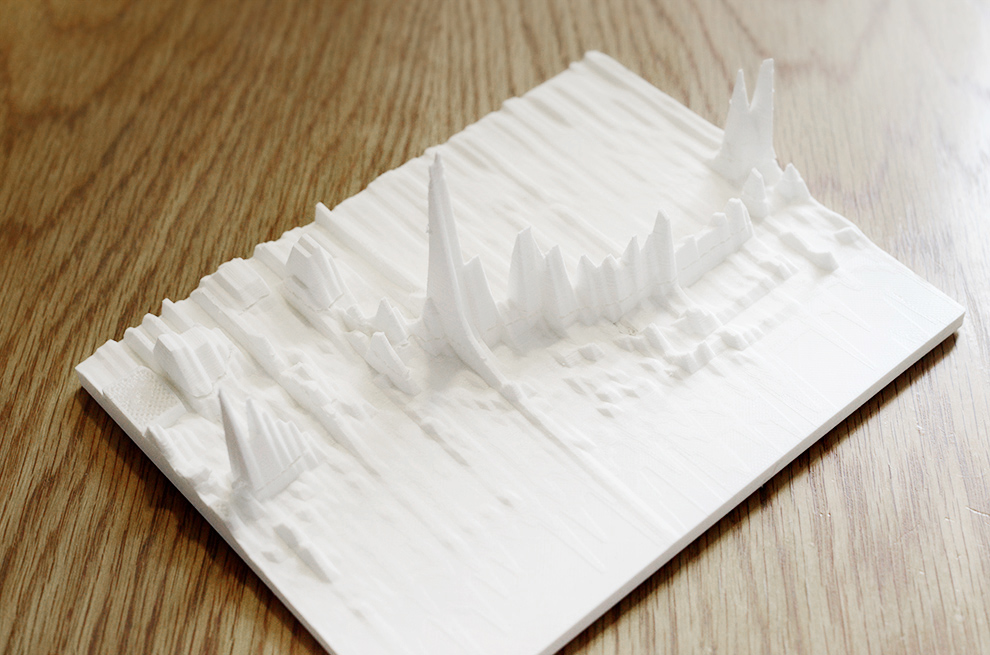
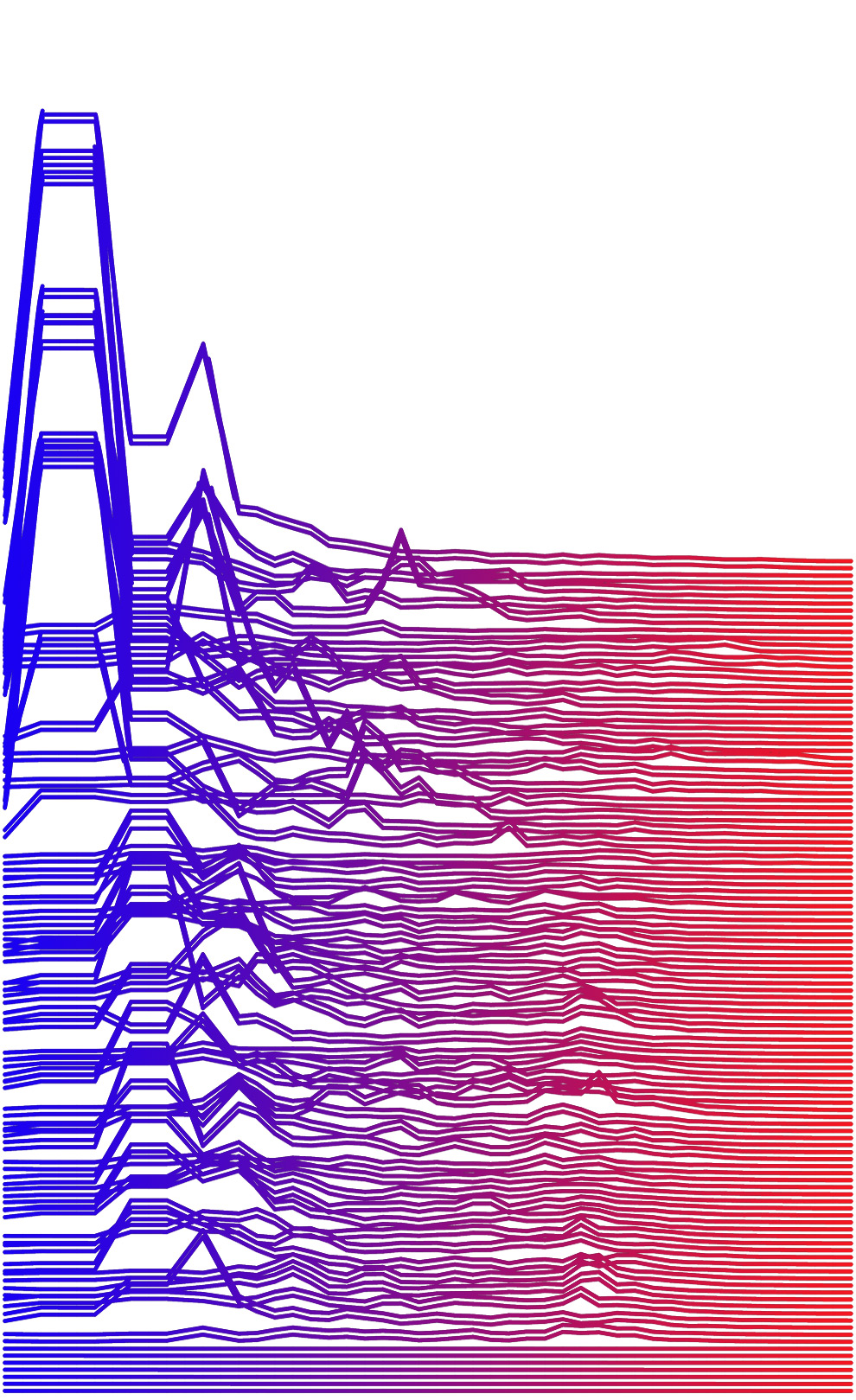
2012024 Tags: research, scripting, twiiter | No Comments »

void in the center


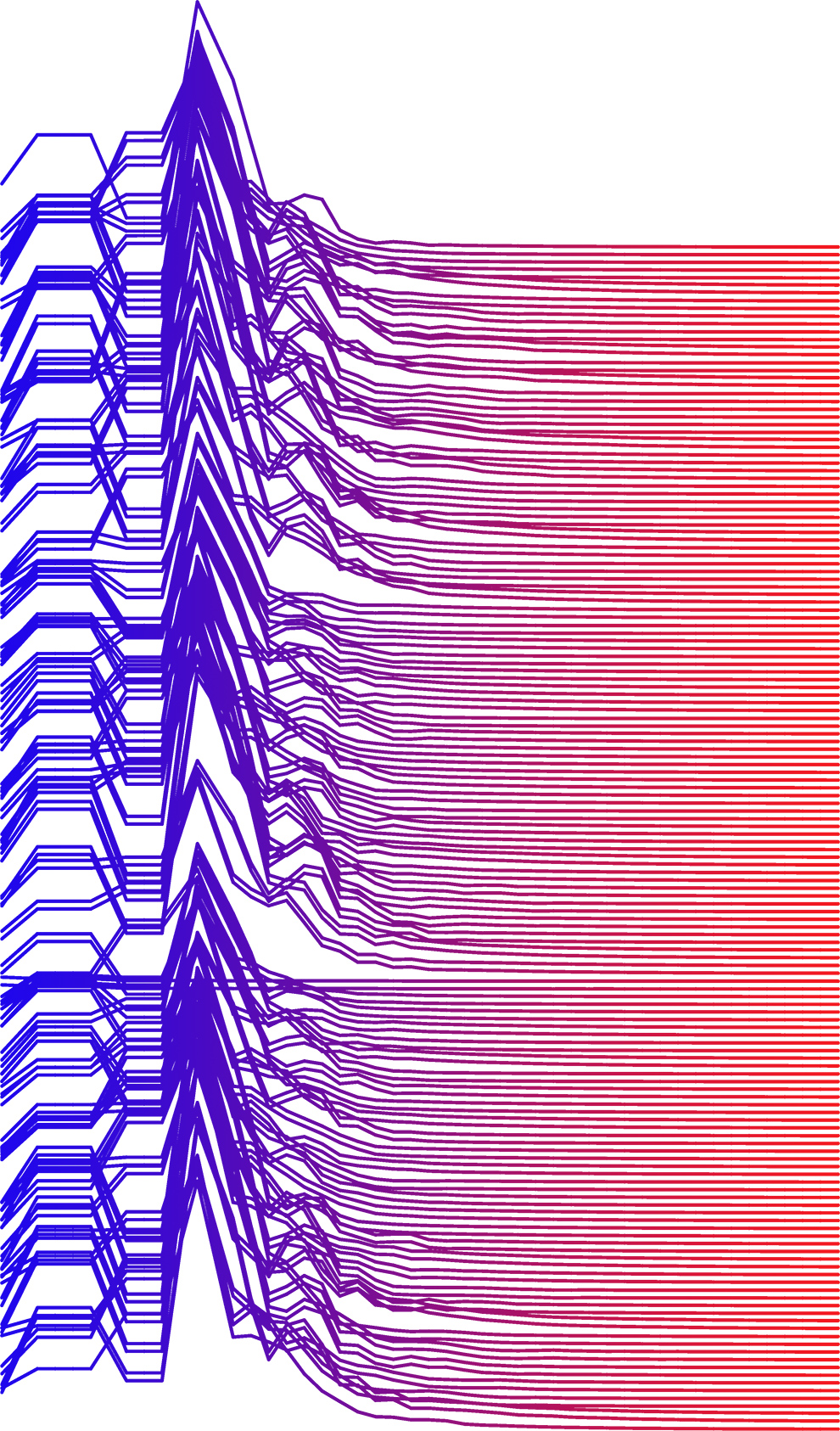
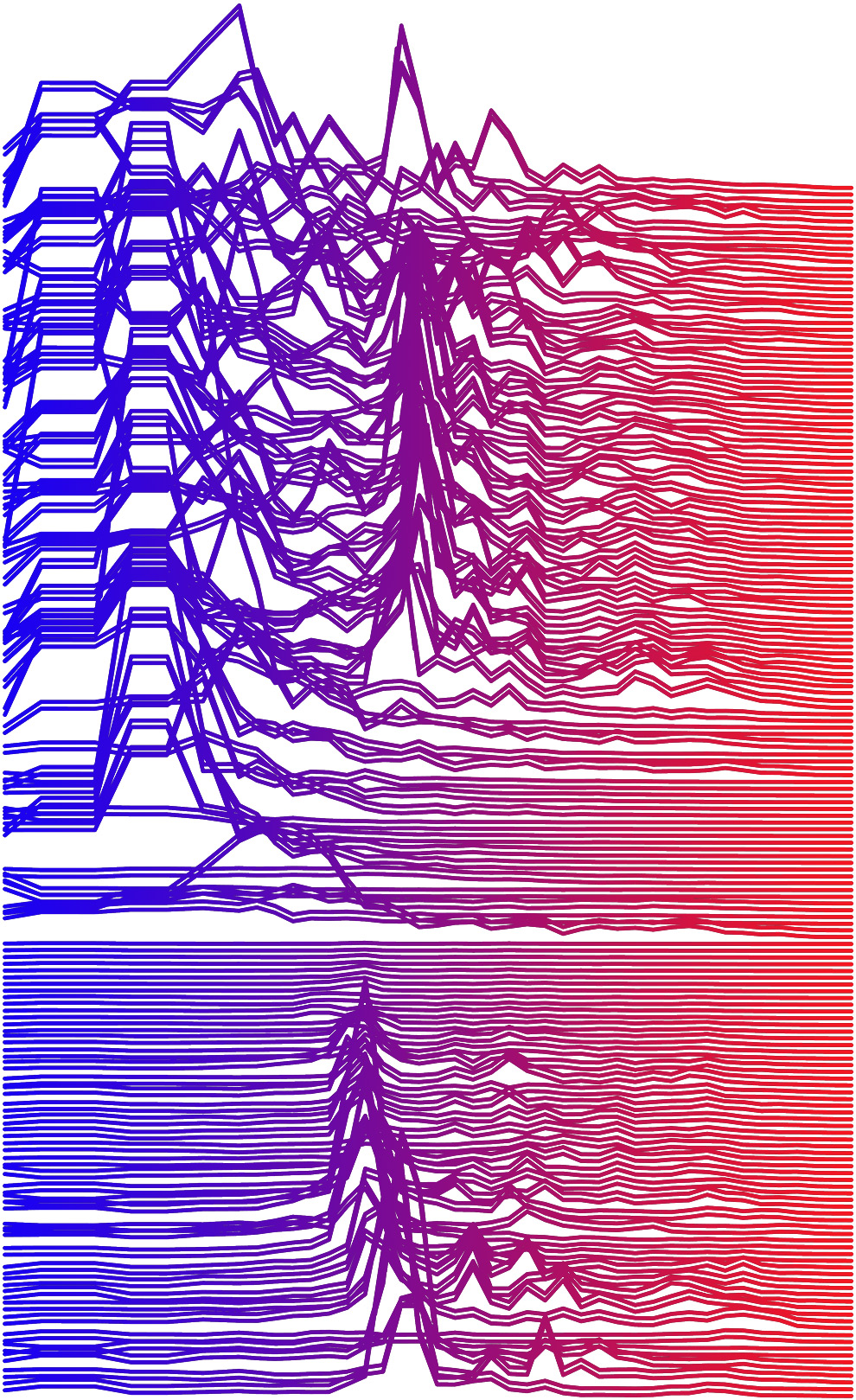
I’m pulling the last 100 tweets from within a half mile radius of latitude 40.800808 x longitude -73.965154 (otherwise known as the desk in my bedroom where I’m typing this now). And right off the bat I can see that the tweeting frequency of some of my neighbors is impressive, out of 100 tweets there were only 42 different users, all of whose profile images are displayed above based on the frequency of their messaging. Voyeurism is something built into New York’s dna, the simultaneous repulsion and attraction of surveillance that was so effectively conveyed in Rear Window. Sometimes when riding the train, on the rare occasions when you’re sans earphones, you can’t help overhearing fragments and context-less snippets of random stranger’s conversation. Most of the time they’re pretty banal, on the order of sports predictions and office gossip, about nothing interesting but still interesting. And that’s what makes the hidden, invisible conversations going on in this five block vicinity so fascinating to me in a way I can’t really describe. 100 random tweets hold no mysteries, but the 100 tweets of the people around me do. A secret knowledge that gives added meaning to the ruby aficionado I see walking down the street or the Mavs fan at the bar, all faces that are part of a huge story that can never end. I’ve started following ThatsOro.


Click more for the code. Based on great examples here and here.


more »

20111231 Tags: graphic design, grasshopper, typography | No Comments »

devilish hairpieces

 
20111029 Tags: mexico, photography | No Comments »

El sistema no es servil

mex01
mex02mex03
Nothing really made much sense, but the ubiquity of groups spontaneously breaking out and dancing was awesome.


more »

2011091 Tags: competition, graphic design | No Comments »

razzle dazzle

razzle02


Inspired by both razzle dazzle camouflage and my middle school trapper keeper, this barrier entry presents a strong graphic face to the street. While the concept of camouflage may certainly seem like a contradictory tact for a protective barrier whose sole purpose is to remain unhidden, by using bold, angular geometric forms to blur the barrier’s edges, this in fact increases its perceived range. The illusory effect of the forms induce nearby traffic to slow down, producing a safer, more bike and pedestrian friendly thruway.


razzle01

20110828 Tags: DUB, fabrication, new york, urban | No Comments »

AR on the cheap

qr001
qr02
qr03


When I first saw this image of my block from the 40s, I knew it was something I wanted to share. Sure, part of it was a sense of pride, that our seemingly nondescript, uptown block once held a moment in time that was deemed important enough for someone to capture. And further, that that historical memory was saved, and became indicative of the history of the subway and the city. Properly fitting amongst a slideshow of once momentous occasions such as crowds cheering with Fiorello at the opening of the 34th St station and documentary photos of the surprisingly frequent automobile on train accidents. But it was also the content of the image.
The included caption was such:

1940: In a view north from 106th Street, only the supports of the old Ninth Avenue elevated line remained as the push to go underground continued.

As the subway ceded elevation in favor of the earth, the Amsterdam avenue elevated train disappeared. I can only imagine the revelation as light and some semblance of uninterrupted silence returned to the street. This image captured a frozen moment of transition, where the elevated train could be either in the act of disassemblage or erection, and with it the hope of revitalization. The newness and flux of urban change was just as relevant then as now, and should serve as a reminder that the present isn’t static and transitions are as true in the New York of 2011 as in 1941. However, that truism seems to have become forgotten in a city where there are now over 25,000 buildings and 100 neighborhoods classified as historic and under the jurisdiction of the NY Landmarks Commission, complete with all the associated zoning regulations and limitations on new building.


The QR code was translated into a laser cut ready file via F.A.T. lab’s QR_STENCILER utility. Using marking chalk, the stencil was painted on the street near to where the original photographer stood in 1941. All in all, this rudimentary, proto-augmented reality was created on the cheap in under four hours.


The removal of the overhead train tracks and the introduction of smart phones in the neighborhood are both changes to be resisted or encouraged. The means of accessibility to this installation are still beyond the means of many people in the area, and as ubiquitous as they may be among some, phones that can read a qr code are still not available to all. In that way, the moment in the original photo and this street marking can define a line through two points, the past and present, collapsed into one and defined by and within the smartphone. The direction and ultimate meaning of that vector is dependent on your own personal point of view. My initial inclination was to create a fantastical image to represent the street in 2081, but that would be devoid of meaning and furthered severed from people’s daily reality. By referring to a historic, shared reality, ultimately then, the means of this technological view of the past is as much of a harbinger of potential futures of the neighborhood as any fantasy image could ever hope to be.


qr04

20110728 Tags: competition, fabrication | No Comments »

light it up

light_02
light_013


With a budget under $300, the installation is realized as a spatial prototype for how a fleeting work can provoke an increased engagement between users and public space. Built with over 200 led lights and conceived to take maximum advantage of a temporarily repurposed historic building, the work becomes as ephemeral as a passing comet, creating a new constellation in the night sky, visible from the streets of Brooklyn for one night only.

2011076 Tags: DUB, fabrication, new york, urban | 33 Comments »

DUB 002

booth_001
booth_002
booth_003
booth_004


Following from the dispiriting failures of 001, 002 proved to be more successful, and not only because of it’s pumpkin orange color, but because it wasn’t cleared of books within 6 hours and the empty shelves themselves weren’t removed after 10 days. I attribute this mostly to an adjustment of tactics and location. Every block has its own subtleties and micro-urban climates, one block is boarded up with for “rent signs” while the next is a thriving pocket of activities and street-level engagement. By moving to a location 8 blocks further south, 002 was placed nearer to a major thoroughfare – 96th street – and received a more steady stream of mixed pedestrian traffic leaving the express train stop on Broadway and by virtue of being closer to street level retail (a large CVS), educational (a school and church) as well as the residential apartments along 97th street. 001 just didn’t get enough foot traffic and frankly felt deserted. I thought being near a hostel and school would generate some interest, but the hostel is an imposing Victorian Gothic structure with a decidedly prison-like bent reflecting its previous use as a nursing home for “Respectable, Aged and Indigent Females” and unsurprisingly generates little sidewalk traffic and even less urge to stop and inspect some books in a phone booth.


In an attempt to encourage sharing and free distribution of the initial selection of books, I didn’t mark the books in any way. But in lieu of the entire initial selection of 001′s books being carted off within a few hours, I tested out being more explicit and treating the books more like a library. Almost like a Dewey decimal number taped to the spine of a library book, I added a visible logo to the bottom of each spine. I hoped this would prevent the books from easily winding up in the hands of sidewalk book resellers, but I fear that the marking implies an ownership that prevents a casual exchange of taking and leaving their own books. I observed a number of people reach out and pick up a book, flip through it, but then return it to the shelf. Some even doubled back for a second look and to engage in a closer inspection of the shelves, but they still refrained from actually taking a book. Perhaps feeling hesitant to, I don’t know, steal/vandalize (irony) something that’s out in public? I can see how there might be a stigma there, to not just keep walking straight along the sidewalk with your head down, but to stop and engage with the street. I intentionally wanted to avoid any directions, like a sign that would say something along the lines of “hey this is for sharing books, you can leave some here” and I still want to avoid anything that seems overtly prescriptive, but after seeing people hesitate when confronted with 002, perhaps there is a more subtle way to gently describe an intended use.


Even as they are rendered obsolete by the ubiquity of smartphones, I’m interested in pay phones because they are both anachronistic and quotidian. Relics, they’re dead technology perched on the edge of obsolescence, a skeuomorph hearkening back to a lost shared public space we might no longer have any use for. Something to be nostalgic for, in the way I can’t think about a phone booth without conjuring up images of an old, impatient woman banging on the door to one while I was inside using a calling card to ask for money. And of course they are nuisance, basically pedestrian level billboards that only blight certain neighborhoods (good luck finding a payphone in Tribeca, while there are eight separate phone kiosks on one block between 108th and 109th streets and Columbus Ave). But they can also be a place of opportunity, something to reprogram and somewhere to come together and share a good book with your neighbors.


All the books were donated by local residents and the plywood was milled by Kontraptionist.


dub_diagram
more »

2011065 Tags: evolution, grasshopper, parametric, research | No Comments »

bucky was right

design-space_galapagos
grasshopper galapagos
galapagos_results


I’ve used genetic algorithms for form finding with a previous project, and that time I was using a tenuous connection between catia, modeFrontier and Robot. So I was excited to see grasshopper begin to natively implement an evolutionary solver with Galapagos. As an initial experiment I started with a classic, something simple – I wanted to find a tessellated form that would enclose the maximum volume using the smallest surface area. I’d like to think that this would produce something unexpected, but it’s pretty much the definition of a sphere. I set up the parametric model to wiggle all over the place with various triangulated densities and differing number sided polygons at each joining segment. My hypothesis was that the form would tend toward symmetry and evolve into the aforementioned spherical shape. I believed that the polygons would tend toward the most sides possible to more closely approximate a circle, later generations evolving away from a triangle toward an icosagon. (Just like on Flatland!)


A couple of observations: Galapagos pretty quickly found the overall shape – smaller radii at the extremes and bulging in the middle – the beginning of a sphere. However, while it tended toward bilateral symmetry, it kept a kink in the first segment that prevented the shape from being perfectly symmetrical. I think the solver got stuck in a local minimum as opposed to a global minimum. Perhaps with a higher mutation level or letting it run for a longer amount it could have jumped out of this. On further checks I found that it was correct, after 30 generations and over 2500 iterations, the surviving croissant-like shape of the optimal designs did have a better SF:V ratio than a perfectly symmetrical design. Perhaps it had something to do with the setup of the parametric model or the way the facets resolve themselves at the extremities?


But in general my hypothesis was proven correct. Which leads to the initial problem with Galapagos. There are a lot of opportunities with this type of experiment and people more clever than me will surely do them, but when you can only solve for one objective it becomes difficult to create truly complex solutions. For instance, with my surface area/volume problem there is only one true pareto solution. Eventually Galapagos will find it, or with enough time and a calculator I could calculate this myself. There is one single, optimal solution, it’s just hidden somewhere amongst a number of parametric sliders. Unless you start getting into multiple, competing objectives, then the pareto point becomes a curve and there are multiple valid solutions, each one involving certain trade offs and a criteria for selection. Say you wanted to find a form with the minimum srf area:volume ratio, but also that form had to have the fewest structural members, or provide the most shade on June 21st, or spatially provide the most potential revenue stream for a project stakeholder. That’s when it gets really interesting and opens the possibility for a design space that includes high performing, unexpected results. It’s a great start, and I can’t wait to see Galapagos evolve.


Download the grasshopper definition for version 0.8.0004 here: http://gracefulspoon.com/downloads/Grasshopper_GALAPAGOS_TEST.rar

20110524 Tags: DUB, fabrication, new york, urban | 2 Comments »

DUB 001A


dub_booth_01
dub_booth_03
dub_booth_02


Reappropriating anachronistic messaging infrastructure (which are really just props for pedestrian scaled billboards) into something potentially more useful. In this case a community book drop.


diagram_05
more »

20110514 Tags: architecture, fabrication, graphic design, work | No Comments »

the future of suburbia

signs01
signs02


In a remarkable piece from New York magazine regarding the liberal world’s MVP, Paul Krugman, the author described the genesis of Krugman’s 2006 book:

When he was writing The Conscience of a Liberal, Krugman found himself searching for a way to describe his own political Eden, his vision of America before the Fall. He knew the moment that he wanted to describe: the fifties and early sixties, when prosperity was not only broad but broadly shared. Wells, looking over a draft, thought his account was too numerical, too cold. She suggested that he describe his own childhood, in the middle-class suburb of Merrick, Long Island. And so Krugman began writing with an almost choking nostalgia, the sort of feeling that he usually despises: “The political and economic environment of my youth stands revealed as a paradise lost, an exceptional moment in our nation’s history …”


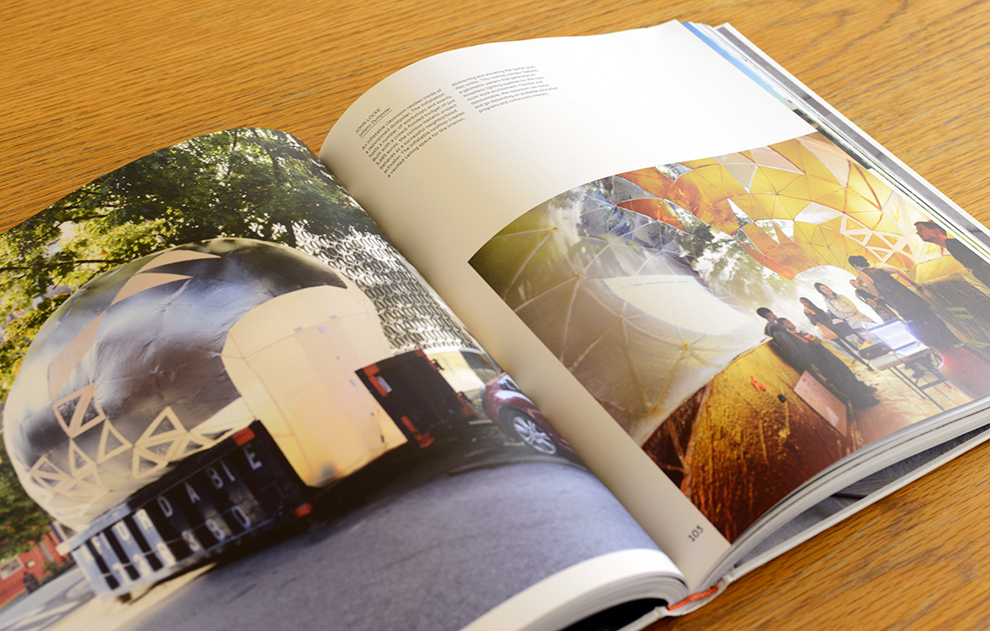
Krugman’s own vision of a lost utopia on Long Island, during that bright post-war bloom of middle class prosperity, which must have had seemed so full of limitless potential and opportunity but somehow lurched toward our current state of contraction, pulled apart and forgotten by the twin poles of unimaginable wealth disparity, was at the front of my mind when I had the awesome opportunity to manage this project from David Benjamin and the Living. This was House #7 of nine theoretical projects that comprised part of a one-day only open house installation on the future of suburbia, a what-if, hyper-fictional reality showing design’s potential to provoke and elucidate a hypothetical path forward hosted by Droog and DS&R.


Conceived with the ingenuity of hybrid housing/service industry residences seen in Tijuana and rendered with the graphic intensity of Chinatown, David’s concept called for a home that is both a store and factory for making and selling signs. The factory is an inhabitable sign in and of itself, and the facade of the house is taken over by examples of constructed signs. As more and more Levittown residences convert to self-sustaining home businesses the House of Signs positions itself as an integral piece of future suburban infrastructure. We went from concept sketch to exhibition in less than 10 days.

2011057 Tags: competition, graphic design | No Comments »

high five, or: no brushes needed

conccanvas
A mural designed for a competition as part of a public art/farm space in the Bronx. The design started simply enough, with a walk through the Bronx and seeing the message “being great is the best revenge” scrawled across an abandoned mattress. The sentiment seemed to aptly sum up the spirit of possibility and potential inherent in every one us that has ever been underestimated or ignored. This led to the method of application of the message – not with paint on brush, but rather by paint applied directly via the volunteer’s hand, slapped down with conviction on the concrete canvas. Each unique creator becomes part of the final composition, through an emphatic gesture that is sometimes messy, with colorful fingerprints and palmprints merging together and breaking out of the geometrical lines of the fonts. The mural and painting technique will unite all those that volunteer and create a lasting memory of community togetherness.


I finished as a finalist, congrats to Oscar Lopez for a great winning entry.

2011046 Tags: china, photography | No Comments »

cctv @ HdeM

cctv01b
cctv02b


Spurred by a recent archinect post in light of the indefinite detention of Ai WeiWei, an artist who briefly collaborated with Herzog and deMeuron on the pictured Bird’s Nest in Beijing before very publicly denouncing the project (as well as the pretty much the whole Beijing Olympics show in general), it brought up Jacques Herzog’s defense of his design and accepting commissions in China, and how events have proven him to be either insufferably cynical or just hopelessly naive. I happen to lean more toward the former. His quote:

We see the stadium as a type of Trojan horse. We fulfilled the spatial program we were given, but interpreted it in such a way that it can be used in different ways along it perimeters. As a result, we made everyday meeting places possible in locations that are not easily monitored, places with all kinds of niches and smaller segments. In other words, no public parade grounds.


These images are from a 2009 trip to Beijing and show that his niche spaces can certainly have the potential to be used for alternative uses, but no matter how over-structured, complex or well-intentioned, that use will always come back around to one mediated by parasitic cctv cameras and a surplus of ever-watching, ubiquitous guards.


more »

20110225 Tags: competition, graphic design | No Comments »

a city of private eyes

barrier011

barrier02c


For a jersey barrier competition submission, we started with an iconic New York quote from Agatha Christie as indicative of the city: “It is ridiculous to set a detective story in New York City. New York City is itself a detective story,” and played off the recurring themes of mystery and dual meanings inherent to the make-up of our city. New Yorkers strive to challenge themselves, whether by running through the park during the marathon or following their career dreams, and we wanted to elevate something that is typically a solitary challenging act pursued underground in the subway – solving sudoku puzzles – to the street level, making it a communal, shared act. The design then works simply on two levels, as both a reflection of the city, and at the smaller scale, of the acts that makes New Yorkers such apt problem solvers.


The design will be quick to apply. Using only a limited color palette and a repeating stencil system, we will be able to economically create a bold, colorful graphic statement that will encourage all those that walk, bike, and run by the barrier to think about and interact with their great city.

« Older Entries

COPYRIGHT © 2004-2012 \ JOHN LOCKE \ ALL RIGHTS RESERVED (RSS)

TOP OF PAGE

last update: 20111204:2255