JOHN LOCKE

  • Featured Work
  • Design Blog           
  • Photography
  • Graphic Design
  • Lion in Oil

About

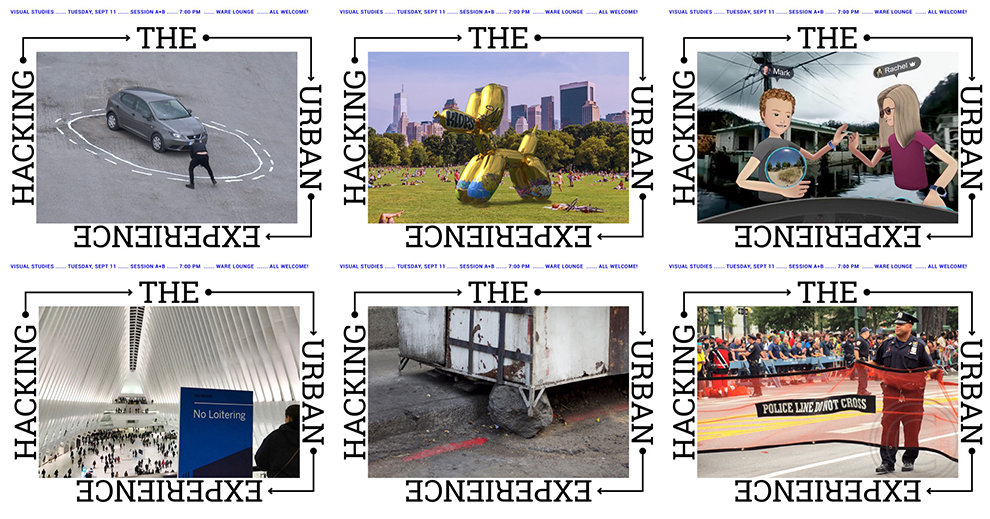
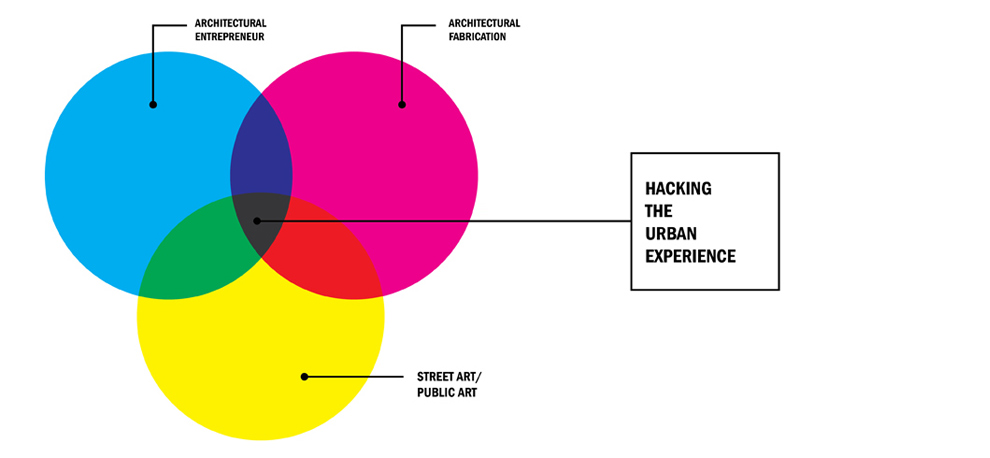
Hello. I live in New York and work at RMA. I hold a graduate degree from Columbia University's GSAPP and an undergraduate architecture degree from the University of Texas at Austin. I have more than six years of combined professional experience at both SOM in New York and Randall Stout Architects in L.A . I also tackle freelance graphic and photography work with my partner in crime, the multi-talented Jackie Caradonio at Lion in Oil. In addition, I teach a course, Hacking the Urban Experience, at Columbia. View my CV here: CV(html) or CV(pdf) . Thanks and have a nice day.

Contact

john.h.locke{at}gmail.com
310.735.3333

Architecture Portfolios

Portfolio 2002-2007 (issuu)
Portfolio 2008-2009 (issuu)

HOME / BLOG

interaction

20130520 Tags: fabrication, gsapp, interaction, new york, research, teaching, urban | No Comments »

HACKING THE URBAN EXPERIENCE III – STUDENT WORK


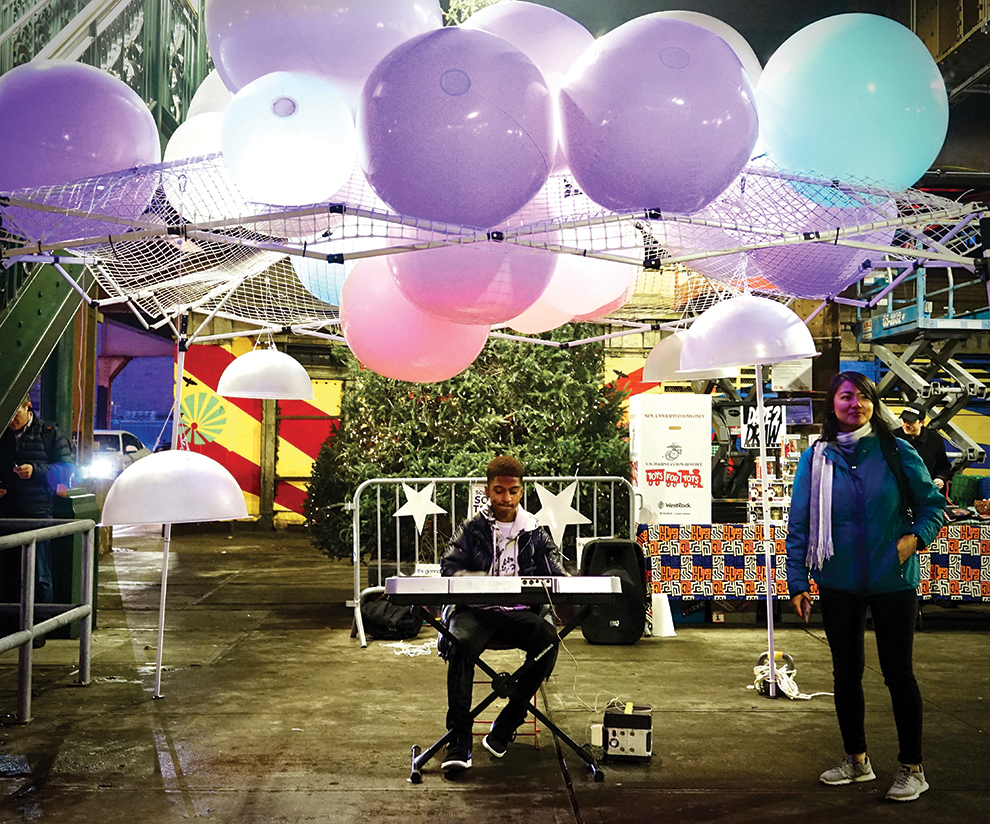
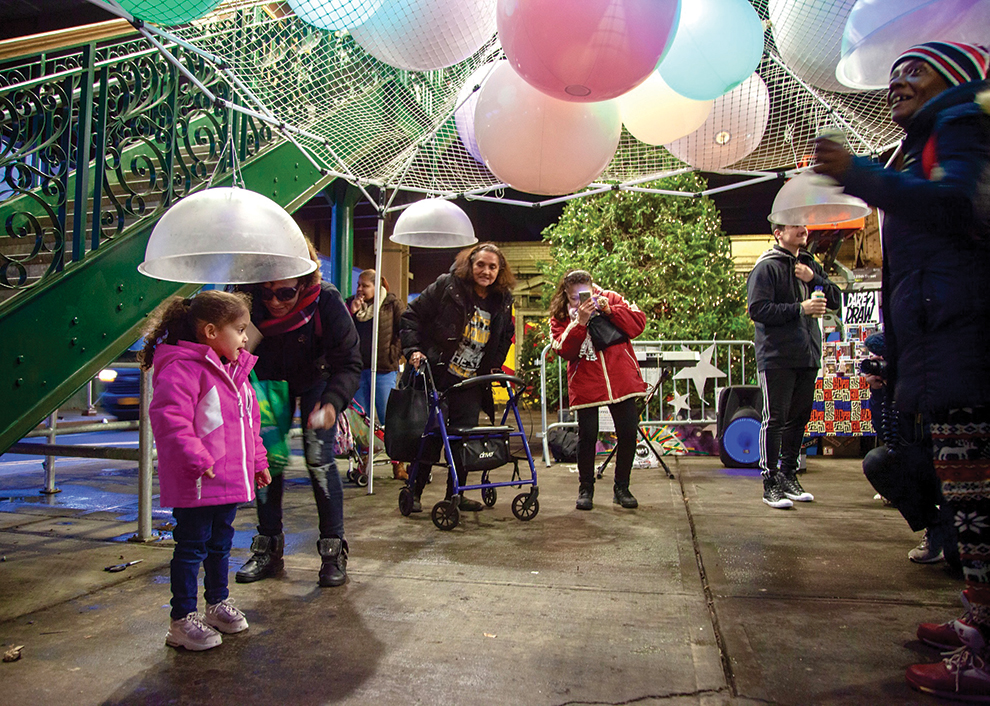
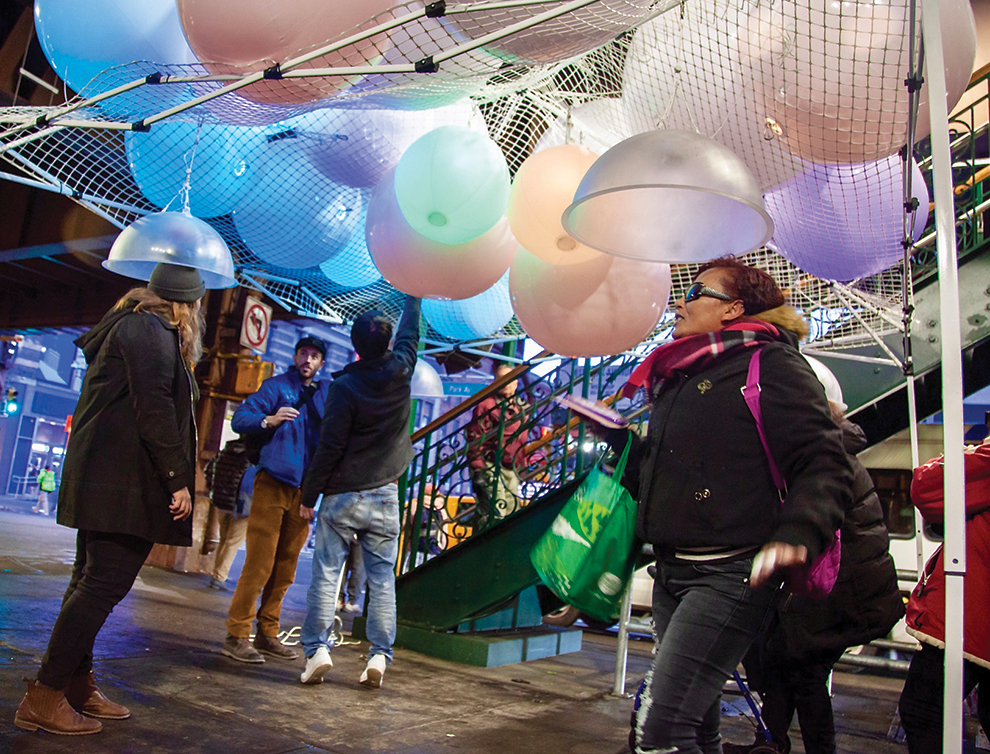
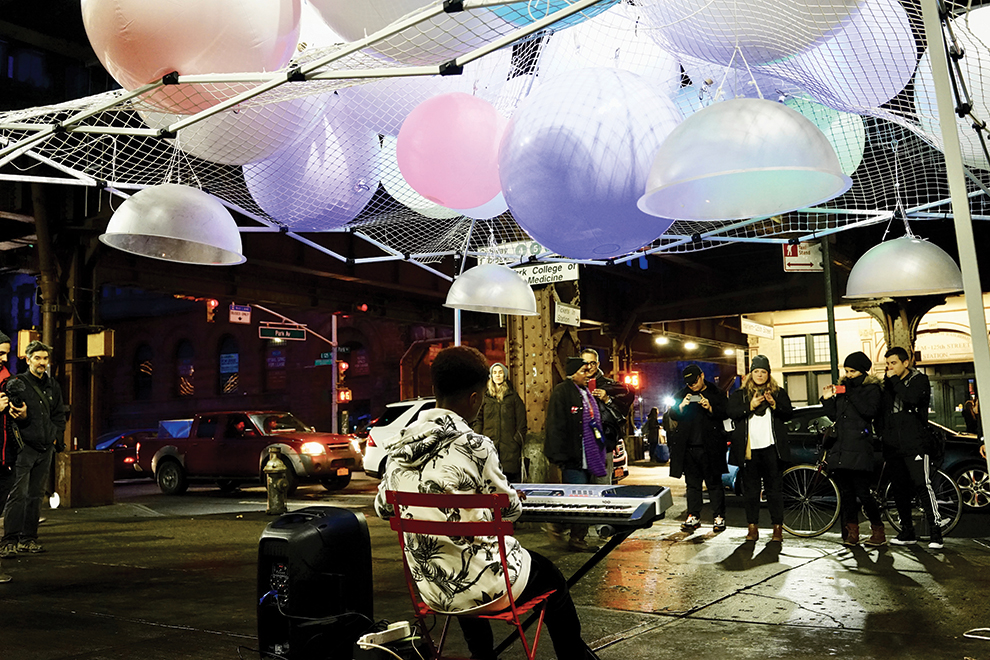
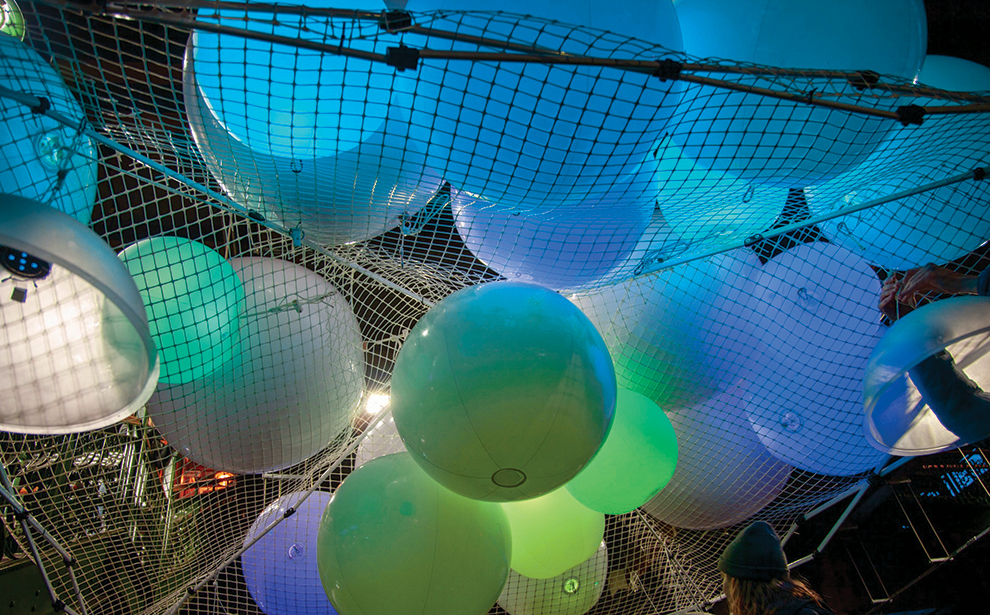
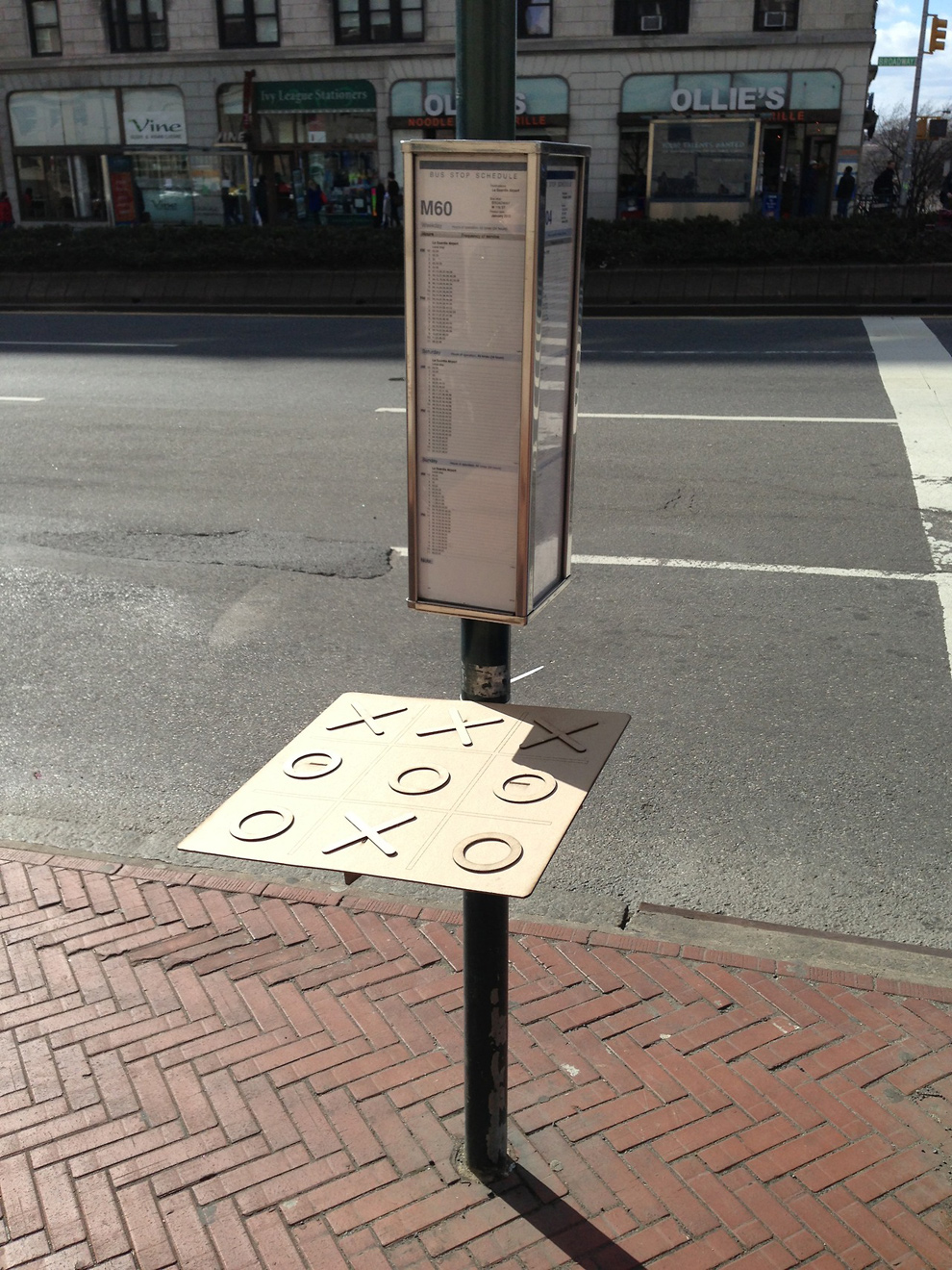
While my natural tendency can lead toward convolution, in the interest of concision here is my attempt to sum up the course objectives in one sentence: “to self-initiate and identify a problem statement relating to the urban environment, and then manifest a possible solution through a public, physical object, while confronting the myriad issues associated with that decision.” Problems addressed included the notion that strangers occupying proximate space are too disconnected – how can you encourage interaction? As well as the problem of physical space inducing a heightened sense of agitation during a stressful time (finals on a college campus) – how can a space be created that produces an alternately playful, soothing affect for passersby? So with that, here’s a sampling of self-initiated work from the third iteration of HTUE.


See previous work and extensive course descriptions here:
Hacking the Urban Environment II – Student Work
Hacking the Urban Environment I – Student Work


All images and work by students Amir Afifi, Hanxiao Yang, Marielle Simone Vargas, Wilbur Lee and Will Chen


Assignment 01 – PARASITES


Assignment 02 – LIGHT PROJECTION


Assignment 03 – FINAL

2013014 Tags: architecture, fabrication, interaction, new york, research, teaching, urban | No Comments »

HACKING THE URBAN EXPERIENCE II – STUDENT WORK

I spent a second semester with a great group of young architects, urban designers and planners teaching a course at Columbia. The class was titled “Hacking the Urban Experience” and was about a number of things I’m interested in, specifically how to fabricate, repurpose and interact with urban space. It was a very good short semester and I was super proud of all of the student’s work. I thought the ideas went deeper and successfully built off the earlier semester. All lectures and process work are archived on the class tumblr: http://hackingtheurbanexperience.tumblr.com. Classes typically took the form of lectures on precedents and concepts, a discussion of student work and tutorials on materials or software techniques as required. Topics during the semester included overviews of unsolicited architectural proposals, building-scale light projections, inflatable materials, urban siting opportunities and community/crowd sourced funding.


Course Description
The course goals haven’t changed dramatically since the last semester, the course still seeks to assert the relevance of the fabrication tools at our disposal as potentialities for social and environmental relevance. Through the re-appropriation and re-imagining of existing urban conditions, the student will design and fabricate a working prototype that embraces the messy reality of our city and promotes community involvement. The student will begin by identifying a quality of the urban condition that includes the latent capability for improvement and work toward fabricating an adaptive, responsive and environmentally viable solution. Specific emphasis will be placed on testing and exploring through hands on research the possibilities of detailing and fabricating connections using unorthodox materials. At the conclusion of the course the student will produce a full scale urban intervention and observe and document their relevant successes or failures.


Workshops were conducted to introduce the students to the possibilities inherent in new material technologies, through production and detailing techniques, and the proper use of fabrication techniques. Material workshops encouraged students to explore with everything from dynamic, variable surfaces using latex and silicone to parametric agglomerations using quotidian materials.


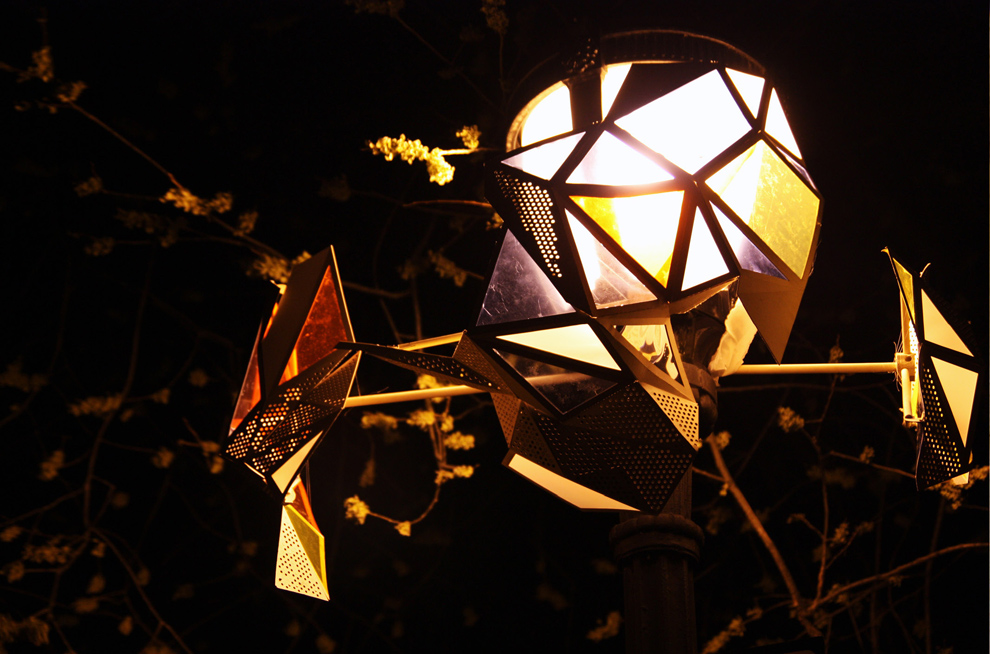
The first investigation was the creation of the connection detail. It was encouraged that this be a parametric joint that breaches the gap between the existing streetscape and the student’s intervention. Flexibility, safety, durability, adaptability will all be tested while exploring different possibilities for a potential synthesis with existing urban forms, examples of which can include: will the student’s intervention clamp on to a lamppost, hang from a phone booth, project from an existing building or rest in a parking lot?


By attempting to capture a broader audience for architectural interventions, a number of questions presented themselves and the student was challenged to anticipate possible eventualities – how will it be used? Can its use be changed? Is it durable? Is it waterproof? Can it safely stand up? Fabrication was considered less from a formal quality, and more from a use, durability, improvisation and public participation viewpoint.


Ultimately the student should have come out of the course with a healthy respect for two core concepts: Firstly, an increased skill in the use and applicability of the fabrication machines we have at our disposal for solving design issues using unorthodox materials in unconventional settings; and two, that there is an opportunity for architects to regain lost relevance by inserting themselves through unsolicited proposals into the public consciousness as steward’s of urban well being.


Assignment 01 – PARASITES
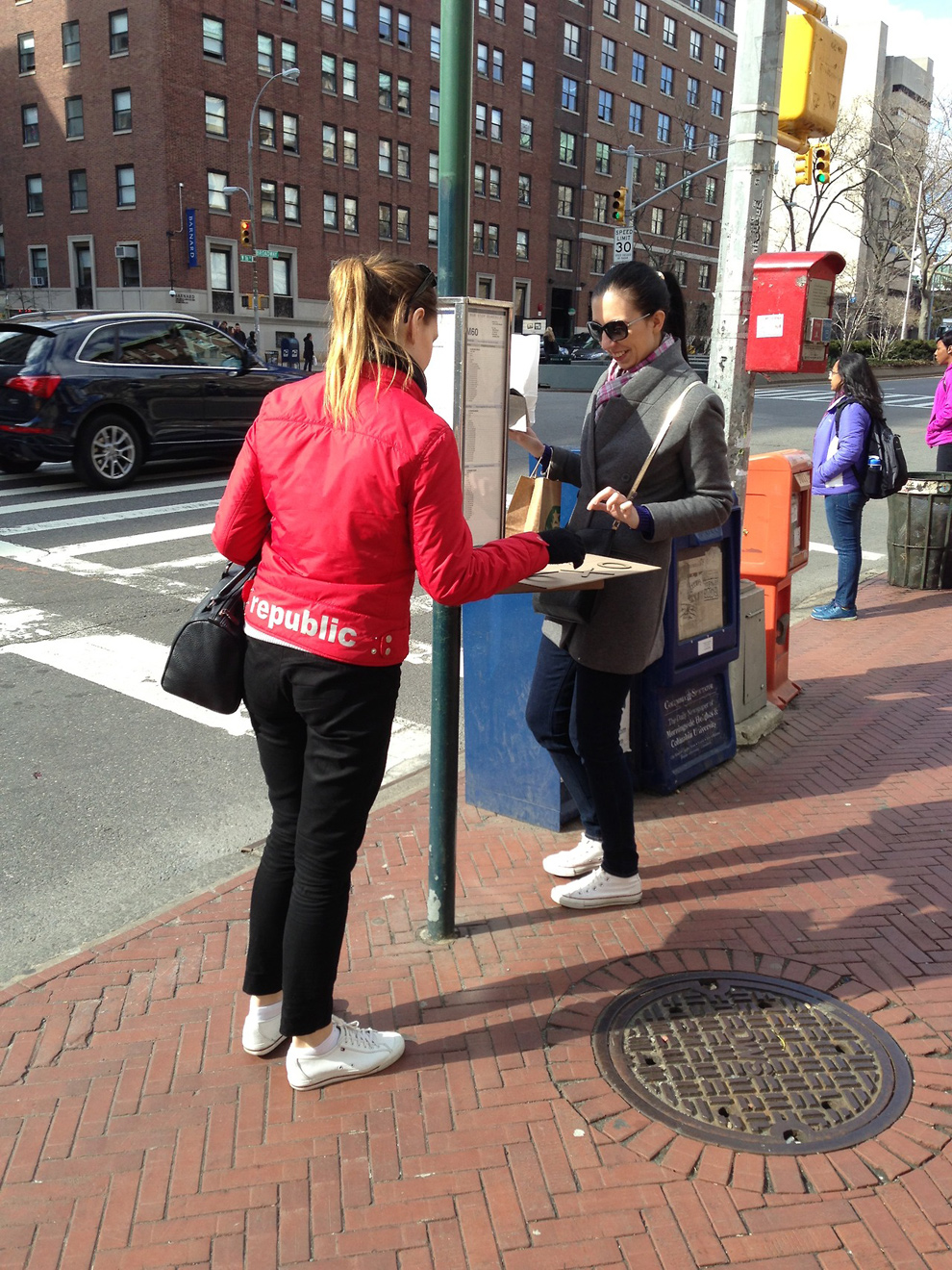
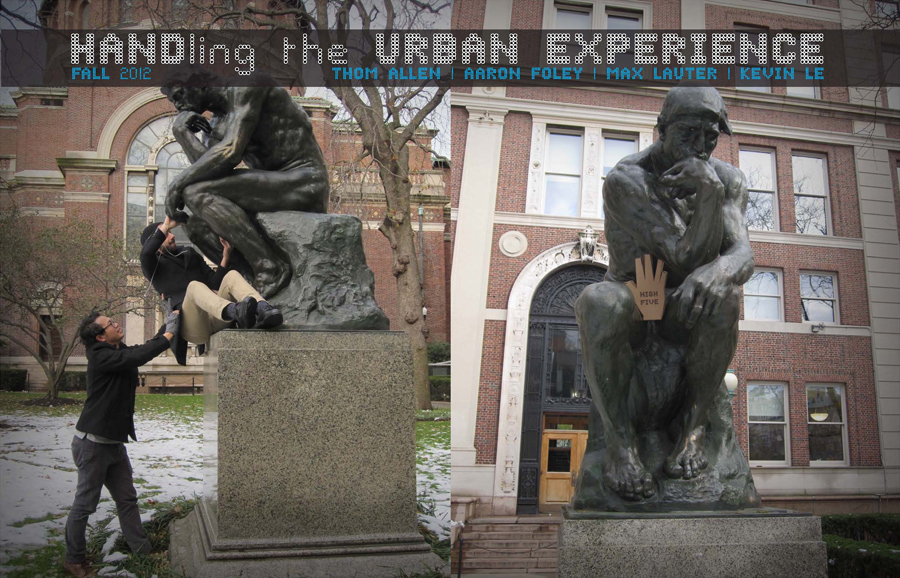
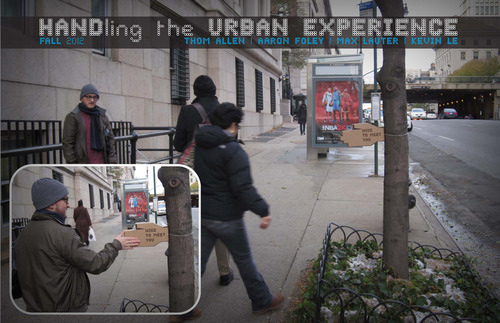
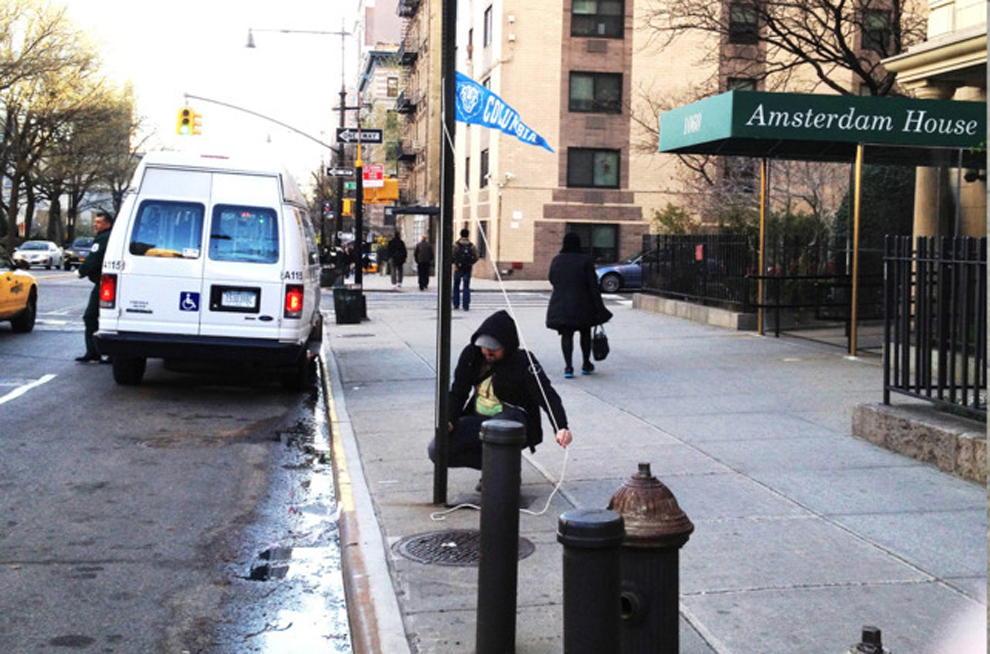
Part of the Atlas of Urban Connections project (TBD), the first assignment involved designing and fabricating a joint to connect something, anything, to a vertical street extrusion (such as a tree, street sign, light pole, etc…). The members of the Public Works Department in NYC are masters of improvisation, you can see it walking down any street here, and there is a lot to learn from their successful and not-so successful techniques for attaching to existing sidewalk infrastructure. This assignment was prepared to introduce the student to the capacity to breaching the gap between the pedestrian and existing streetscape objects, with the goal to test flexibility, safety, durability, adaptablility while exploring different possibilities for potential synthesis with existing urban forms.


Tom, Aaron, Max, Kevin


ChunChun, Yuri, Shuang, Rubing, Renwick


Assignment 02 – INFLATABLES
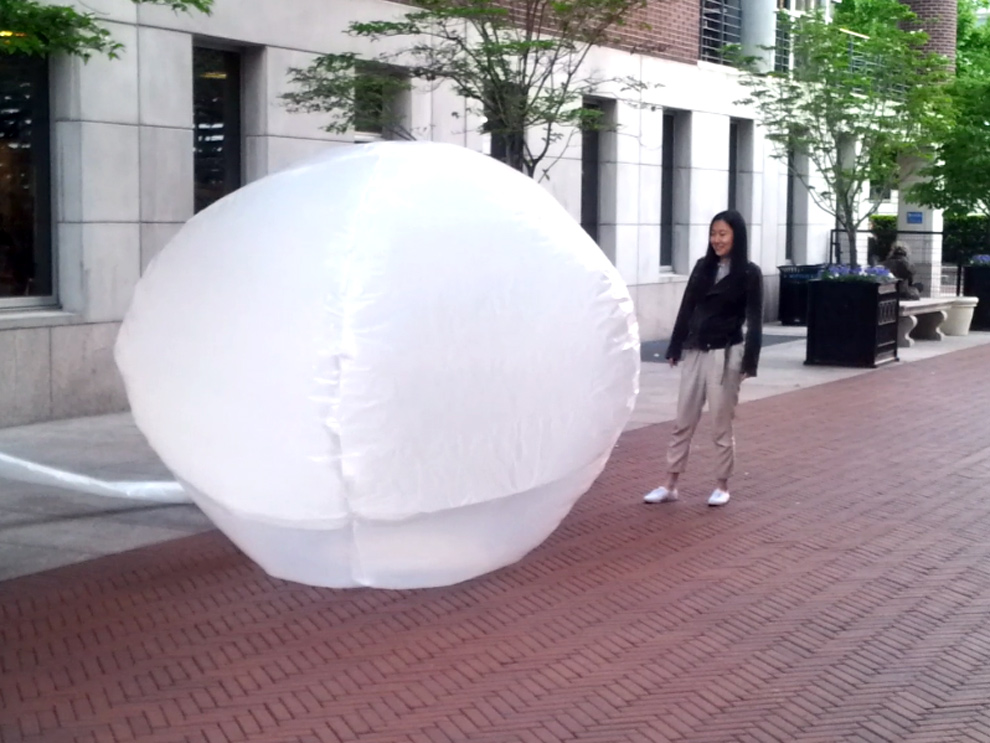
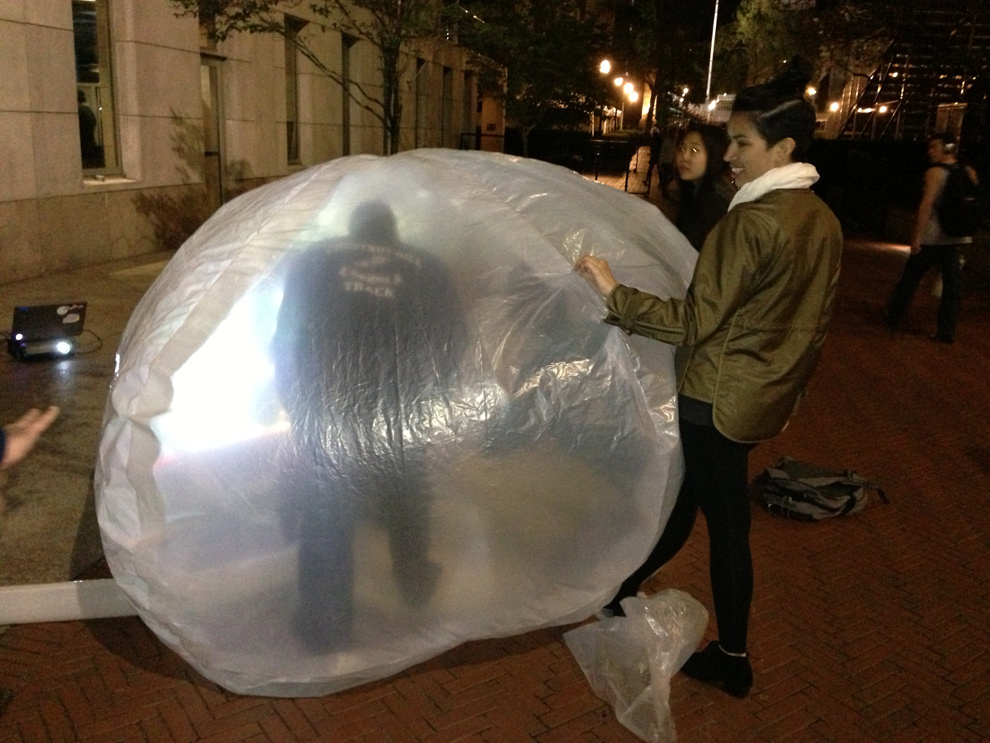
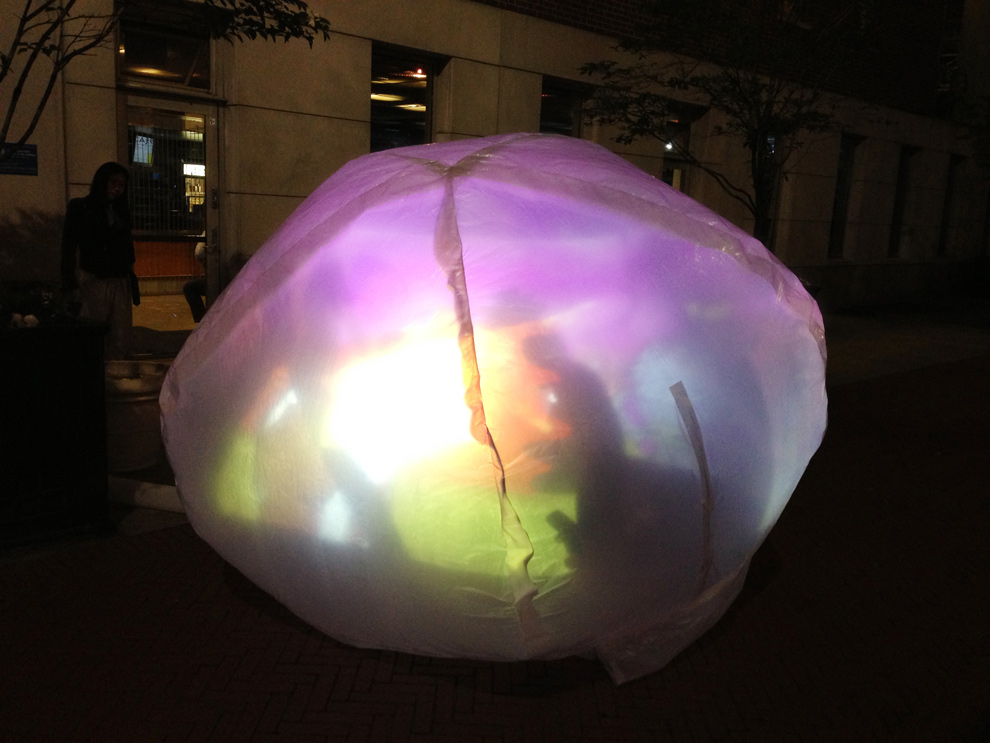
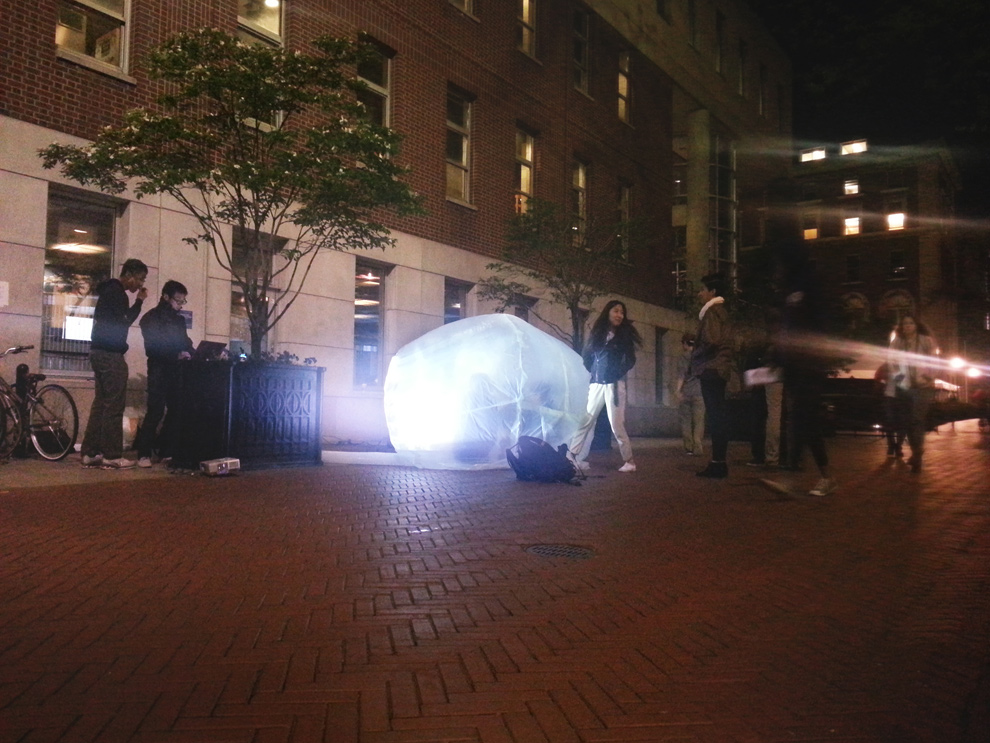
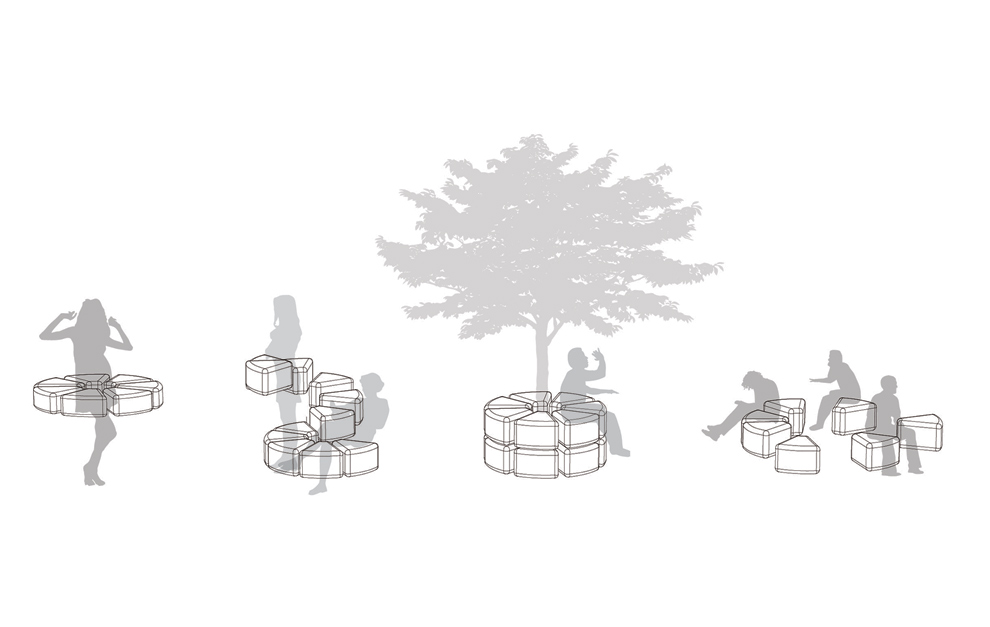
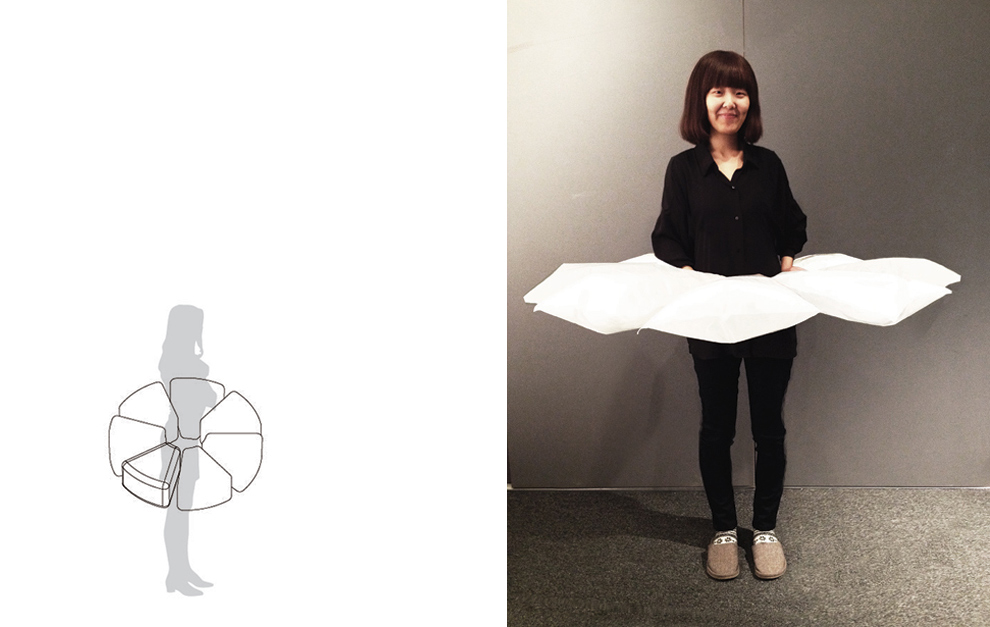
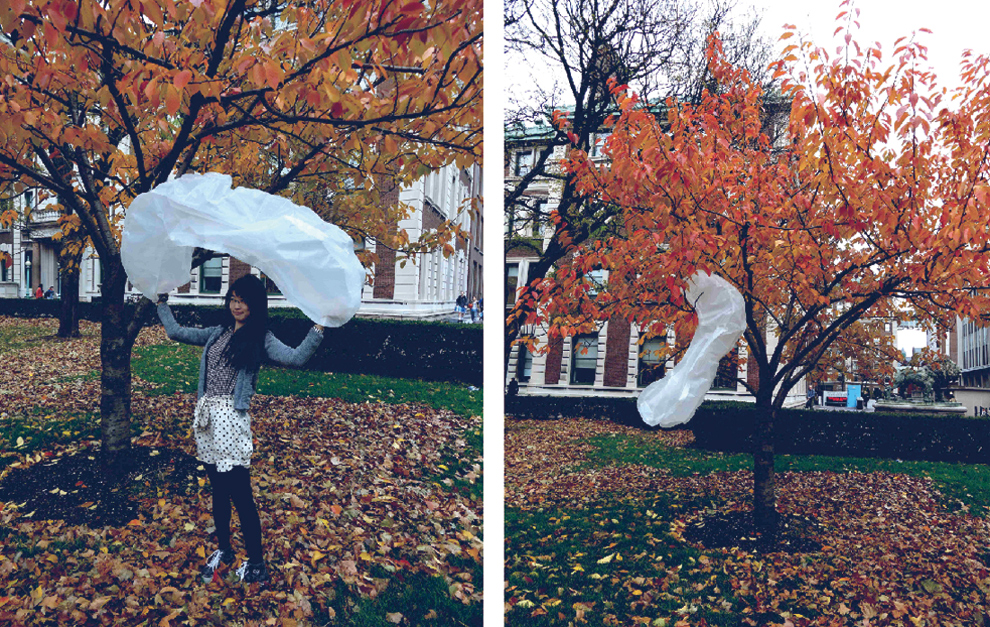
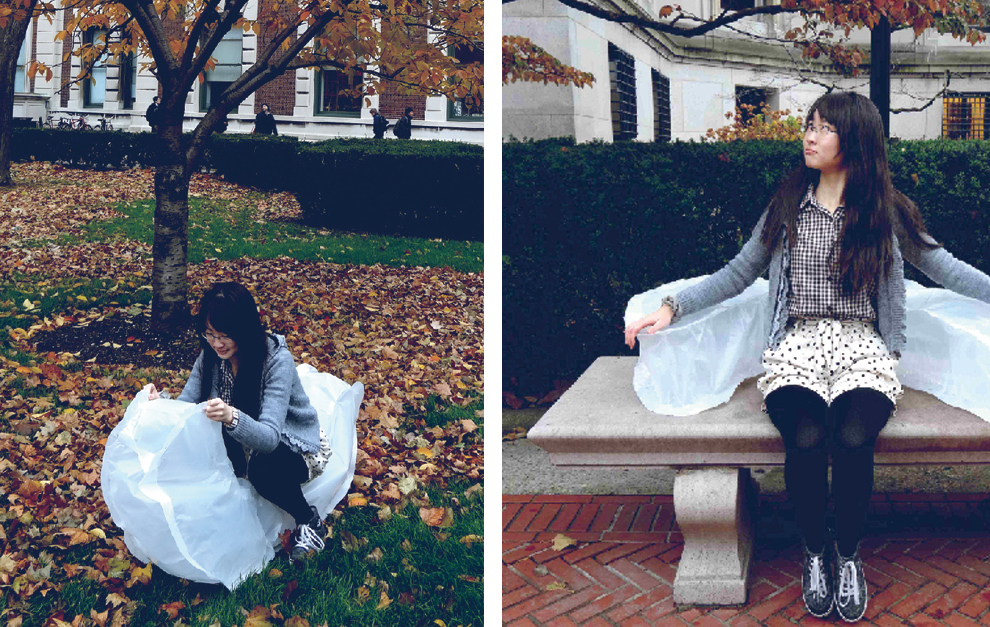
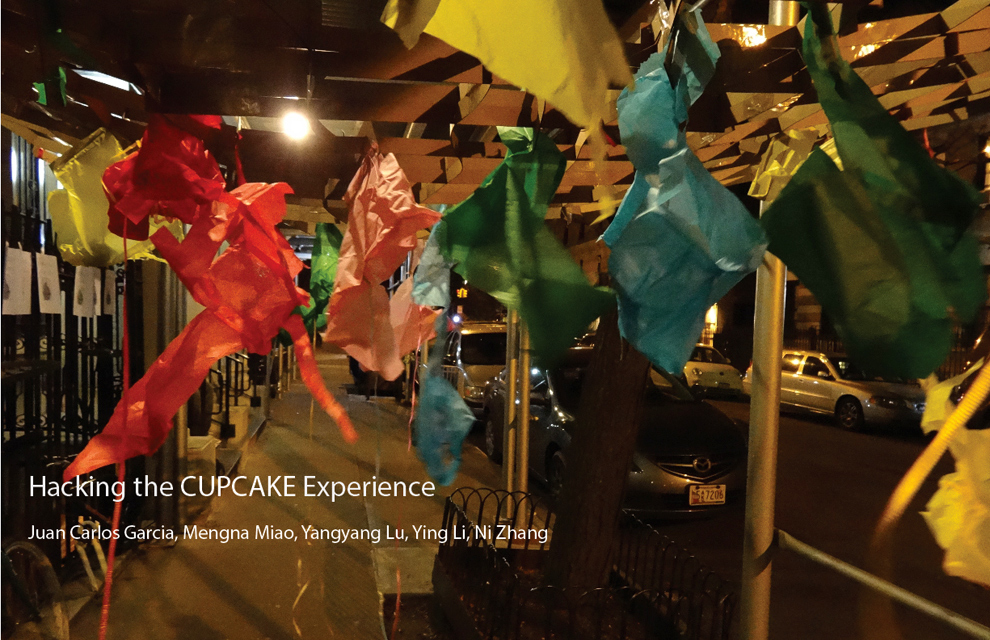
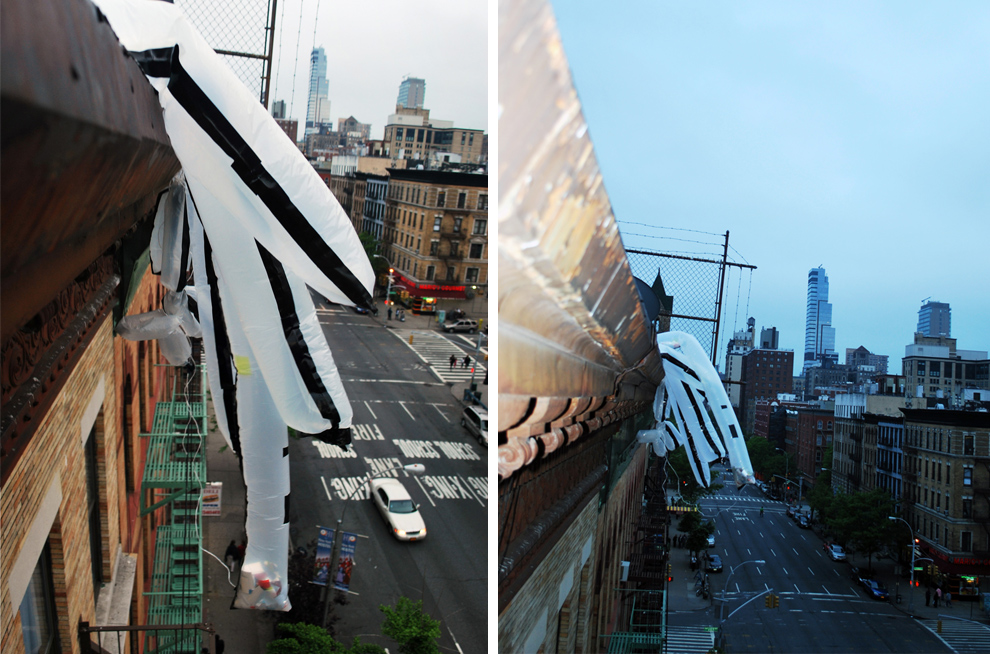
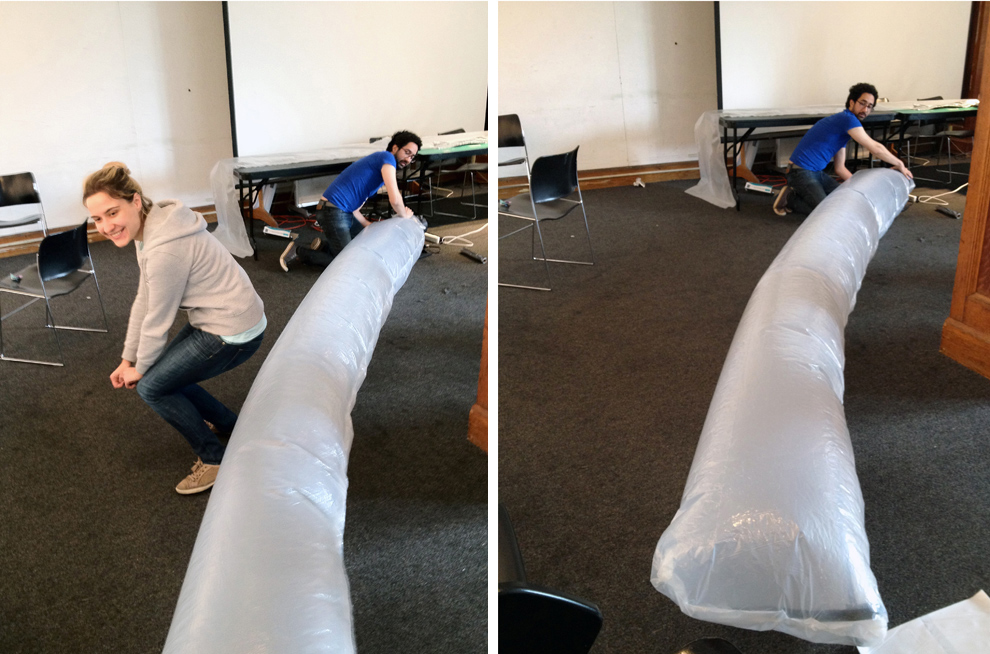
Hurricane Sandy played hell with our first few weeks, and necessitated that the initial assignments were bundled together. However, we still had a chance to look at inflatables and the material qualities inherent in cheap polyethylene of different mil thickness. Using an iron, tape and plastic, quick inflatable bladders were constructed and tested. The students were tasked with creating an inflatable, mobile “seating” system that was either self-supporting or used a site’s natural currents to inflate.


ChunChun, Yuri, Shuang, Rubing, Renwick


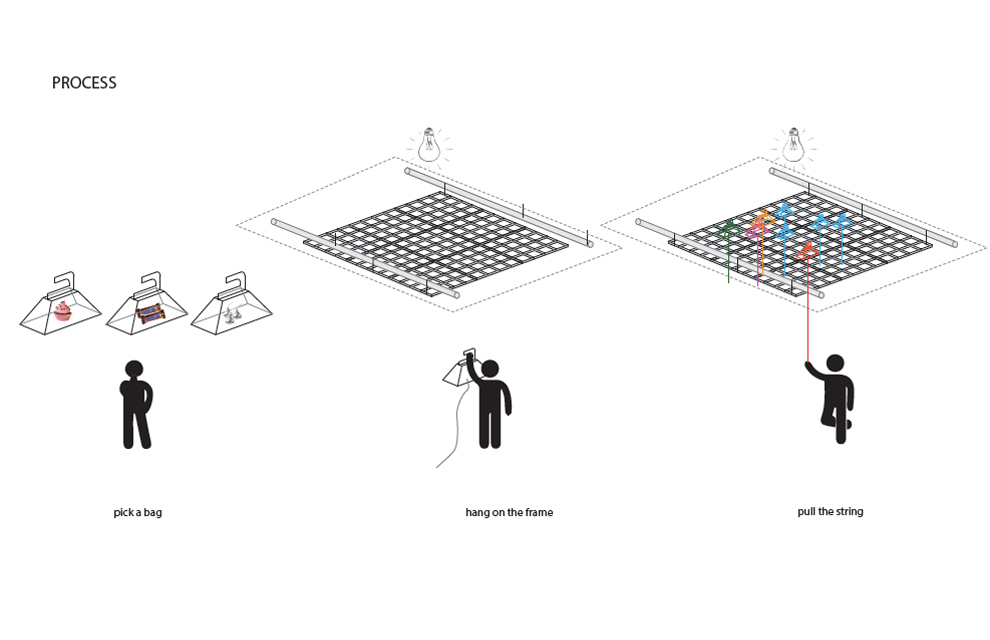
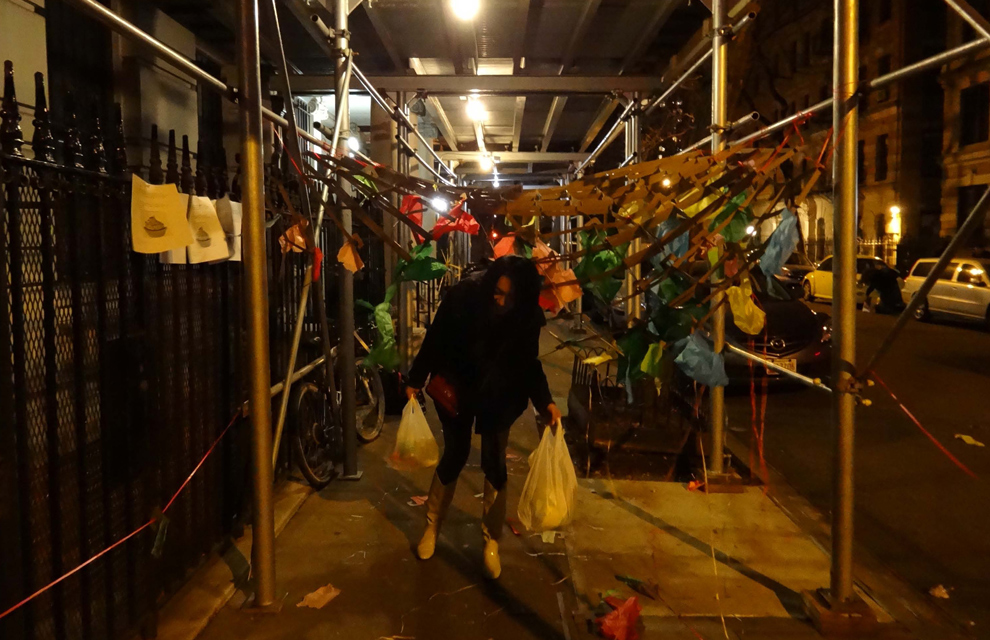
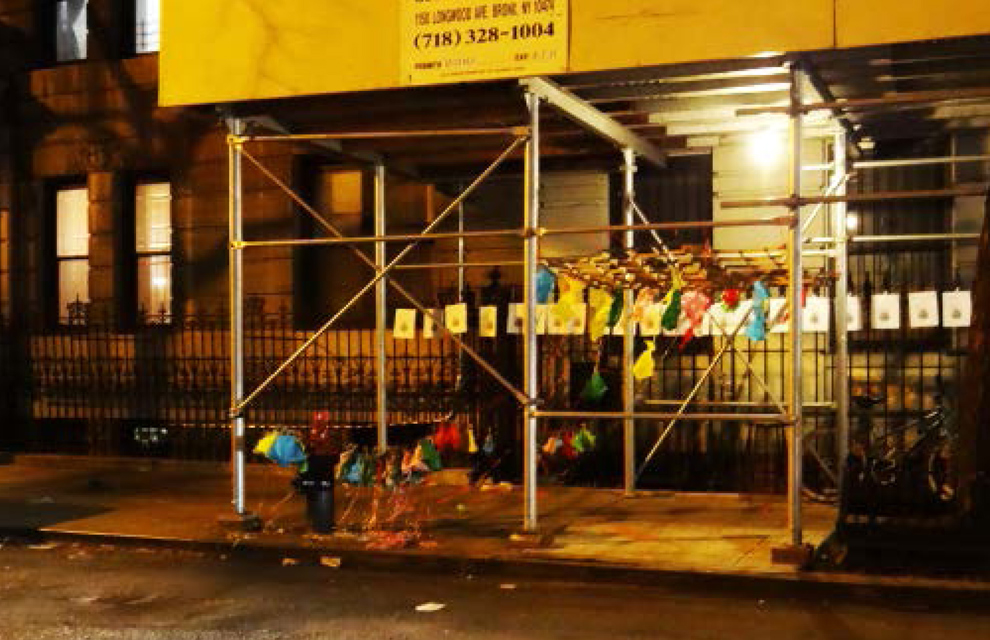
Ni, Mengna, Darian, Juan, Ying


Assignment 03 – LIGHT PROJECTION
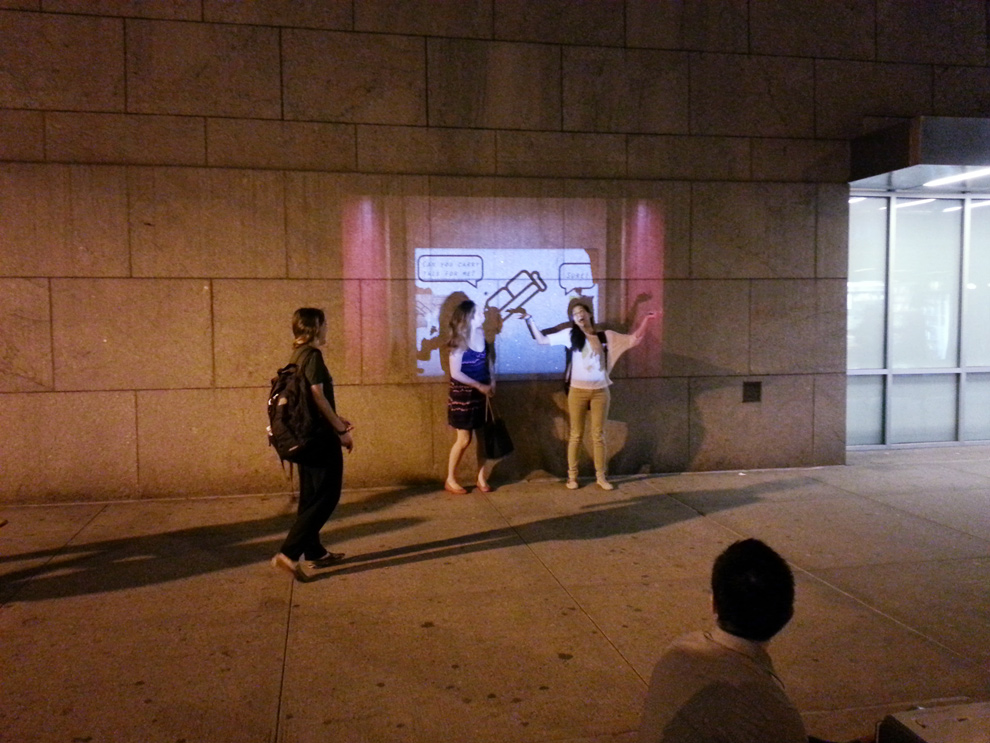
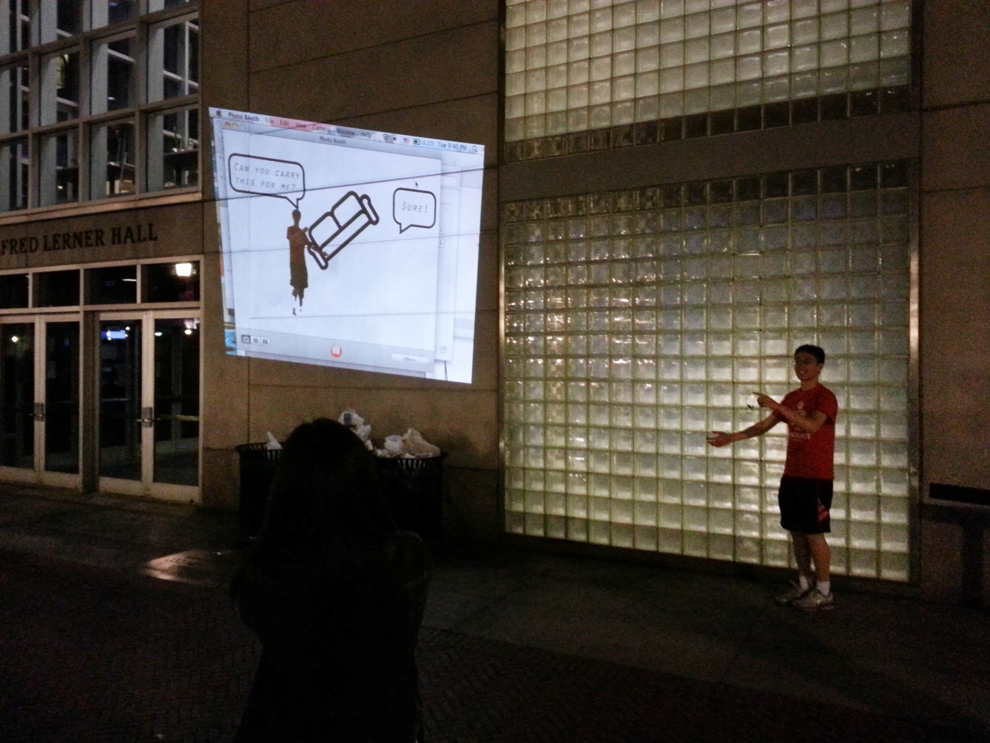
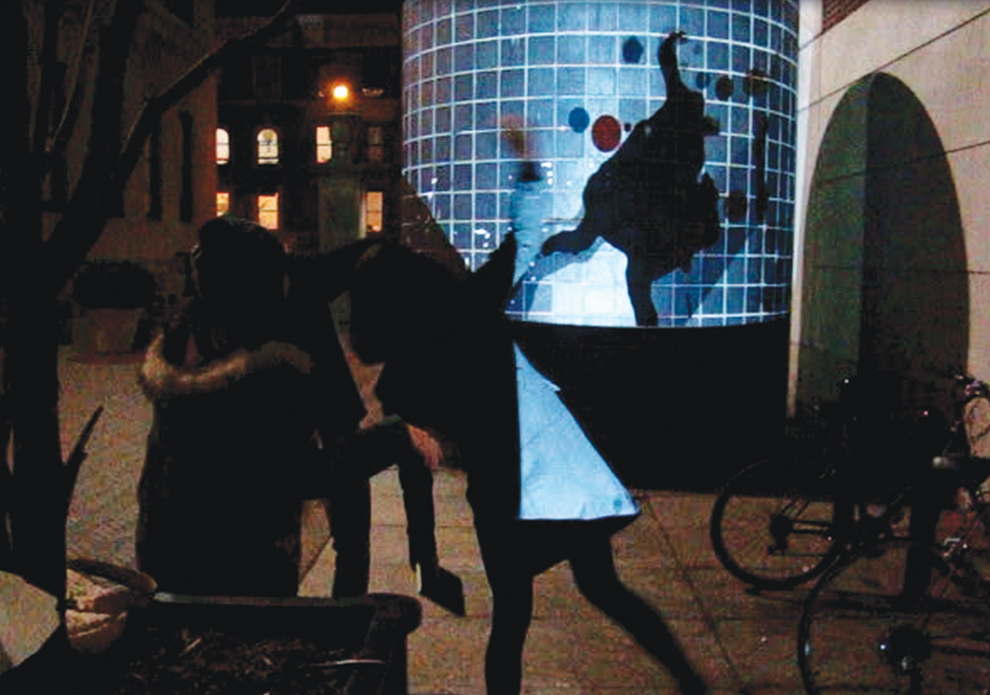
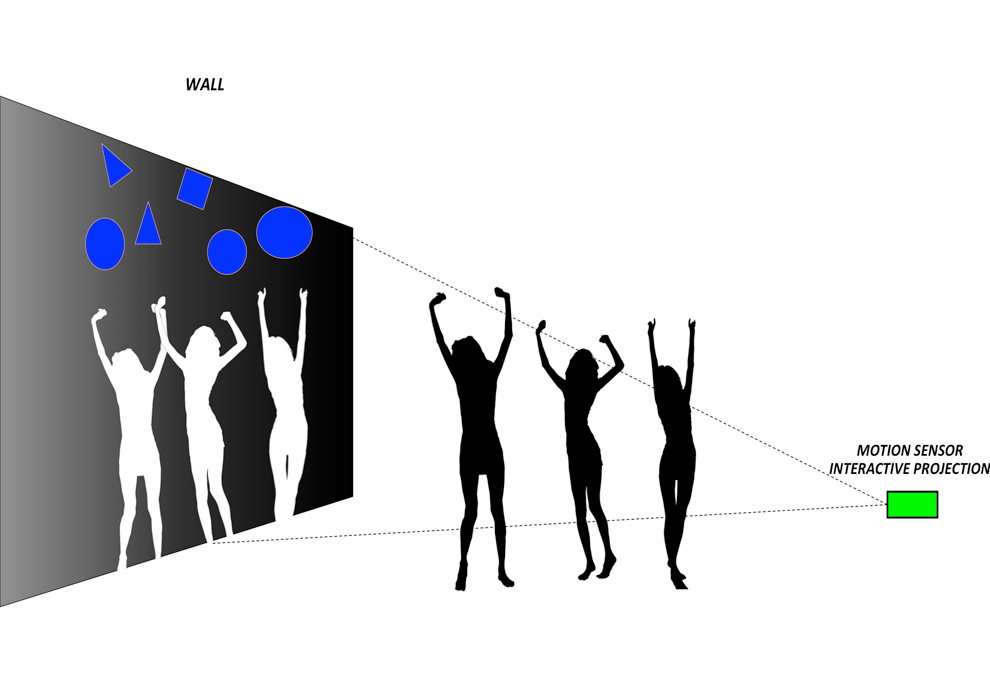
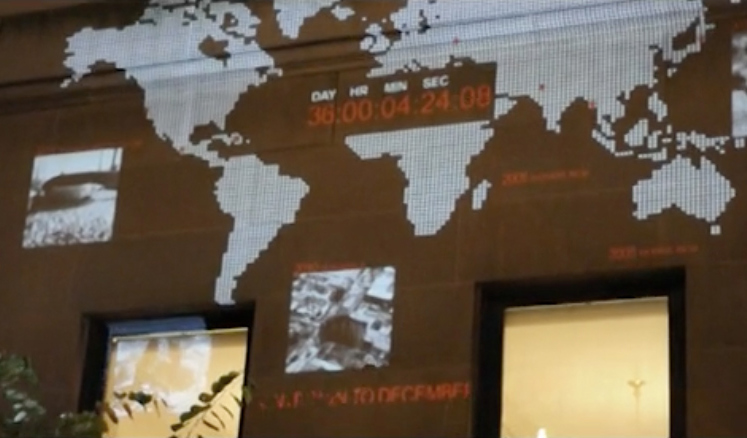
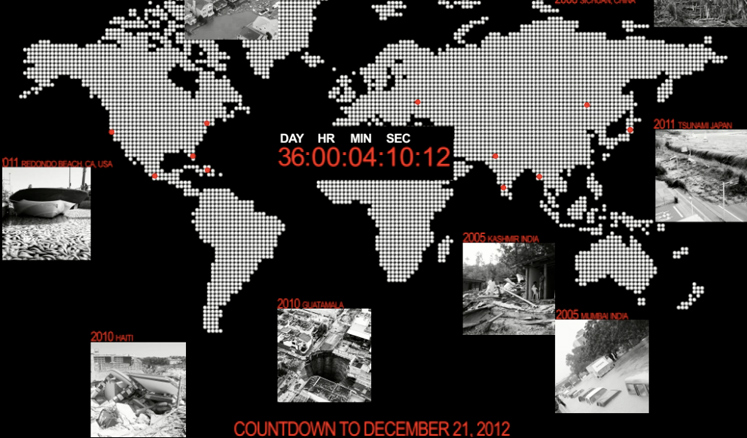
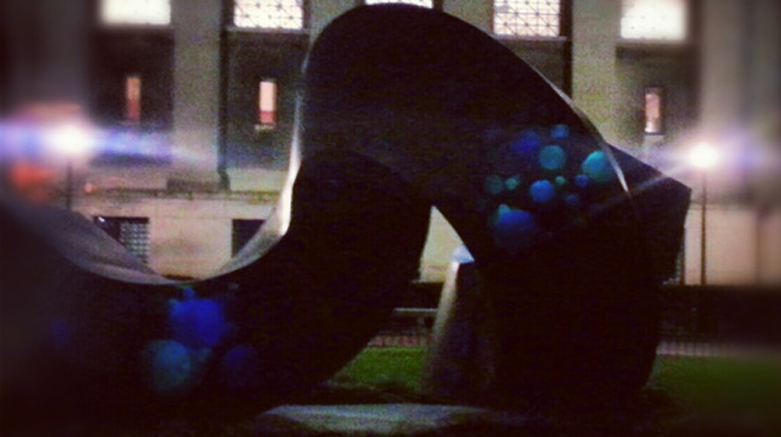
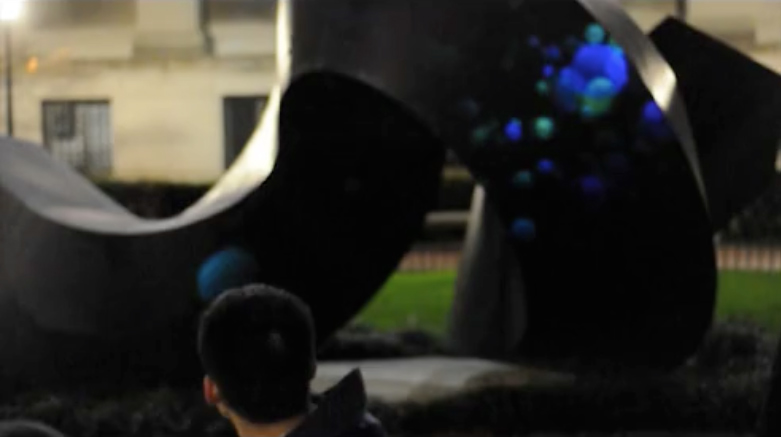
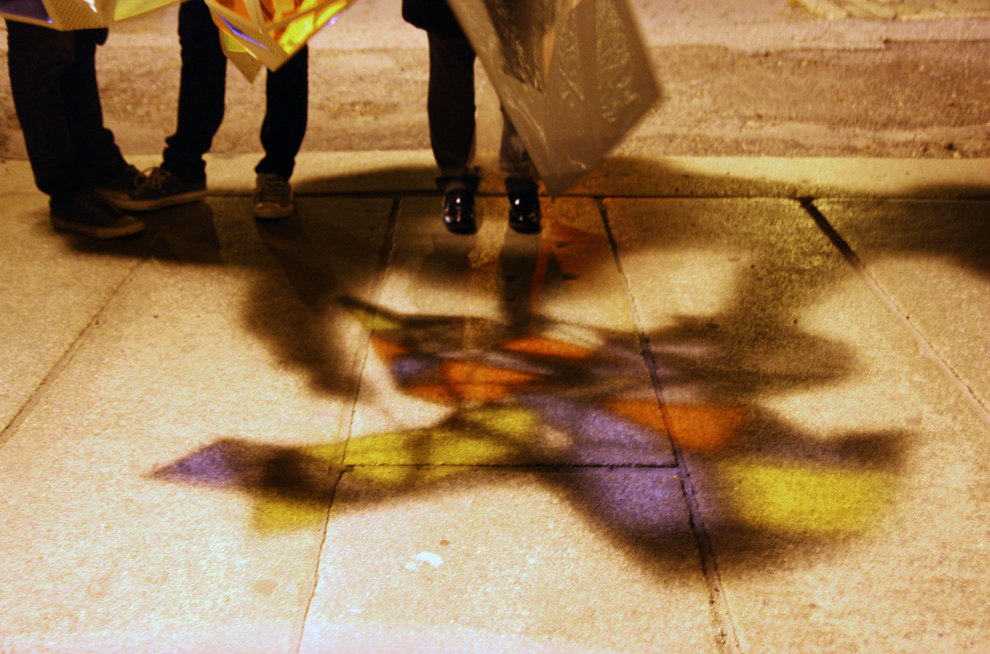
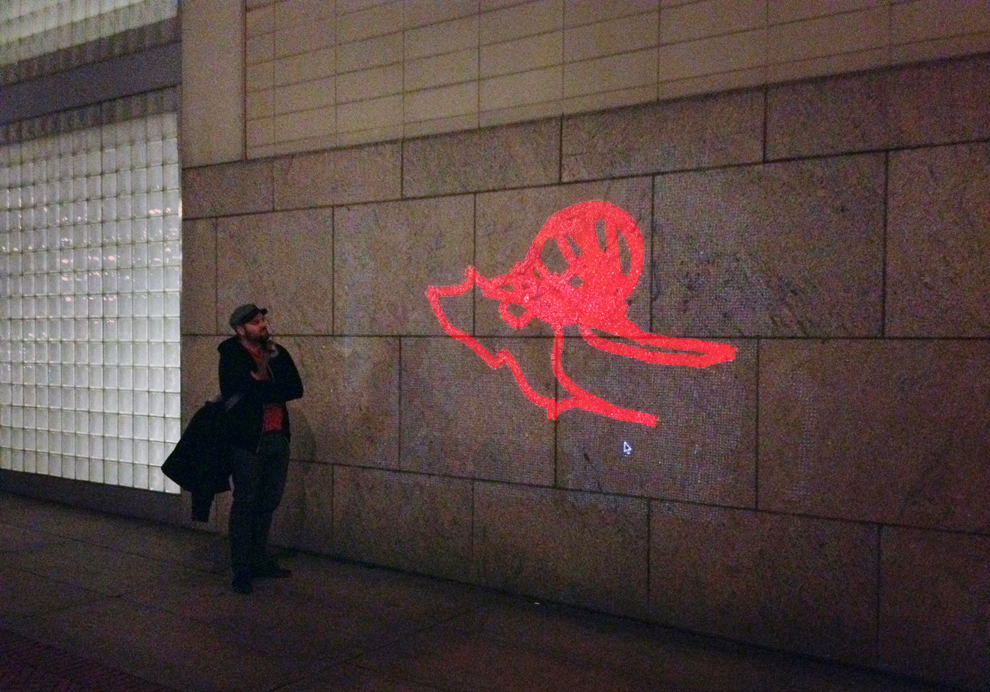
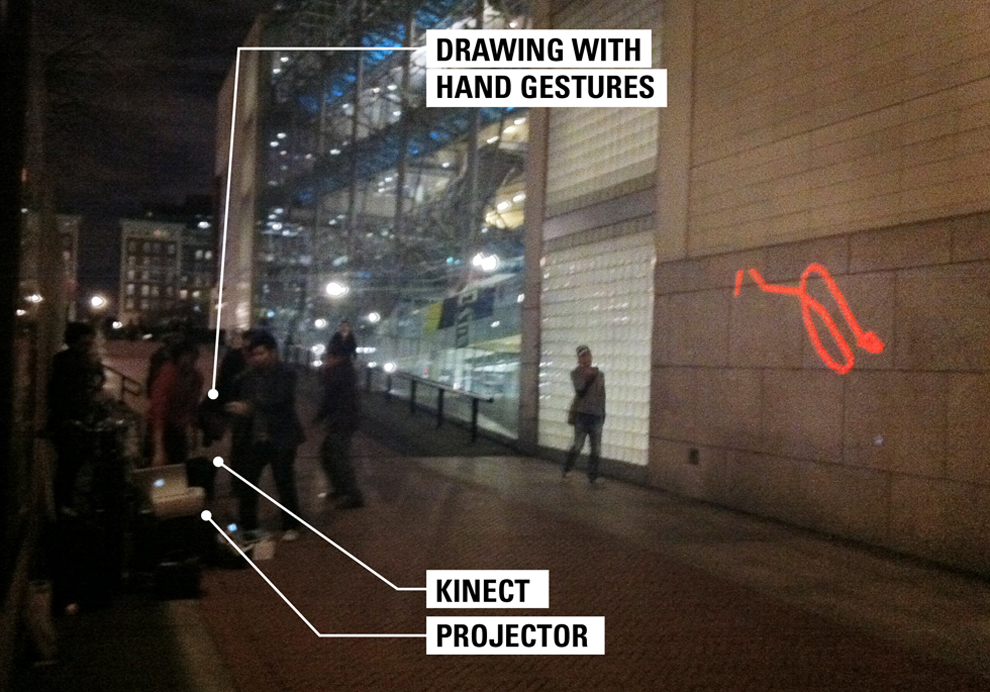
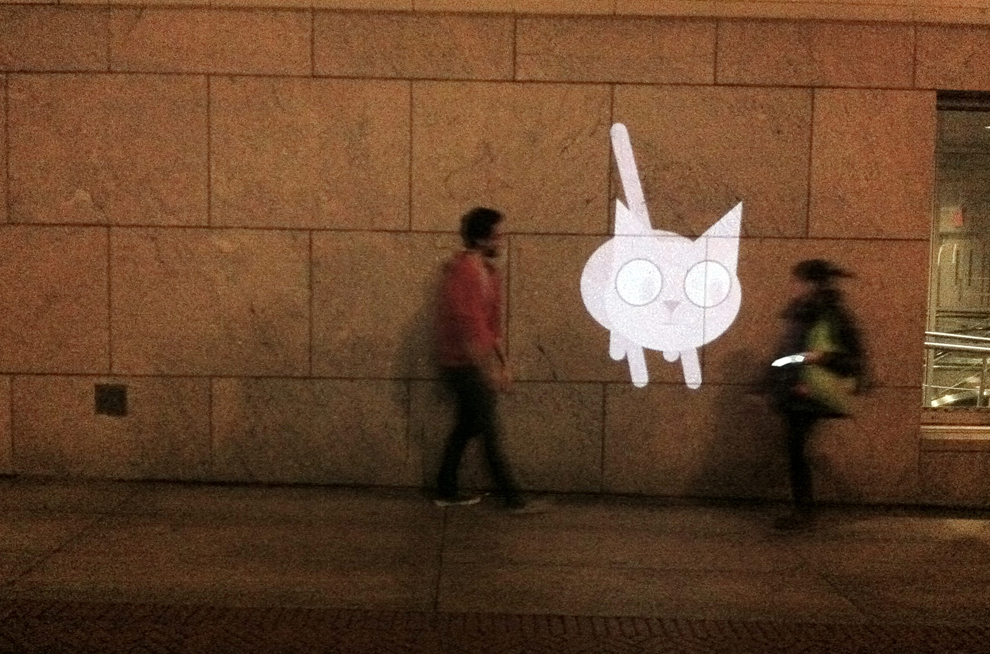
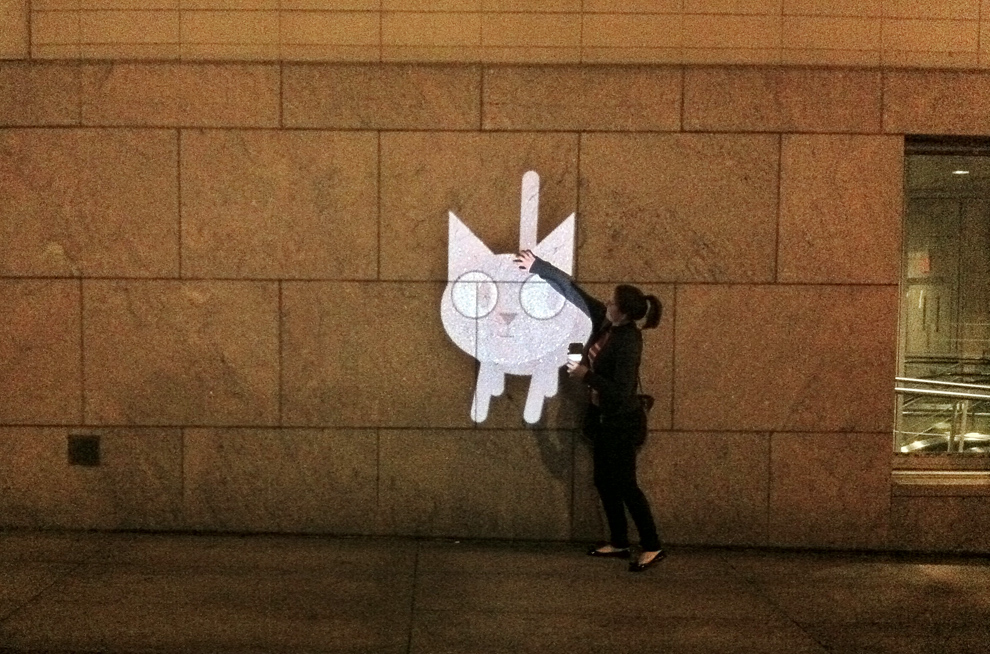
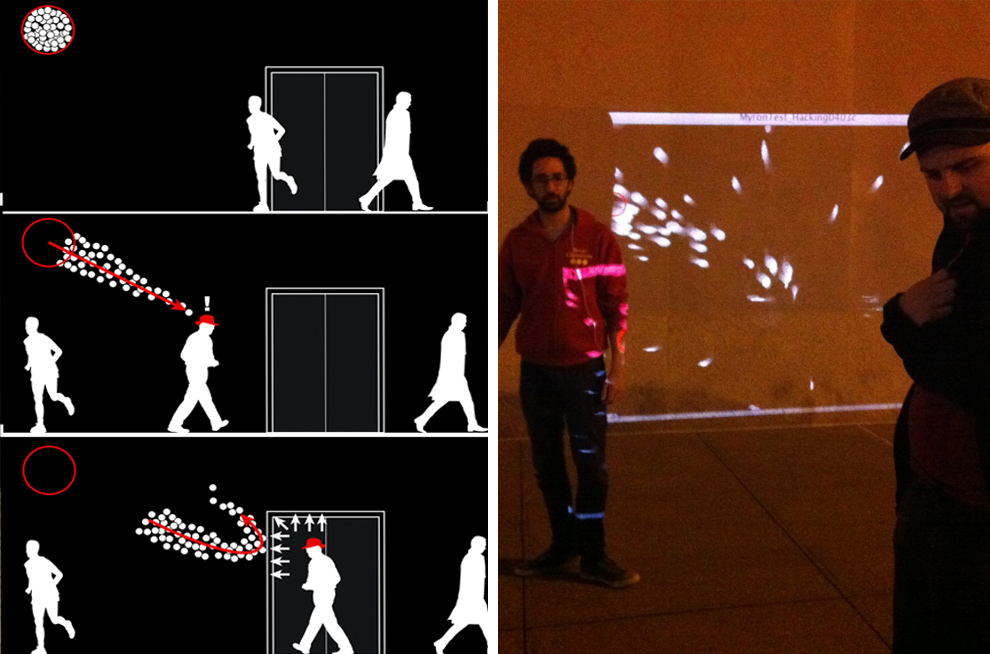
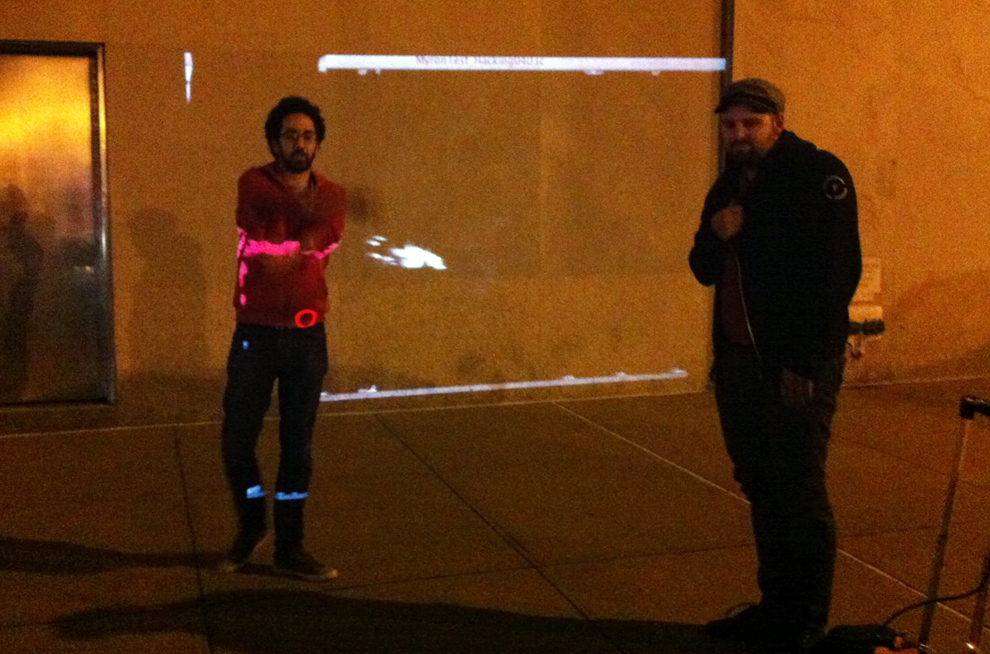
Using Graffiti Research Lab’s projection bombing tutorial at Instructables, the class set up a mobile power station using a 75V marine battery, and set off around the neighborhood near Columbia to experiment and throw up some interactive light projections.
The last year has seen some truly inspiring displays of the potential light can have as an interventionist tool, and the class studied this problem using three main strategies: 1) messaging independent of site, i.e. you only need a blank wall, 2) site dependent projections, like those following the curving, horizontal bands on the Guggenheim, and 3) flexible projections that can adapt and interact to a number of different sites, taking advantage of the unique characteristics of each. Care was given to create projects that both actively and passively engage those passing by the site. Each group’s projects was able to successfully confront one of these strategies.


Ni, Mengna, Darian, Juan, Ying


ChunChun, Yuri, Shuang, Rubing, Renwick


Tom, Aaron, Max, Kevin


Kaz, Greg, Ella


Assignment 04 (FINAL)
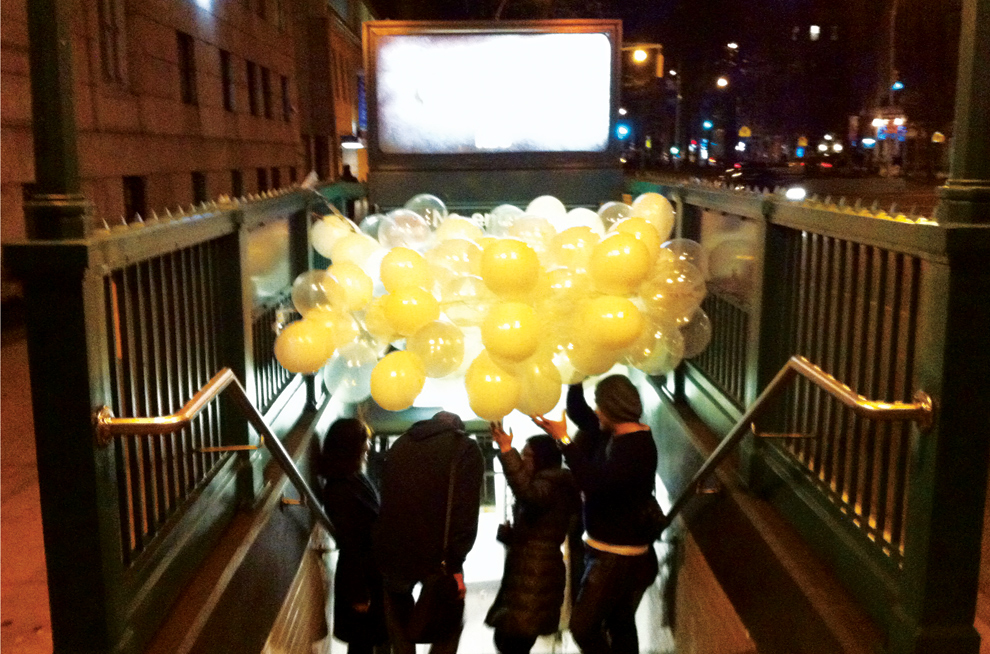
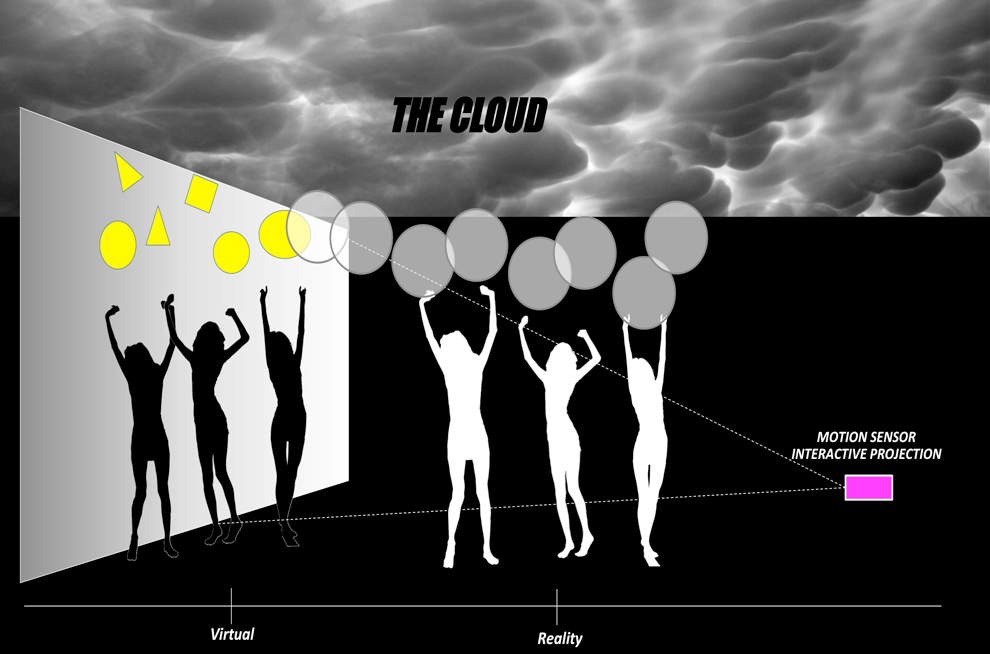
Building off the previous assignments, the final assignment sought to synthesize the work and concepts of the class into a larger installation that could still be completed in our very tight time frame, but started to explore the core ideas of the course, in effect becoming a proof-of-concept, working model. By attempting to capture a broader audience for architectural interventions, a number of questions presented themselves and the students were challenged to anticipate a range of possible eventualities – how will it be used? Can its use be changed? Is it durable? Is it waterproof? Can it safely stand up? Fabrication was considered less from a formal quality, and more from a use, durability, improvisation and public participation viewpoint.
Ultimately, A successful project would accomplish three things: 1) display ingenuity in fabrication technique and material 2) re-imagine or re-design a specific urban site/condition to take advantage of its hitherto hidden potential, and 3) have a performative component, in that the intervention has a temporal quality that while engaged promotes public interaction.


ChunChun, Yuri, Shuang, Rubing, Renwick


Kaz, Ella, Greg


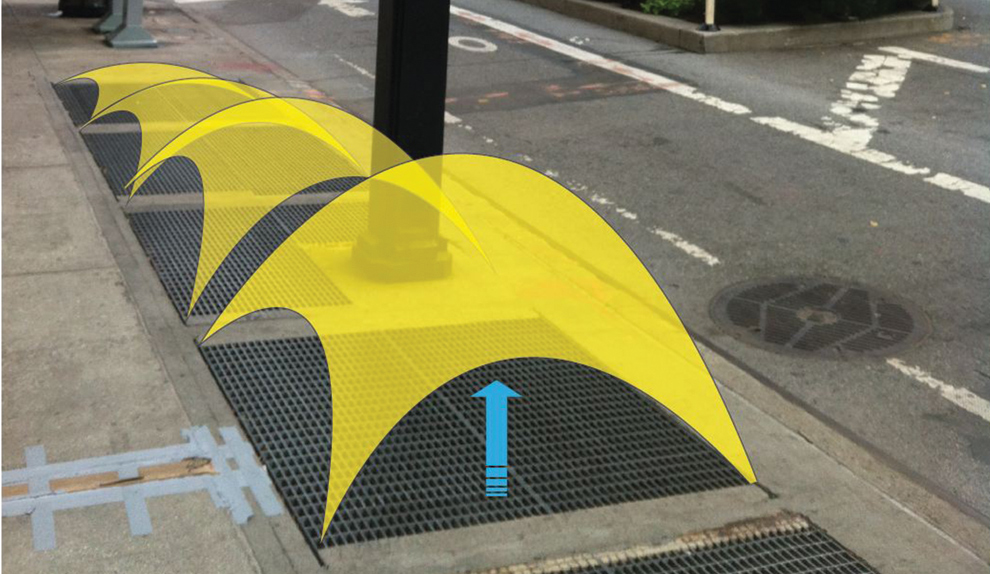
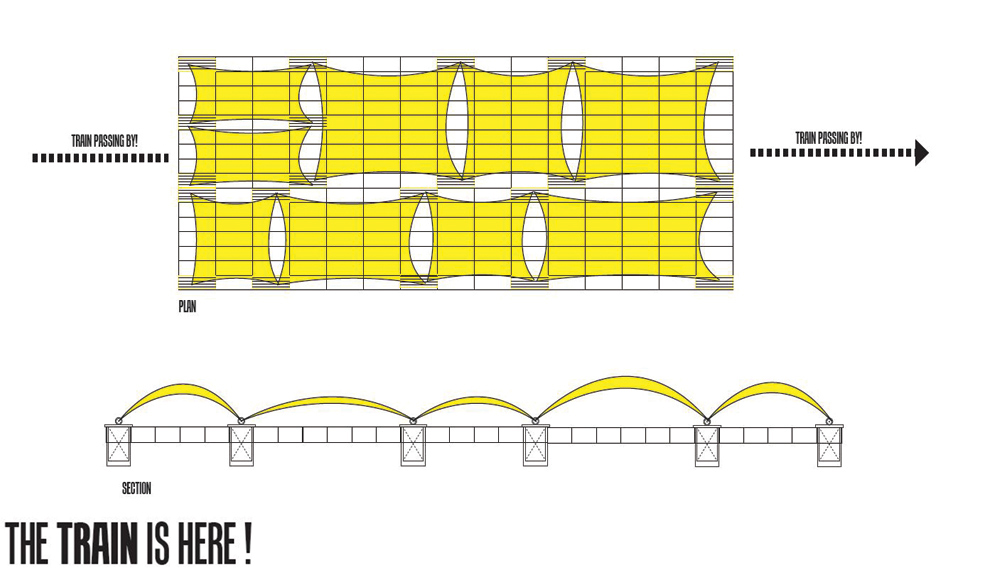
Tom, Aaron, Max, Kevin


Ni, Mengna, Darian, Juan, Ying

20120516 Tags: architecture, fabrication, interaction, new york, research, teaching, urban | No Comments »

HACKING THE URBAN EXPERIENCE – STUDENT WORK

I had the pleasure to teach a course this semester with a great group of young architects and urban designers, titled “Hacking the Urban Experience” at Columbia. I couldn’t be more proud of all the hard work and the high level of engagement with which the students approached the class. All lectures and process work are archived on the class tumblr: http://hackingtheurbanexperience.tumblr.com. Classes typically took the form of lectures on precedents and concepts, a discussion of student work and tutorials on materials or software techniques. Topics during the semester included overviews of unsolicited architectural proposals, building-scale light projections, inflatable materials, urban siting opportunities and community/crowd sourced funding.


The course sought to assert the relevance of the fabrication skills at our disposal as potentialities for social and environmental relevance. Through the re-appropriation and re-imagining of existing urban conditions, the students designed and fabricated working prototypes that embraced the messy reality of our city and promoted community involvement. The students began by identifying a quality of the urban condition that included the latent capability for improvement and worked toward fabricating an adaptive, responsive and environmentally viable solution. Specific emphasis was placed on testing and exploring through hands on research the possibilities of detailing and fabricating connections using unorthodox materials. At the conclusion of the course the students produced a full scale urban intervention and observed and documented their relevant successes or failures.


Material workshops were held to encourage the students to explore constructions from inflatables to parametric agglomerations using quotidian materials. Ultimately, the goal was for the students to come out of the course with a healthy respect for two core concepts: firstly, an increased skill in the use and applicability of the fabrication skills we have developed for solving design issues using unorthodox materials in unconventional settings; and secondly, that there is an opportunity for architects to regain lost relevance by inserting themselves through unsolicited proposals into the public consciousness as steward’s of urban well being.


Students:
Jared Dignanci, Farzin Lofti-Jam, Ehsaan Mesghali, Katerina Petrou, Paul Tran, Wassim Shaaban, Maryam Zamani


Assignment 01
Part of the Atlas of Urban Connections project (TBD), the first assignment involved designing and fabricating a joint to connect something, anything, to a vertical street extrusion (such as a tree, street sign, light pole, etc…). The members of the Public Works Department in NYC are masters of improvisation, you can see it walking down any street here, and there is a lot to learn from their successful and not-so successful techniques for attaching to existing sidewalk infrastructure. This assignment was prepared to introduce the student to the capacity to breaching the gap between the pedestrian and existing streetscape objects, with the goal to test flexibility, safety, durability, adaptablility while exploring different possibilities for potential synthesis with existing urban forms.
Wassim, Katerina, Paul


Jared, Farzin, Ehsaan, Maryam


Assignment 02
Using Graffiti Research Lab’s projection bombing tutorial at Instructables, the class set up a mobile power station using a 75V marine battery, and set off around the neighborhood near Columbia to experiment and throw up some interactive light projections.
The last year has seen some truly inspiring displays of the potential light can have as an interventionist tool, and the class studied this problem using three main strategies: 1) messaging independent of site, i.e. you only need a blank wall, 2) site dependent projections, like those following the curving, horizontal bands on the Guggenheim, and 3) flexible projections that can adapt and interact to a number of different sites, taking advantage of the unique characteristics of each. Care was given to create projects that both actively and passively engage those passing by the site.
Wassim, Katerina, Paul


Ehsaan, Maryam


Jared, Farzin


Assignment 03 (FINAL)
Building off the first two assignments, the final assignment sought to synthesize the work and concepts of the class into a larger installation that could still be completed in our very tight time frame, but started to explore the core ideas of the course, in effect becoming a proof-of-concept, working model. By attempting to capture a broader audience for architectural interventions, a number of questions presented themselves and the students were challenged to anticipate a range of possible eventualities – how will it be used? Can its use be changed? Is it durable? Is it waterproof? Can it safely stand up? Fabrication was considered less from a formal quality, and more from a use, durability, improvisation and public participation viewpoint.
Ultimately, A successful project would accomplish three things: 1) display ingenuity in fabrication technique and material 2) re-imagine or re-design a specific urban site/condition to take advantage of its hitherto hidden potential, and 3) have a performative component, in that the intervention has a temporal quality that while engaged promotes public interaction.
Wassim, Katerina, Paul


Maryam, Jared, Farzin, Ehsaan

20090524 Tags: architecture, fabrication, gsapp, interaction, processing, school, scripting | No Comments »

interactive elevator installation

living01
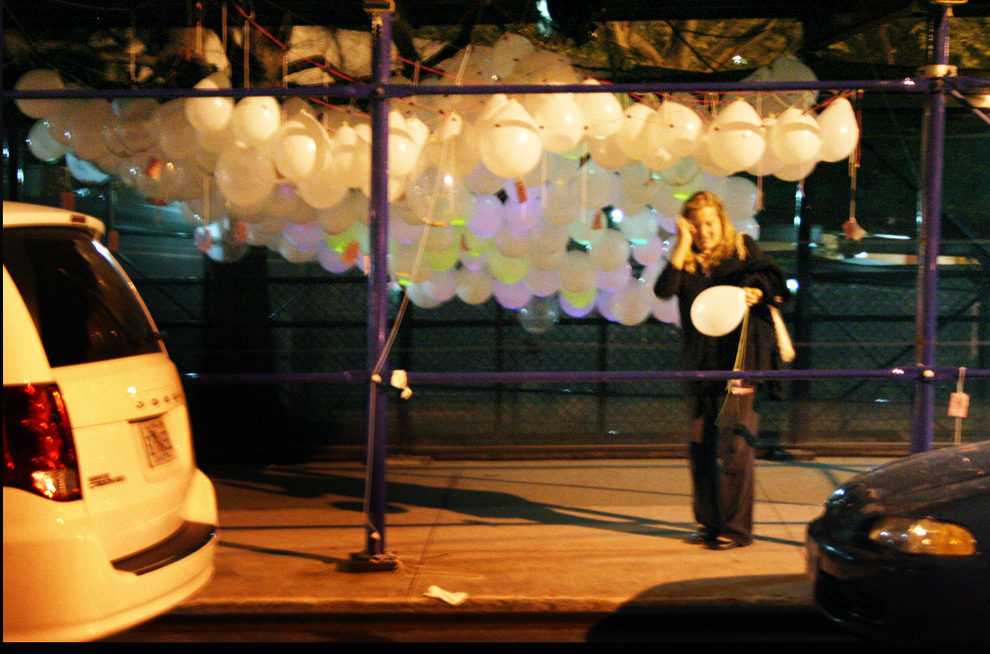
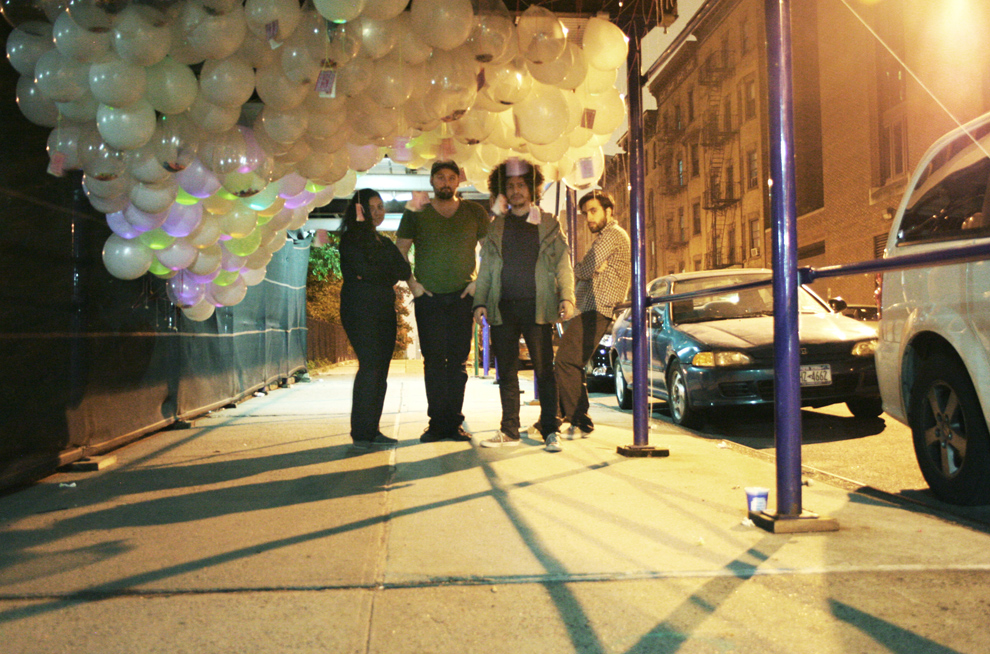
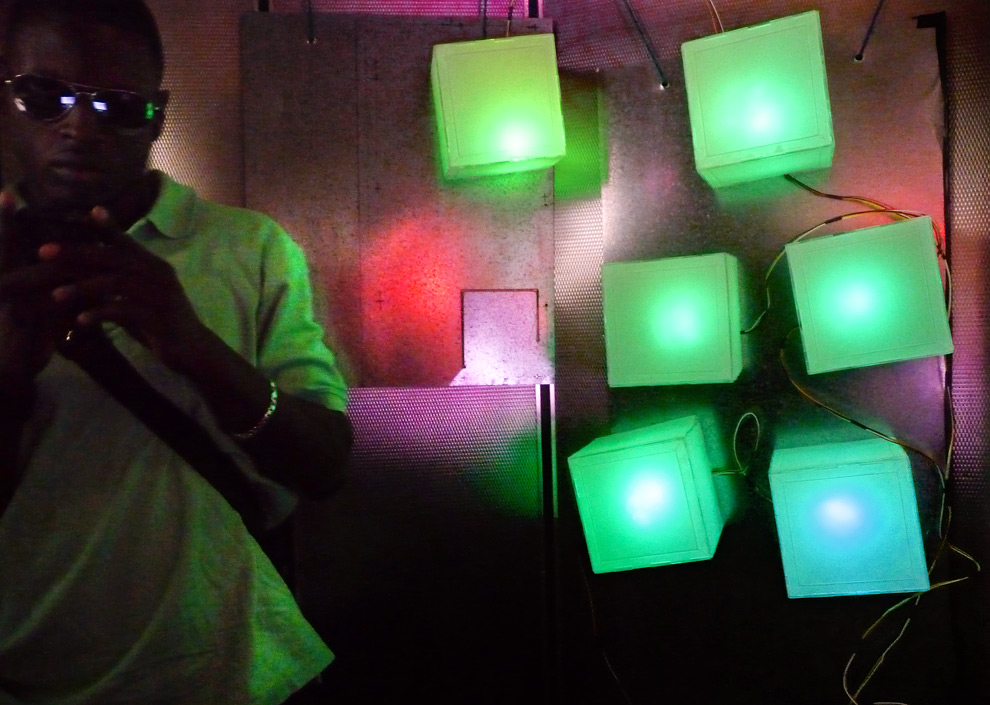
For our living architecture course, we created an interactive light installation in the elevator of Avery Hall, controllable by anyone with a cell phone and a twitter account. The simplified process includes texting an emotion to twitter from any cellular phone using the #livarch hashtag. That tweet is then picked up by a realtime search, fed through our twitterfeed rss, then added to our own twitter account. For a more detailed explanation, see this previous post on getting multiple twitter users onto one twitter feed. That emotion is then directed to our pachube feed and sent through processing to an arduino microcontroller that controls the color and pulsing of the individual leds. The installation non-invasively attaches to the surface of the elevator via magnets. Allowing it to be placed on any metal surface, such as a building exterior, furniture, or a vehicle.


The lights within the elevator respond to the mood of the user. For instance, if a student texted “happy #livarch” the space within the elevator would begin to slowly pulse with a greenish/blue hue. However, if another student sent “angry #livarch” the first light will quickly flash a bright red. There are twelve lights total and show the collective mood of the twelve most recent users.


In this way, the elevator becomes a living representation of the collective mood of the building, but it is also hoped that a feedback loop can be created, a loop that actually influences the mood of those that ride the elevator. The emotion felt in the lobby will be altered by the time you reach the sixth floor. And that new emotion becomes what gets texted back to the elevator.


Lastly, future installations will be physically located away from the target user. For instance, Avery’s mood will be projected to the elevator in Uris Hall and vice versa. In this manner, we can both create a new form of pen-pal with distant locations, but also hope that our mood, whether angry, sad, happy or nervous, will both manifest itself in a new form of architecture, but also have an effect on the greater world around us.


The project team also included Talya Jacobs and Guanghong Ou.
See more for video and code:


living02c
more »

2009035 Tags: architecture, interaction, school | 2 Comments »

living architecture

livarch


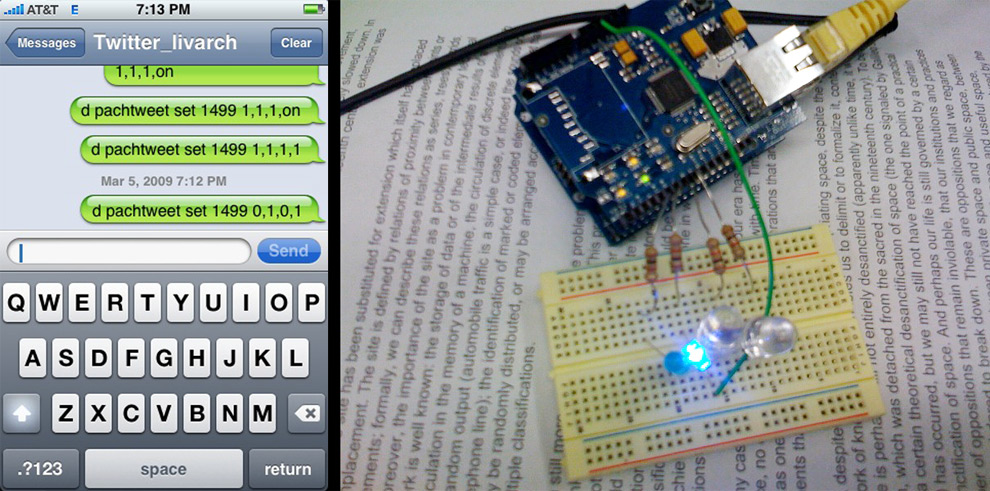
The beginning of our project for living architecture. It’s in its early stages, but we’re starting to get the interaction working. First, a user can send a message from their phone to twitter, then twitter forwards the message to pachube, then pachube feeds the data through the net to the little led’s hooked up to the arduino on my desk. At this point we’re thinking of an interactive light display down in the cafe, that will display the collective mood of the studio above.

COPYRIGHT © 2011 \ JOHN LOCKE \ ALL RIGHTS RESERVED (RSS)

TOP OF PAGE

last update: 201102:1627