JOHN LOCKE, ARCHITECT

  • Featured Work
  • Design Blog           
  • Photography
  • Graphic Design
  • Dept of Urban Betterment

About

Hello. I live in New York and work at The Living. I hold a graduate degree from Columbia University's GSAPP and an undergraduate architecture degree from the University of Texas at Austin. I have more than seven years of professional experience at noted architecture firms, including New York-based Rogers Marvel Architects and SOM. I also tackle freelance graphic and photography work with my partner in crime, the multi-talented Jackie Caradonio at Lion in Oil. In addition, I teach a course, Hacking the Urban Experience, at Columbia. View my CV here: CV(html). Thanks and have a nice day.

Contact

john.h.locke{at}gmail.com
310.735.3333

Architecture Portfolios

Portfolio 2002-2007 (issuu)
Portfolio 2008-2009 (issuu)

HOME / BLOG

kinne

2009097 Tags: colorado, kinne, photography, writing | No Comments »

mesa verde

mesaverde1mesaverde2

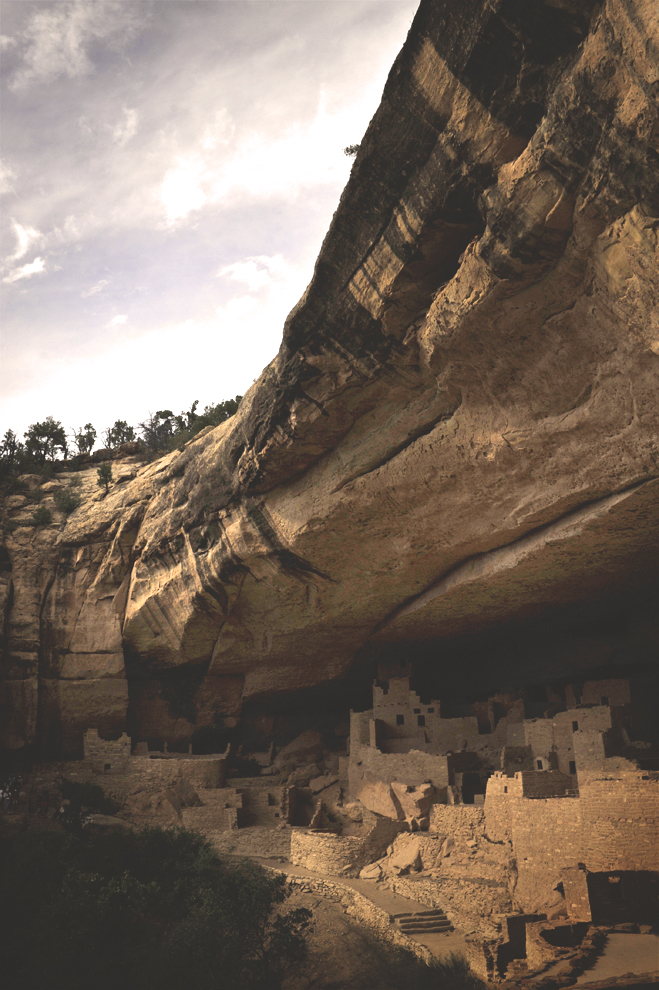
The popular perception of the American Indian has to be one of the most malleable concepts in our history, adapting at will in parallel with the westward course of the U.S. empire. Wrapped up in fear and guilt, modern-day perceptions of the Indian have been everything from exterminable threat, to endangered “noble savage,” to hippie-like ecological warrior. It doesn’t matter that none of them were at all accurate, but at least the active placement of Indian culture somewhere in American thought has to be preferable to their current status as an invisible afterthought, a victim of apathy. Walking around on a ranger-led tour of the abandoned cliff-dwellings at Mesa Verde, I took a number of notes regarding history, construction, climate, etc., but the two big takeaways were difficult to reconcile: 1) as an archeological and architectural site this place is amazing, and 2) this is an incredibly empty and lonely place. The people who built it are gone, no one knows why, and no one knows how they lived.


To elaborate:


1) Architecturally and tectonically Mesa Verde is beautiful, Cliff Palace especially. The masonry has a wonderfully tactile quality and the seamless edge where the cut blocks meet and merge with the cliff face is incredible. The Pueblos were obviously master craftsman. It’s the stuff of science fiction, fantasy and legend. People built and lived in miniaturized towns, forsaking the wildly more accessible mesa tops, for an existence cleft out of rock on the side of a canyon.


2) But the sense of unreality distances the visitor from having any meaningful connection to the people who lived here. All historical artifacts that weren’t plundered in the late 19th century have been thoroughly removed and crated by the Park Service. This leaves a completely anesthetized space of pure architectural form devoid of any function. Also, original paths that were crumbling and inaccessible have been recreated into smooth concrete streets safe for tour groups (see picture here of Mesa Verde in 1891). This uncanny mix of new and old, without any clues to habitation makes the Pueblo culture seem only more remote and lonely. At least at Pompeii you can see the ash covered tables and plates and other trappings of quotidian life — the gulf of time doesn’t seem quite so vast because of its recognizability. But here, things are more enigmatic without any pat answers. It didn’t help that I towered over the cramped spaces. An average Pueblo Indian of 1200 was around five feet tall. This gives the whole place the feel of a scaled-down stage set where doors seem smaller than windows and it’s incomprehensible to judge how — or how many — people lived in a 120sf space. I could appreciate the abstraction of the piled-up stacks of cubes and cylinders as elemental architecture, but it’s difficult to leave it at that. Was this actually a successful way to live? If so, why did they leave?


The Park Service museum isn’t much help. The ’70s-era dioramas of Indian life in the museum were rendered pretty ridiculous by their blatant attempts to Westernize Pueblo life in the 13th century, making it more accessible to contemporary culture. (C’mon really NPS? Bar-B-Ques around the kiva and playing fetch with dogs…on a cliff? For shame.) I felt more removed from Indian culture than ever. The rangers were more knowledgeable and, in their mini-lectures, they rejected any definitive answers but proposed that everything had dual spiritual/function purposes. Kivas were used for religious ceremonies, but also for living in during the winter. Vents were cut to allow smoke to exit and spirits to enter. But in the end, it’s all speculation. The last Pueblo cliff-dwellers who left around 1400 assimilated into other tribes and weren’t big on keeping any type of written historical record. Their only references to Mesa Verde are proclamations that it was simply time to leave, which, to an archeologist, must be somewhat frustratingly inadequate. But the Pueblo see time as cyclical. Time matters less than location when a belief in continual or infinite time creates a casual air or disregard for the quantifiable number of years. Time is like the seasons, not Western linear time – where this event happened at this time which in turn caused this proceeding thing to happen – so conceivably Mesa Verde could be inhabited again.


I wish I could imagine that. But as the steady stream of buses unloaded another batch of brightly-colored tourists, nothing seemed farther from reality. I made the short hike back to the car, trying to beat the rush back to Highway 160. The 30-mile, winding, two-lane road out of the park can seem like forever if you’re stuck behind a mini-van.

2009094 Tags: kinne, nevada, photography, writing | 2 Comments »

running into the void

neg01
neg02

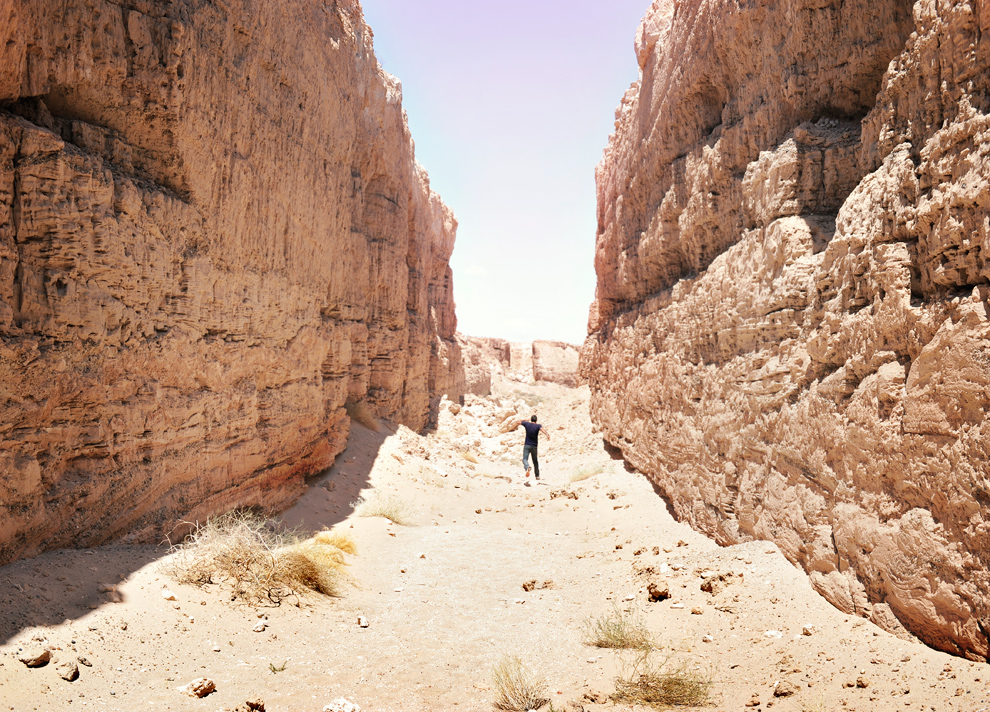
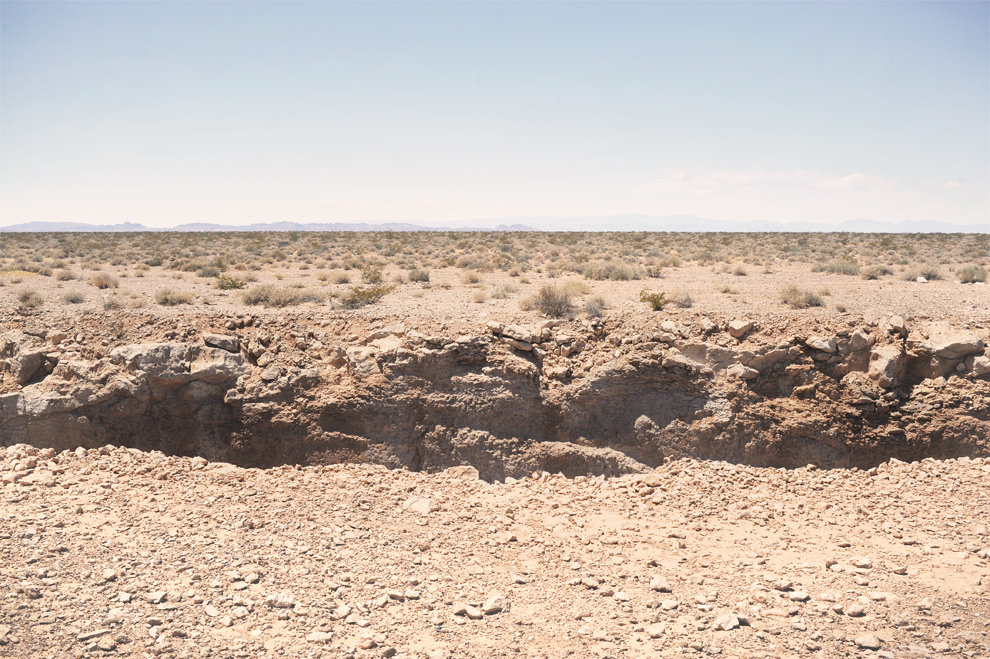
Before you can walk down into the Double Negative, you have to drive up to Mormon Mesa. I’d been around a lot of mesas growing up, the lacerated mountains formed the backdrop for countless family excursions, but this was the first time I’d actually been up on top of one. The dirt road out of the nearby town of Overton, Nevada, is monotonously flat, until you reach the edge of the embankment where the road shoots up, a sight that when viewed through the front windshield of a four-cylinder Grand Am seems impossibly steep with dirt that is treacherously loose. But again, after cresting the ridge and arriving on the caprock, you find yourself in the midst of another flat expanse. Mesas form by the twin processes of weathering and erosion. The weaker types of rock are eroded away, while the more resistant types – like sandstone – persist, forming the flat top of the mesa. Geologists measure the processes that formed the Mormon Mesa in epochal time scales. The same geological history can be observed in a smaller, vastly accelerated scale as the once-crisp, man-made edges of Michael Heizer’s Double Negative deteriorate. The 1969 artwork becomes part of a tiny artificial blip in the geological history as the incontrovertible mass of the desert moves back in to reclaim the void which was removed.


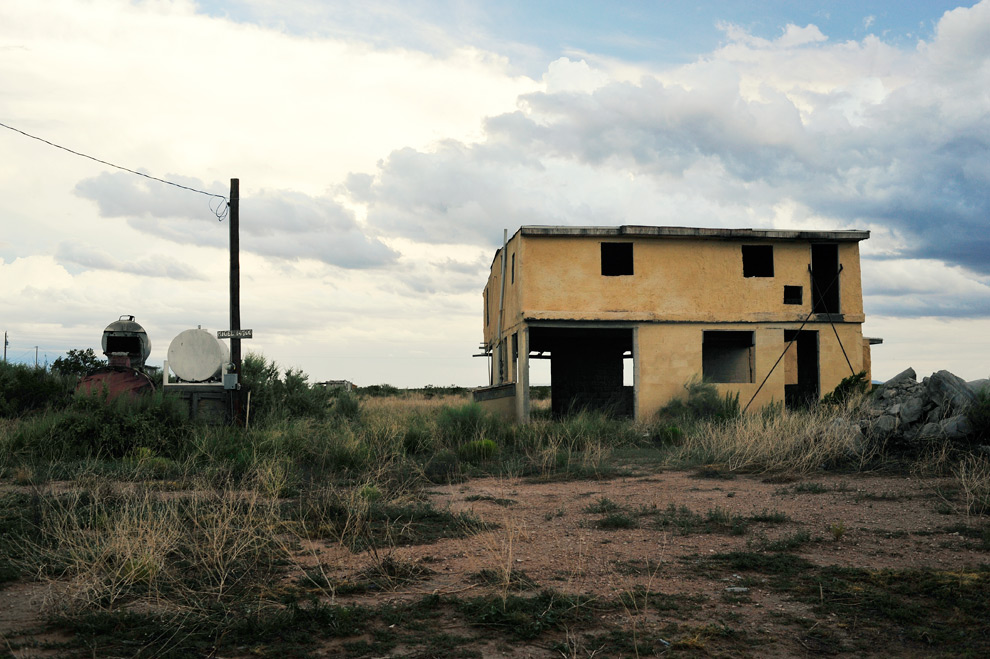
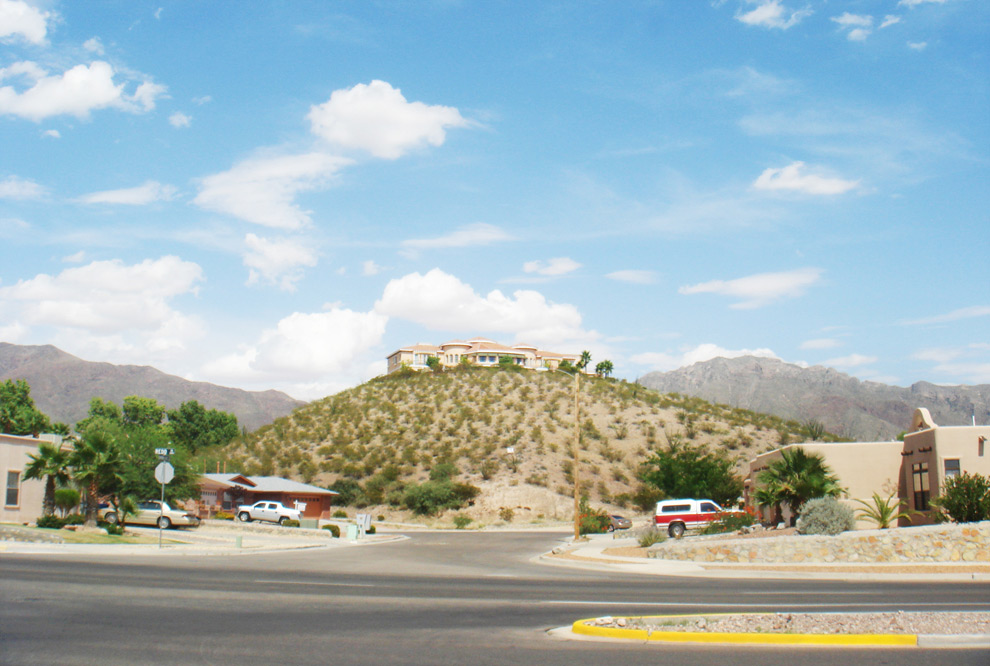
Working with two bulldozers, dynamite, and a skilled crew, Heizer removed 244,800 tons of sandstone and rhyolite from the edge of the Mesa to create two trenches facing each other on opposite sides of the mesa cliff. The channels are around 50 feet deep and 30 feet wide, as well as approximately 750 feet and 325 feet in length, respectively. Double Negative comprises the cuts as well as the space between them, see MOCA’s description of the work as a 1500 x 50 x 30 foot sculpture (aside: how can something this remote and this huge, be considered part of a Los Angeles museum’s collection? And is that antithetical to the staunchly anti-gallery ethos espoused by some land art practioners?). Another pretty accurate description is “that old cut out on the mesa,” given by the waitress at Overton’s Sugars Home Plate Restaurant and Sports Memorabilia fine dining establishment in response to my query as to whether she knew where it was. I received the distinct impression that the folks of Overton had either: a) never been out to Double Negative, and/or b) didn’t hold it in very high regard. (I initially found this to be kind of sad and a little narrowminded, but the more I thought about it the more I started to equate their attitude as pretty analogous to how I feel when out-of-towners show up eager for a tour of Times Square.) Instead, the two other patrons enjoying an afternoon meal at SHPRandSM suggested I look at the “tank that is parked in front of the old post office” or the “house that looks like a castle” as being more interesting. Both of which I did indeed end up seeing (see photos here and here), but I have to admit I still found Double Negative to be far superior.


So, any time you’re going to talk about Double Negative, you have to start by mentioning that its power comes from being “an old cut,” or simply negative space. It’s there in the title and Heizer pretty much sums it up when he says: “There is nothing there, yet it is still a sculpture.” The destructive force loosed onto the desert was the act of creation. And, paradoxically, what was removed from the mesa’s edge, constitutes what is. At least from an architectural standpoint, what I find most interesting about Double Negative is how powerful the void space becomes, a place where a slit in the desert can hold and command your eye in the panoramic expanse of the desert. This was also the first place where something wasn’t sticking out of the desert scrub, but rather — as cliché as it sounds— it was bringing the sky down into the earth. Stephen Holl does this a lot (he even has a project called Void Space/Hinged Space), but also think about the Twin Towers (or even the Petronas Towers): what really made them powerful is the slot of void between them and the way the blue sky captured between them doesn’t seem the same as the blue sky around it. It holds the void the same way the two trenches hold space. It’s so powerful you can almost hear the light moving between the embrace. I’ve had professors who would call this a “charged void,” full of electrical tension running between the trenches. Unable to stand still, I had no choice but to run through them (even while panting in the brutal 110-degree August heat).


I think it’s a good thing that Heizer is letting Double Negative deteriorate, allowing it to erode to the point where the original intention of the artist is hidden and it becomes a further enigmatic, less differentiated, more primitive part of the landscape. The disintegration of the boundaries allow the softer indentation to achieve a greater continuity of experience from inside the event to outside — for example, from landscape to art. Or, to put it another way, it becomes a compound object, something language doesn’t necessarily give us the luxury to “know” well enough to describe, and opens the possibility of allowing the object to “just be.” And being uncoupled from the obligation of knowing allows the possibility to present itself for art (or architecture, music, painting, etc.) to transport us into an integrated realm of feeling where the experience of heat, dust, colors, textures, sand, and walls allow us a wonderful sense of completeness.


Ok, let me try to put it another way. In this paragraph by Ellen Douglas, the poet deals with loss and memory in a way that is plasticized, or architectural:


“Charlotte knew that her mother had listed and stored in her heart all the things she had not been able to do for lack of money, and that she sought for her daughters a fleshier bedfellow than that specter, Want, whose hard bones she knew so intimately, who had lain down beside her almost before the dent that marked her dead husband’s place in the feather bed had been plumped up and smoothed away.”


The void space of the bed becomes an architectural manifestation of a memory. The dent and terrible loss described provoke similar shared qualities in different readers. It is not a photography, it is a memory of actual space, it has an interiority. While each of us may respond slightly differently, there is still an undeniably common response to the depth of our feelings toward Charlotte. The sense of shared feeling is something Kant described as a community Subject with a capital “S.” Douglas and Kant are describing an architectural event that goes beyond representation to convey something both more abstract (loss) and more concrete (the dent) all at once. It’s another way to say that Double Negative is so powerful as architecture because it is an event that can take on so many meanings with a common interiority that we can all respond to, one that can provide shelter, destroy the land, hold space, offer protection, erode away, and criticize art — all of which is done through an architectural manner.


P.S. After all of my inquiring, this thing is surprisingly easy to get to, a little more than an hour from Las Vegas, and contrary to what some sites say regarding the necessity of high-clearance, four-wheeled vehicles, when I drove out there, I didn’t have any trouble in my compact.

20090831 Tags: california, kinne, photography | No Comments »

tourists, death valley

deathvalley
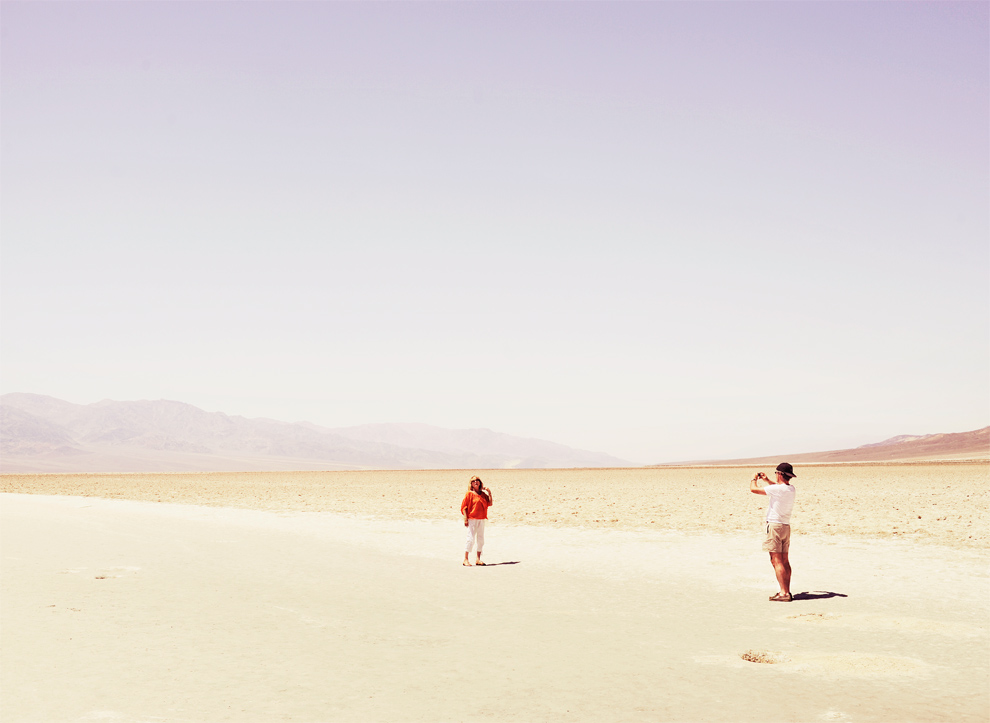
The lowest point in America, literally, -282 feet below sea level.

20090829 Tags: kinne, nevada, photography, writing | 2 Comments »

pahrump in the night

pahrump01
pahrump02
pahrump03
pahrump04
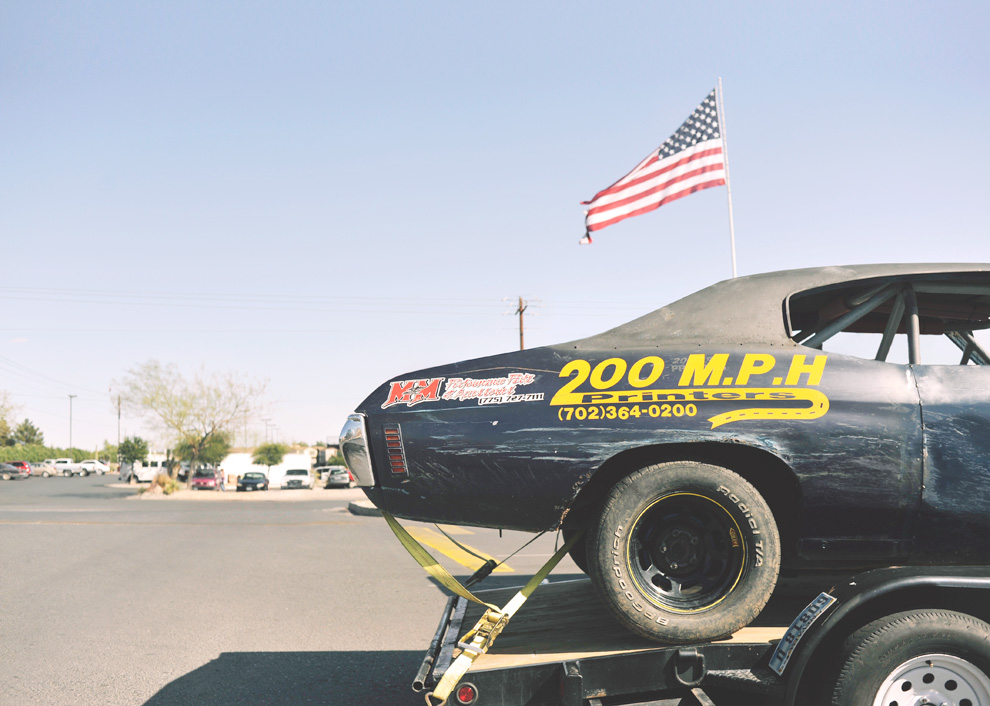
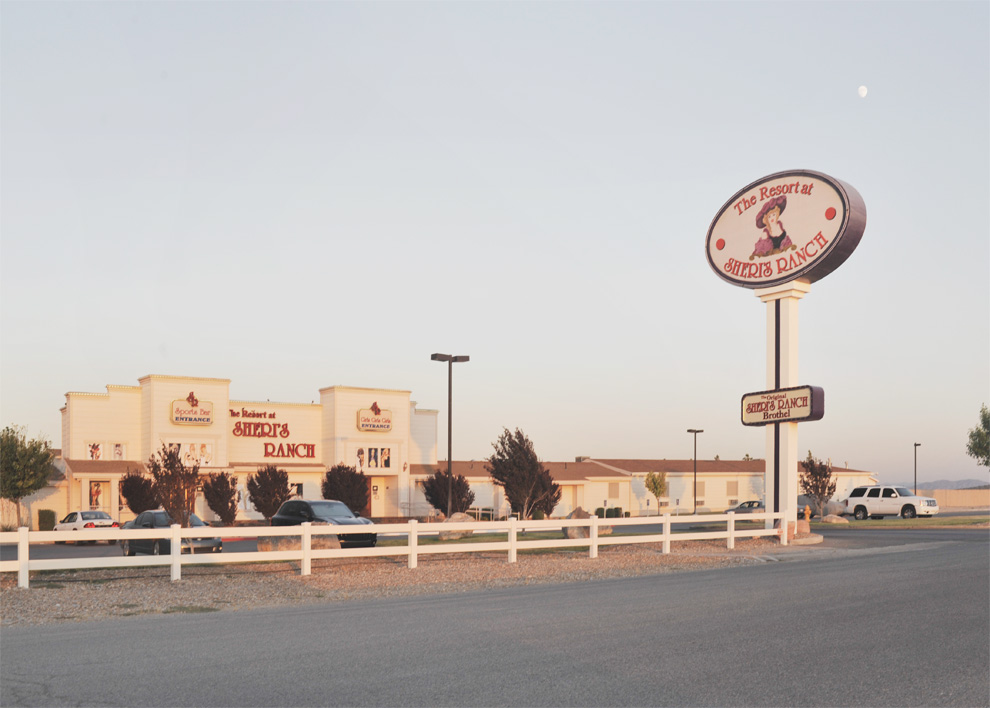
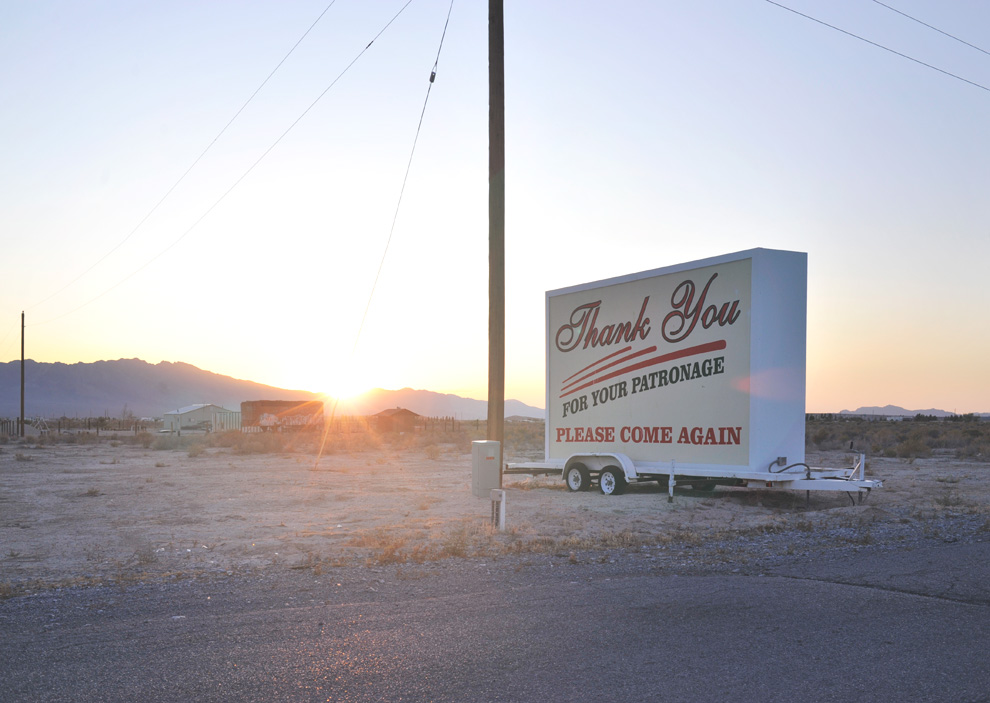
Driving east out of Las Vegas, you know you’re getting close to Pahrump when you start seeing the roadside billboards offering prostitution and other “legal delights.” And, while granted the signs have a lo-fi late-’90s back-of-the-newspaper-strip-club-ad-aesthetic (think black background, lots of fonts, prominent use of the letter “x”) complete with stock photo image of a sultry(lazy-eyed) pouty-lipped(sleepy) blonde with a generic nom-de-sex like “Mandy,” the town of Pahrump itself is going for more of an ironic, self-referential tone. Evoking less the drugged-out seediness of Taxi Driver or the genre-defining, classic portrait-of-an-era HBO documentary Pimps Up, Hoes Down, Pahrump bills itself more as “The New Old West,” and seems to be shooting for something along the lines of a kitschy Wild West saloon re-enactment, complete with swinging doors populated by straight from central-casting whisky-swiggin’ cowboys and sweet-natured high-kicking gals. Which, I have to admit, is pretty much the definition of a “rollicking good time.” But it’s all rendered in a way that makes it seem like a more nefarious,Disney version of the actual West (see: public tours and souvenirs from the Chicken Ranch), but where, you know, actual sex is happening out back and the less said about the realities of mandatory HIV testing, condom distribution, bombed-out trailer homes and wage disputes, the better. The myth of the West is played out in the realities of this best little desert town where casinos outnumber schools, the number of brothels and street lights are equal (two), muscle cars have replaced horses, and everyone goes about life with a half-concealed smile because they are in on the joke. Reminding you that southern hospitality is alive and well is a sign dripping with innuendos thanking you one last time as you ride out into the sunset. That Michael Jackson lived and home-schooled his kids in Pahrump is one of the least interesting things about it.

 
20090828 Tags: kinne, photography, spiraljetty, utah, writing | No Comments »

dinosaurs and dump trucks

spiral01
spiral02
spiral03
spiral04
spiral05
spiral06

(sitting as near as possible to the window mounted ac-unit, vainly seeking respite during a typically sweaty, humid New York summer thunderstorm, I find myself returning back to the basaltic Promontory Range along the Great Salt Lake.)


“If ‘monuments’ in fact exist today, they are no longer visible.”
Paul Virilio


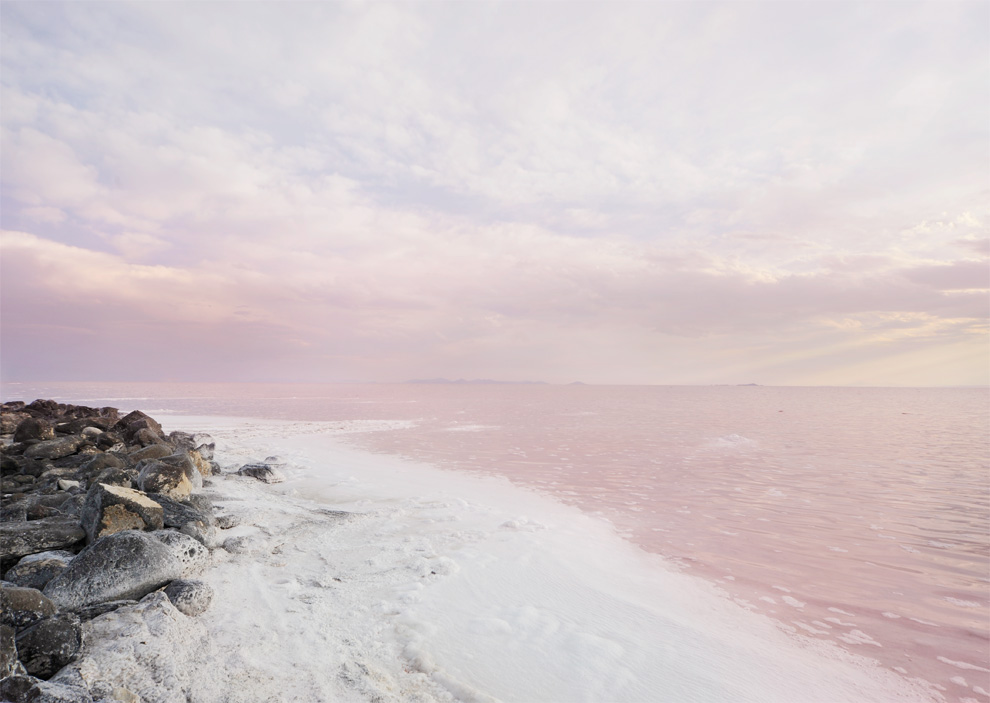
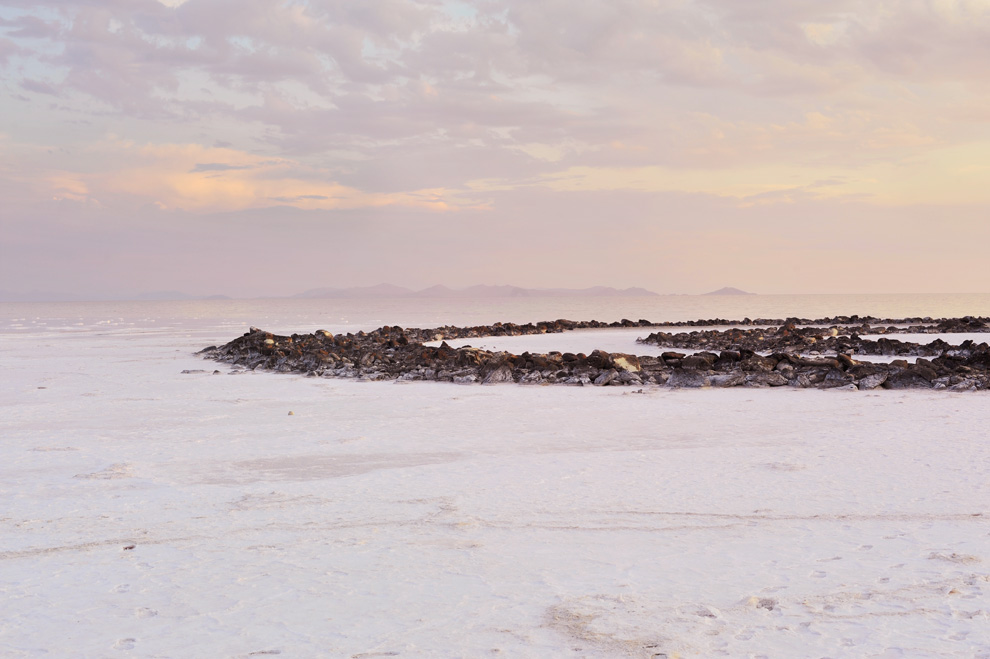
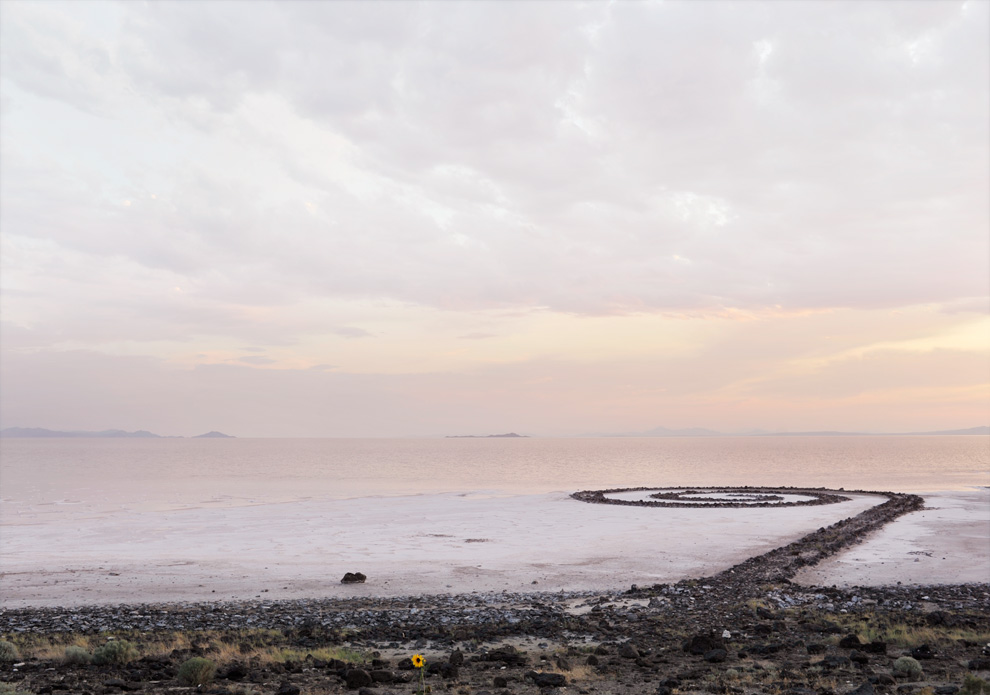
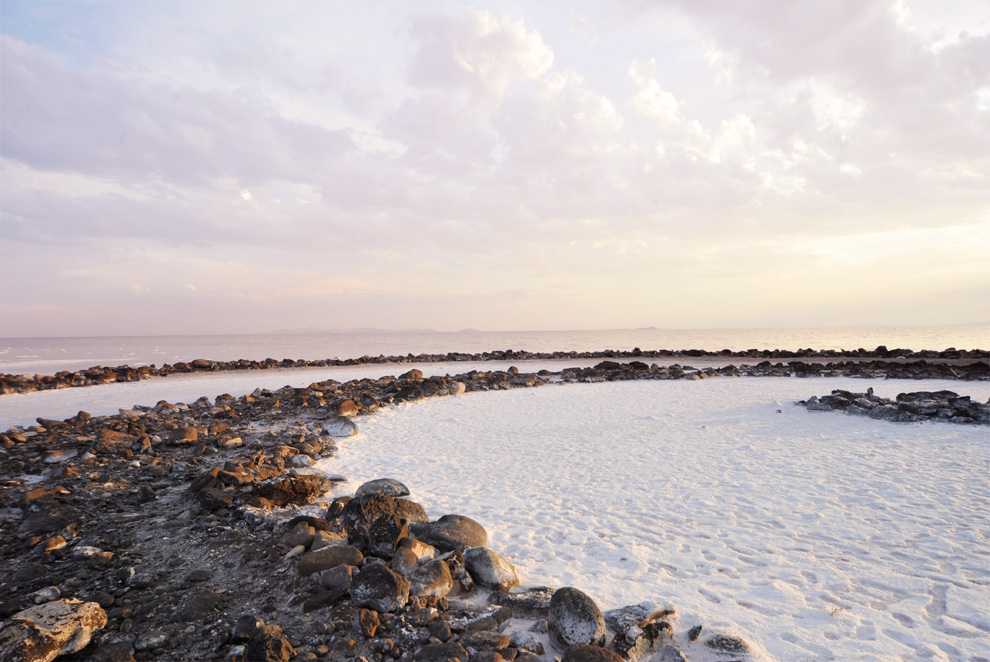
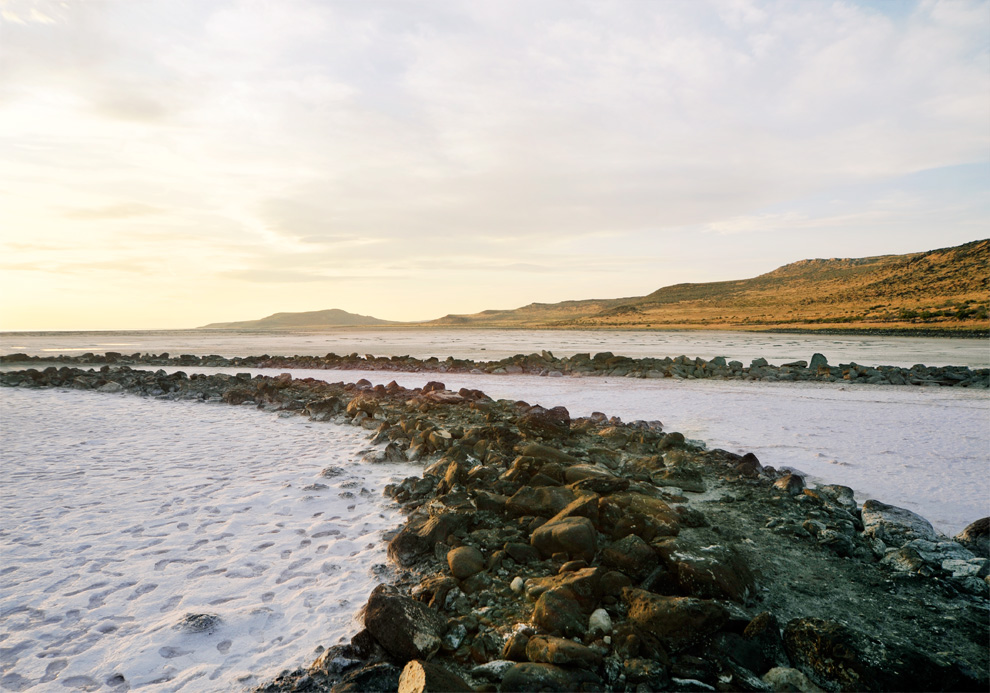
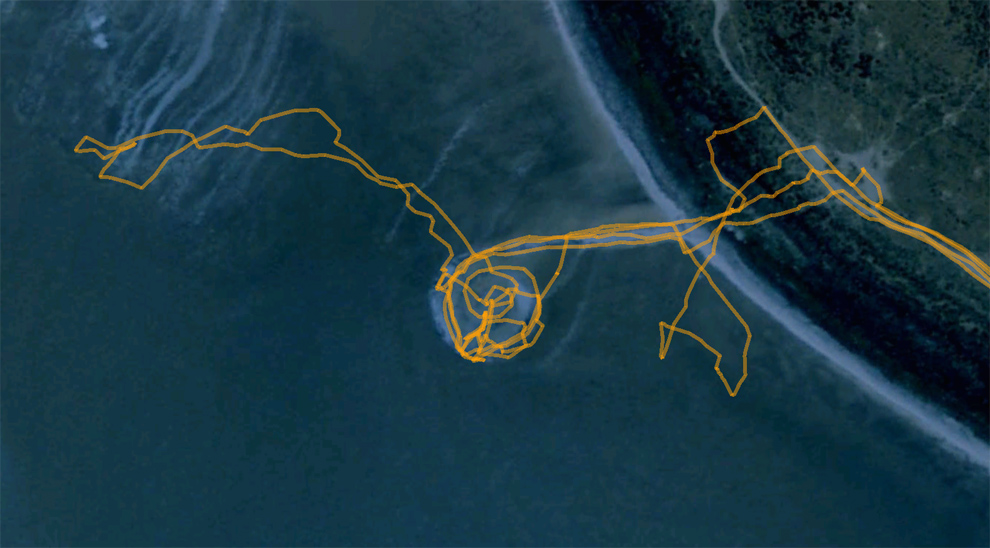
I had left the Super 8 around noon and made the Golden Spike National Monument by two. I was constantly stealing glances down to my printed map, but it proved unnecessary. At the first nameless, dusty fork in the road there is a large printed sign hammered into the ground: “Spiral Jetty <-- 18.2 miles.” Once the road devolved from dirt to rock, I ditched the Pontiac and hoofed it the last, short ¾ mile. And then there it was. Less a jetty, the spiral is now landlocked, only touching the red waters on its outer, westernmost coil. I nearly broke my leg scrambling down the ridge, jumping from rock to rock, my jaw on the ground.


Here’s the thing about the Spiral Jetty, hyperbole crystallizes on it like salt deposits. (!) Canonized as the epitome of land art, Spiral Jetty is “the quintessential heroic gesture in the landscape.” Time and art history texts have relegated it to the status of masterpiece, unquestioningly titling it the iconic post-war artwork, classified as the ultimate embrace of the western landscape, with a direct link to the primal, pre-historic apologue of life and death. Robert Smithson, the essential iconoclast for rejecting the confines of the New York gallery scene for the freedom of the Great Outdoors. And so on. And, like everything in the West, you print the myth because the facts can’t compete; they’re too slow, too complex, not as easily digestible. As an art object, Spiral Jetty traffics in myth in spades, assuming legendary status in no small part due to two occurrences.


One, about two years after it was completed it was swallowed up by the waters of the Great Salt Lake, unwittingly creating a small cabal of people, those who had actually seen it, to fan the art world and spread its gospel. At the height of its popularity, it no longer existed as a physical object, but rather as an idea and media object that was disseminated through film, photography, drawings, diagrams and writing. Land Art (earthworks, earth art, LAND/ART, whatever) and Smithson faded from memory in the late 90s, but both experienced a resurgence in 2002 when MOCA and the Whitney debuted a major Smithson retrospective that was fortuitously staged simultaneously with the re-emergence of the jetty itself. After 30 years it rose again out of the lake like an Authurian legend, almost as if the waterline of the Great Salt Lake itself was under Dia and the Whitney’s command.


Two, Smithson himself was transformed into a mythic hero, due to his tragic death at thirty-five, only three years after completion of the Spiral Jetty. He was the cowboy Icarus art god who fell from the plane, clutching his camera while scouting sites in the Texas plains.


The problem is the canonical adorations become conventional; the cliché saps the object of its inherent strength allowing it to safely be categorized in a simple historical box, kind of like in an “Oh yeah, Spiral Jetty, that’s a masterpiece, what else is new” way. So the viewer is really left with one of two options when actually confronted with the object itself. The first is a vaguely discomforting, disappointing notion that the object has been rendered impotent to the point of dissolution. Again, think Sistine Chapel, Mona Lisa, the Grand Canyon. What you came to see is gone, disappeared in a mass of jostling Germans in short pants. The second is incredulousness leading to exhilaration. That thing is really real, it exists, Smithson pulled it off. The syntactic gaps between what you expected in your mind and the reality of what is sitting in front you are bridged, and something fires.


At least, those were the two options I predisposed myself for when I set out from Salt Lake City. Arriving at the jetty and Rozel Point I felt a mixture of what was certainly exhilaration, delight and disappointment. The one truth is that the facts are always more complicated. And as interesting as combing over the historical essays and theoretical exercises might be, I can say without equivocation, that whatever you may think, it will be better in person.


My reaction is as follows, but first an examination of those historical essays is in order (naturally). But only those penned by Smithson himself, because the artist’s own writings are incredible, they’re personal, banal, critical, whacked-out like a space age fever dream. Take this for instance:


“Following the spiral steps we return to our origins, back to some pulpy protoplasm, a floating eye adrift in an antediluvian ocean. On the slopes of Rozel Point I closed my eyes, and the sun burned crimson through the lids. I opened them, and the Great Salt Lake was bleeding scarlet streaks. My sight was saturated by the color of red algae circulating in the heart of the lake, pumping into ruby currents. My eyes became combustion chambers churning orbs of blood. Swirling within the incandescence of solar energy were sprays of blood. Perception was heaving, the stomach turning, I was on a geologic fault that groaned within me. I had the red heaves, while the sun vomited its corpuscular radiations. Surely, the storm clouds massing would turn into a rain of blood.”


It sounds like it could come from a pulp drug novel, and you’d be excused for thinking this guy is some kind of stoner rock god. He’s placed the spiral as a symbol of our primordial, antediluvian origins, where interior and exterior blur (“sun burned crimson through the lids”), man and nature entwine and merge (“geologic fault groaned with me”) and apocalyptic visions reign(“clouds massing would turn into a rain of blood”). From there his writing continues, oscillating from straightforward field note-ish accounts of the construction of the Jetty (“From New York City I called the Utah Park Department and spoke to Ted Tuttle”)-I would’ve liked to hear what Ted thought – back to scientific geological records of the site, segueing into 60s gonzo acid trip territory, then back around to ruminations on the nature of the picturesque and sublime in Enlightenment and Romantic travel narratives (he was really into Frederick Law Olmstead). The whole thing is definitely worth reading a few times.


Maybe it was the battered copy of J.G. Ballard’s Terminal Beach that was riding along in my backpack, but I found myself returning to what I saw as the most interesting of the many genres that Smithson quotes from – science fiction. In Lytle Shaw’s essay, “Smithson, writer,” Shaw argues that Smithson, by using such time cancelling phrases in descriptions of his Jetty such as “immobile cyclone,” a “dormant earthquake,” and a “spinning sensation without movement,” is associating the outdoor site with science fictions ecological apocalypse and is in effect stopping nature’s clock in the midst of its most dramatic productions. The frozen natural disasters are not just part of harnessing the sublime power of nature, but they are the actual genesis of the form of the sculpture itself – the Jetty is the physical embodiment of the forces Smithson found at the site.


Smithson’s freezing effect is but part of a larger thematic connection to the science fiction genre, one that includes time as a driving force. In “Entropy and the New Monuments,” Smithson goes through a number of rhetorical inversions to imply that first the monuments of his age will reverse the temporal baseline by shifting past and future, but then secondly, that those monuments will function as actual agents that cast doubt on the possibility of directional time itself:


“Instead of causing us to remember the past like the old monuments, the new monuments seem to cause us to forget the future. Instead of being made of natural materials, such as marble, granite, or other kinds of rock, the new monuments are made of artificial materials, plastic, chrome, and electric light. They are not built for the ages, but rather work against the ages.”


Not only an indictment of modern architecture, the essay brings up a crucial notion for Smithson, the one word that summed up his preoccupations with dissolution, degradation and the direction of time: entropy. The second law of thermodynamics, the rejection of Newtonian perpetuity, entropy codifies the inevitable disintegration of all matter. The universe will eventually fizzle out to nothing, the center cannot hold. Ruins are monuments to entropy, and the site around Rozel Point holds a number of examples. Smithson chose the site in part because of the preponderance of enigmatic wreckage. Your first view of the Salt Lake is also the first encounter with a jetty, not a spiral one, but an abandoned oil drilling station that has been overtaken by disrepair, frozen in a state of natural decay. And the Spiral Jetty itself ended up having a short half-life, disappearing under the salt water before emerging again with a new patina of white salt. The concept is pretty incredible, Spiral Jetty the sculpture is not just a representation of the concept of entropy, it is entropy. Simply put, it was ‘entropy made visible.’ You take nature and turn it into art. Nature can be the basaltic rocks and earth of Utah or an immaterial idea, while art can be a jetty or a building. All that matters is the transformation and the acknowledgment that what is built will in turn erode. Nothing is stable.


A hot topic in the architectural world right now is ‘emergence,’ a topic which is pretty vague (something about scripting), but I would argue that Spiral Jetty is part of the concept that process is more important that the final piece and time produces interesting and unexpected results that are outside the reach of the creator. The crystallization of the salt particles, the ever shifting water levels, the dissolution of the pure form to something a little fuzzier, the way the water gets all foamy as it laps up against the rocks are things that Smithson couldn’t have planned predicted. Object and site move forward together as something new. The site was revitalized, but the historical textuality of the site (the industrial ruins) was superimposed onto the bulldozed earth of Smithson’s object. He refers a lot to ‘collapsing time,’ in his writing, merging the stone age with the space age. Check out his film on the Spiral Jetty, Smithson trumps Kubrick’s celebrated 2001 jump-cut from bone-as-tool to orbiting spaceship, with his own lumbering dinosaur to rumbling dump truck. Kubrick was looking forward to technological evolution, Smithson portrayed the artist as mover of mountains, a primordial designer. Construction is also destruction, and the built-in obsolescence of the Spiral Jetty is paralleled and alluded to in the fate of the dinosaurs. Even at its conception, the time was ticking.


The space age/nuclear age allusions become even more explicit with Smithson’s later quote upon seeing the Spiral Jetty from a helicopter: “From that position the flaming reflection suggested the ion source of a cyclotron that extended into a spiral of collapsed matter. All sense of energy acceleration expired into a rippling stillness of reflected heat.” He links the Jetty to the spiral-shaped cyclotron developed during the Manhattan project that was integral to enriching uranium by speeding up and separating particles using electromagnets.


Smithson’s description of the sun burning crimson through his closed lids could also be seen as a reference to accounts from B-52 crewman, dropping the H-Bomb in the Bikini Atoll in the early 50s. The first invisible wave ejected from an explosion caused by nuclear fusion is a blast of x-rays. Pilots reported seeing the bones of their hands through their closed eyelids, while the rest of the crew appeared as walking skeletons. The military must have also picked up on the latent apocalyptic archetypes of the Utah salt flats. In 1944, 70 miles away at Wendover Air Force Base, the US Air Force began preparations for the use of the atomic bomb against Axis Forces. Paul Tibbets and the 509th Composite Group began running mock flight trials with the newly designed B-29 Superfortress, trials intended to simulate the precise deployment of one bomb followed by a sharp aerial maneuver to avoid the initial blast wave.


You can walk the spiral in less than five minutes, it’s smaller than you think (vaguely disappointing). And with the recession of the water level, you can cut back across the coils, leaving footprints in the white salt. It crackles and hums as the microscopic salt crystals break (delightful). And absorbing the bizarre atmosphere of the place, dangling my feet in the surprisingly warm water, the salt already crystallizing between my toes, while pondering the peculiar evening redness of the place (exhilarating), I thought back to Smithson’s quote that “a great artist can make art by simply casting a glance,” and I returned to Ballard, and Traven, the protagonist of ‘Terminal Beach.’ Left to wander the ruins of an abandoned atoll, once used for the testing of nuclear weapons, he makes his home among the decaying observation towers and mock bunkers. Gradually he succumbs to the same entropic devices taking their toll on the debris of science and civilization. Decaying physically and mentally, the structures of his mind become one with those of the island, until one day he sees two travelers, scientists, who came to conduct biological research in an empty, contaminated submarine holding pen. Smithson’s preoccupation with time and entropy, antediluvian history and science within the vortex of the inner workings of the mind find substance in this exchange from Ballard:


‘”Doctor,” he said, “Your laboratory is at the wrong end of this island.”
Tartly Osborne replied: “I’m aware of that, Traven. There are rarer fish swimming in your head than in any submarine pen’.


spiral_path

20090827 Tags: kinne, photography, utah, writing | No Comments »

exile town planning

mormon

“In ordinary times … the center always wins. Its power grows with time, and that can’t be reversed”
Thomas Pynchon, Gravitys Rainbow


A slight deviation before I get to the Spiral Jetty. Any discussion of centeredness, the confluence of the natural and man-made, authority and entropy in Utah deserves a tangent into the realm of historically utopic Mormon Town Planning, which eventually everyone just called Standard Utah Town Planning.


Here’s a quick primer on Mormon urban planning in Salt Lake City and Utah in general (and this holds true from dusty one-blinking-light towns with generous cow to person ratios, to the shining Olympics-courting metropolises), streets don’t have names like “Crystal Cove Road” or “Misty Meadows Way,” no, here every road is a cryptic combination of number and cardinal directions. For instance, the Super 8 Motel Salt Lake City (excellent wifi by the way) is located at 616 W 200 South. In other words, after decoding, W 200 South is a location that is two blocks South and West of the central Salt Lake Temple of the Latter Day Saints.


Before cities were wrapped around a central commercial core, a common spiritual core bound the city together. The steeple, stretching to heaven, was the literal and spiritual focus of the town. Here, in Utah, the physical layout of the urban grid is still a manifest of the spiritual hierarchy and priorities of the community. In the City of Zion, the first order of Heavenly business is the consecration of a Mormon Temple at the city center. All street names defer to the center and subordinate their own individual identity for what is in essence a mileage marker to salvation. You could probably make a pretty convincing argument that here in Utah a singularly unique situation arose where urban planning occurred post-Industrial Revolution and allowed church and industrial core to mature in parallel. In other words, the business of Utah is the church.


I was concerned how this street-naming system could adapt around unavoidable natural barriers such as rivers or mountains and whether the town fathers had to throw in a winding “Joseph Smith Drive” that would have the freedom to snake around a stream or run parallel to the Wasatch foothills. There are in fact diagonal streets that cut through the rectilinear urban grid in situations that demand unorthogonal solutions, but these streets are appropriately enough simply named “Diagonal Street” or some other such functionally innocuous sounding name. In a city of Salt Lake’s size, there are multiple temples, so there’s also of course the issue of how, when you’ve crossed the threshold into the territory of a new Temple, someone knows which E 200 S you’re referring to – is that in relation to Temple A or Temple B. It is still unclear to me how this works, but one has to assume they’ve addressed this point as mass confusion is not ensuing.


The result of being in towns like this is twofold, on one hand it is extremely convenient (assuming you’re a Mormon – Utah is 62.5 percent LDS – so you probably are) to find and locate yourself in relation to a temple. This grounding must also be comforting on some level. Utah Mormons grew from exile, having been banished from Ohio and Illinois, they found their Zion in the desert and must still find peace knowing that a Temple is always an easily navigable route away. While on the other hand, it also feels like a somewhat grim, insidious and not-so-subtle means to reinforce the binds that the church exerts over the city, which you’re constantly reminded of while driving through any neighborhood, reading a map, asking directions, etc. Somebody out there has probably done an interesting study of whether there is a higher concentration of crime in block E 1500 S versus E 200 S.


Like all artists, the Mormons took the natural, the desert, and made it their art. And in so doing, the land became an integral part of their history and belief system. From the hardships of the desert came the notion of “Deseret,” whose meaning states that the welfare of the community holds primacy over that of the individual. Thus they were able to endure the harsh desert, and by what looks like to all accounts, prosper. The departure from Illinois became less a banishment and more a self-imposed exile. Where their desert Zion offered both a freedom to escape what they saw as religious and social persecution, and also as a natural barrier preventing outside interference and encouraging notions of self-sufficiency through isolation.

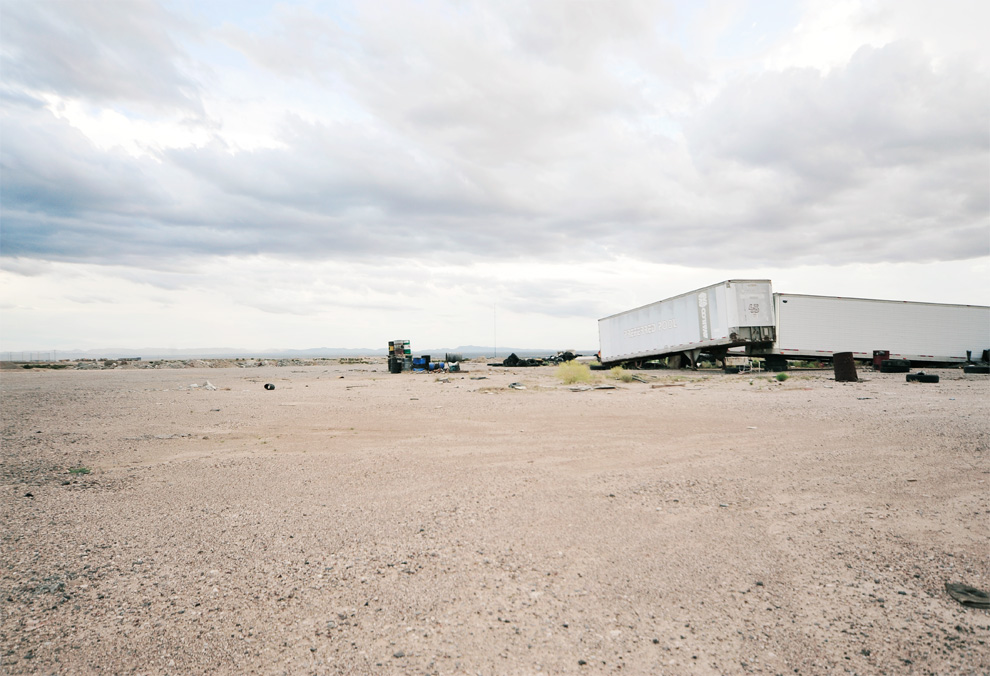
20090821 Tags: kinne, photography, texas | 1 Comment »

seen outside horizon city, texas

horizon

20090819 Tags: infrastructure, kinne, mexico, photography, research, texas, writing | No Comments »

something there is that doesn’t love a wall

wall01
_dsc77221
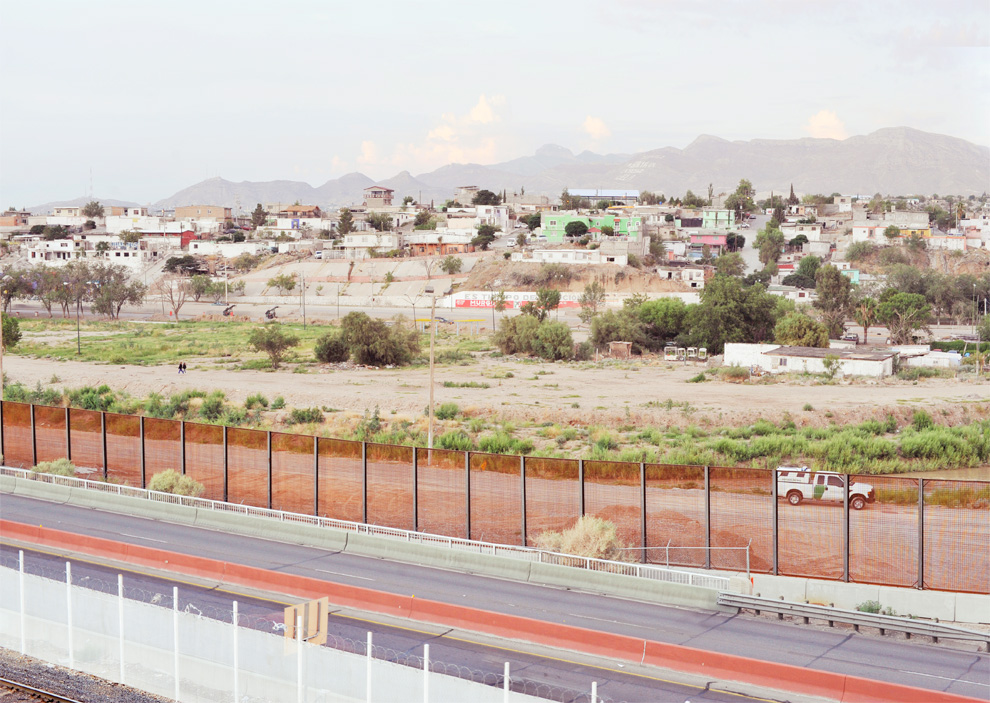
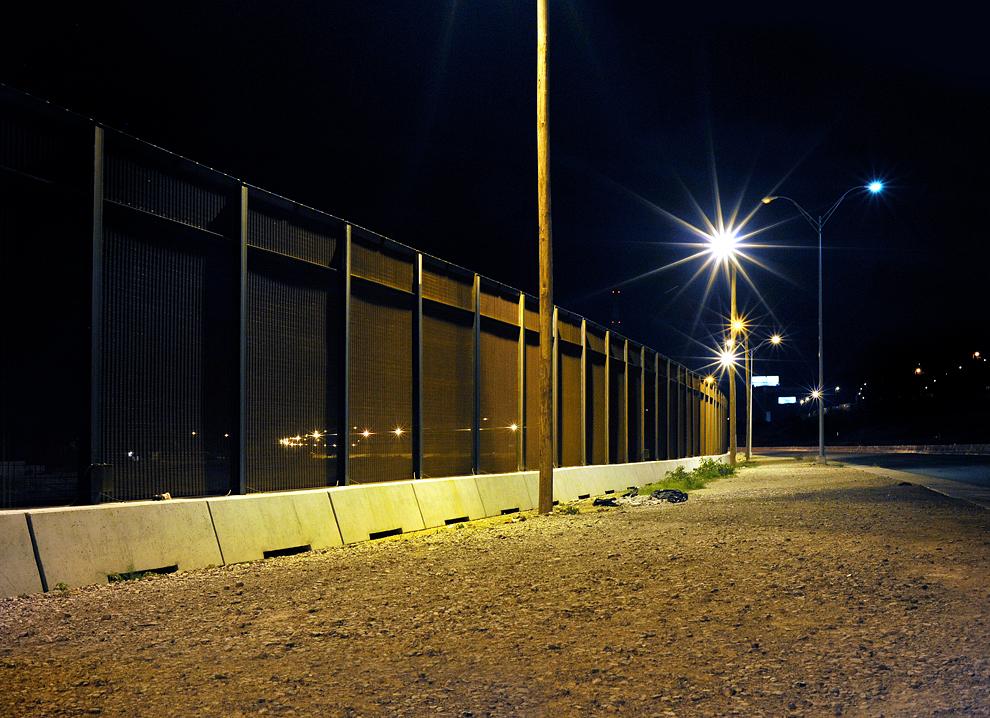
It’s eighteen feet tall. The vertical steel pylons are set closer together than the width of a truck to resist the force of direct a hit, thereby avoiding the possibility of any punctures or vents. The pylons are infilled with an anodized metal mesh, a mesh that flaunts heartbreakingly clear views through to the other side, which, however, is at the same time dense enough to prevent all but the smallest of fingers and toes from finding purchase. A man wielding bolt cutters was shot here by a Border Patrol agent eighteen months ago. (boilerplate response: “the Mexican government opposes the use of lethal weapons in situations that do not represent a proportionate risk.”) The concrete base is over three feet wide to withstand a potential rocket attack and extends six feet into the underground bedrock layer to deter any would-be tunneling. It cuts through the desert for 690 miles, heedless and ignorant of laws designed to protect and uphold environmental protection, endangered species reserves, migratory bird paths, antiquities, Native American graves and religious freedoms, among thirty others. To the U.S. Government it is not a wall, it is “tactical infrastructure.” And no one wanted it here.


Two neighbors are meeting at the terminus of their properties and inspecting a damaged rock wall that divides their lots in Robert Frost’s “Mending Wall.” The narrator is playful, almost goading and pushing the neighbor into articulating the necessity of rebuilding the wall. These are the last five lines of the poem:


He moves in darkness as it seems to me~
Not of woods only and the shade of trees.
He will not go behind his father’s saying,
And he likes having thought of it so well
He says again, “Good fences make good neighbors.”


That second guy, the one moving in darkness, the recalcitrant and plodding neighbor, a blind slave to the cliches of the father, that guy is Michael Chertoff. As reported in the Washington Post of August 2007, El Paso Mayor John Cook stated: “Most people in Washington really don’t understand life on the border …They don’t understand our philosophy here that the border joins us together, it doesn’t separate us.”


The context of Cook’s statement was a lawsuit filed by the City of El Paso, El Paso County, the El Paso County Water Improvement District No. 1, and the Ysleta del Sur Pueblo, among others, against the Department of Homeland Security. In 2005, Congress tasked DHS with the “the expeditious construction of barriers” to construct the border wall and granted Chertoff power to void any federal law that would prevent that expeditious construction. Thirty-six laws protecting environmental quality, historical resources and native American sites were waived. El Paso believed the waivers were detrimental to the health of the region and found them unconstitutional. In September 2008 a Federal District Judge granted the DHS’s motion to dismiss the lawsuit. El Paso lost, and the fence was quickly rushed to completion before a January 31, 2009 deadline. With the damage already done, in June of 2009 the US Supreme Court denied the city and county’s appeal. The court upheld that Congress had legitimately granted Chertoff the power to dismiss any law that could potentially deny his given mandate.


Except in matters of national security, Mexico City and Washington, D.C., are remote and disengaged from the workings of the border. Today it is largely up to the local governments and organizations along the border region to resolve persistent local urban problems in the area, such as zoning and water rights. The border region has frequently been defined as a “third space,” with competing government agencies, and NGO’s occupying this new territory. However, the lawsuit showed that no matter how far removed, the Federal Government can still trump local concerns.


Even in an administration bursting with hubris, when defending the border wall Chertoff stands out as a fount with a number of choice quotes. Among them being, in defending security at the border from El Paso concerns: Chertoff claimed the city “had no idea how difficult it is here at the border.” And considering the detrimental repercussions a steel border would have for economic and cultural future of the conjoined twin cities of El Paso and Juarez, Chertoff stated that in response to DHS actions that, “We don’t want to destroy the border in order to save it.” (Even hearing a government official obliquely reference Bến Tre logic in a domestic setting is both ridiculous and pretty frightening.)
But in the end, Chertoff is no different than the neighbor in Frost’s poem, unable to comprehend the inane necessity, but nevertheless pushing forward with all expeditious concerns, all the while ignoring the difficulty of justifying its existence does not preclude actual construction. As an essential infrastructural component, the wall was rushed to completion and now stands as a thin monument to fear and paranoia.


Succintly summed up, and quoted in BreitBart, the border fence “is a political initiative meant to satisfy conservatives in Congress who have played to fears about all immigrants being terrorists, criminals, and living off the dole,” El Paso County Attorney Jose Rodriguez, the point man in one of the lawsuits, fumed.


Immigration had become a national security priority. Tijuana and Ciudad Juárez grow at an annual rate of 6.3% and 5.3%, respectively. Most of this growth is attributed to immigration from within Latin America. It is estimated that over 33% of the cities’ populations originated from outside the state of Chihuahua. Of those that emigrate from Tijuana and Juárez, 95% go north, to the United States. This has created a nomadic class of people, with aspirations for a better life elsewhere. The Mexican side of the fence is less a home, and more of a strategy for escape, which in turn creates an American side ‘under siege,’ – the U.S. builds increasingly higher walls and more gated communities.


A quick note about the second photograph: say what you will about Border Patrol Agents, they’re nothing if not efficient. Less than two minutes after pulling off the road, and about 30 seconds after taking a picture I was boxed in by two white trucks. A cursory glance showed that I was not a Mexican, and a more thorough glance showed that there were in fact no Mexicans stowing away in the trunk.


This would be one of many inadvertent interactions with the Border Patrol. They’re ubiquitous, most notably in the compulsory check points scattered all along the highways of the southwest. Typically they’re pretty casual, and I can’t help but think that there’s always some half-concealed disappointment at my glaringly non-immigrant, Caucasian-ness. And it’s important not to confuse the Border Patrol with their stern-eyed, grim faced cousins – the Custom Agent. Those guys don’t joke around. But the Border Patrol is different. Even odds are they haven’t been on the job that long – the number of active agents has doubled since 2001. What makes them even more interesting, and endemic of all border complexities, is that they’re typically Hispanic. Which means that statistically they themselves are less than two generations removed from being Mexicans living in Mexico. This is something I’d like to ask this guy about. I’d also like to ask whether they ever experience a sense of futility in what has to be a frustratingly obvious system that expends such vast sums of man hours, time and money just to briefly detain illegals in over-crowded processing centers, then deport them back across the border as part of a never-ending cycle of catch and release. And while they’re certainly fraught with complex issues of identity, nationalism and duty, issues that I can’t begin to understand, those are all of the things I wanted to ask about. But standing under the border wall floodlights along a dark, lonely road, I couldn’t muster the courage.

20090818 Tags: kinne, mexico, photography, texas, writing | No Comments »

mt christo rey

elpaso
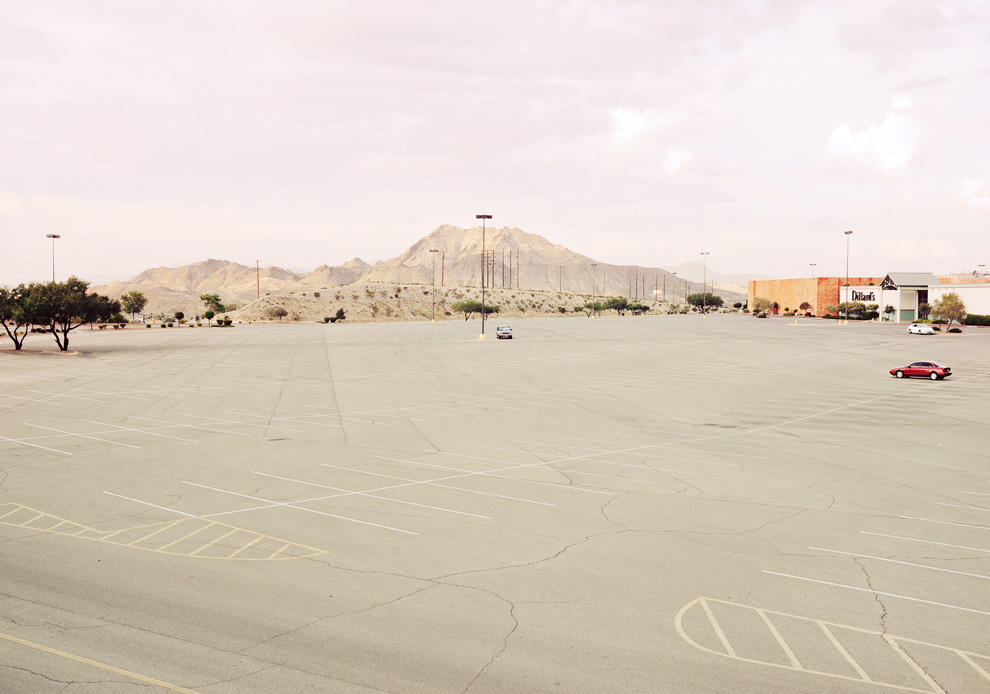
A pretty good indicator of the economic health of El Paso is found in the number of stores tucked into the Sunland Park Mall that deal in only one type of good (clothing) that, storewide, all ring up for the same price (a price less than a student-discounted movie ticket in nyc); as it stands that number is at least three. Think dollar stores. There’s the store where every clothing item is $8.80 (but not $8.88!), the store that only sells Mexican-flavored cowboy hats for $7 (where the arcade used to be), and the store that is basically Puff’s $12 Zoo but now has a different, less-cool name. Most of the national chains left the uniquely predetermined claustrophobia that defines the enclosed-mall for the cheap, ample and available land around the desert that was waiting for strip malls.


But, on the other hand, a really good indicator of the economic health of El Paso is found in census data which shows that the city’s poverty rate tops 27 percent, and the median income hovers significantly below the national average of $48,000 at around $35,600. El Paso’s population is also over three quarters Hispanic, while a quarter of the population is foreign-born. Really, however, neither indicator provides an adequately clear picture of the unique trans-national partnerships that allow the border region to work, and prosper.


Actually, the best indicator of the economic health of El Paso can be measured by the extent of the U.S. Army Corp of Engineers’ progress in erecting a border wall along the Rio Grande, dividing El Paso and Juarez. In a last ditch effort in the fight for its own economic and cultural self-survival, the city of El Paso sued U.S. Homeland Security to halt construction of the wall. In January of this year, the Supreme Court denied their appeals. They lost.


If you’re a fan of talk radio, or are familiar with the rancorous fulminations over the very existence of legal and illegal immigration – part of that broader, more general right wing fear of the “other” – it must come as a surprise that El Paso is one of the safest cities in the country, not to mention the happiest. El Paso is the third safest urban center (after Honolulu and New York) with only 18 murders in 2007 in a city over 700,000, and was recently ranked by Men’s Health Magazine as the second “happiest” place in America. The title of number one happiest place in the country went to Laredo, Texas, another border town north of the river. That El Paso is safely ensconced in an embrace of jocularity across a shallow river from blood-soaked Juarez is another indicator that in spite of seemingly contradictory evidence, the border provides a delicate alternate model for economic growth, one that is beset by constant danger by overblown concerns of national security and ever-higher barriers.


How does it work? When former Juárez mayor Gustavo Elizando states that the only way “the cities in this region can make it, is to forget that a line and a river exist here,” he is referring to an economic co-dependence. El Paso and Juarez have generated a series of overlapping economic and functional circulation realities between the cities that circumvent the traditional gatekeeper role of boundaries. Culture, family, a never-ending supply of labor pass back and forth in an asymmetrical relationship of twin cities, one twin richer, the other bigger, that leads to a mutual beneficence. However, there is a constant danger that the pass will be choked off, doors will close, and the cities will drift.


In a Reason Magazine article titled “The Miracle of El Paso,” the author argues that El Paso defies the belief that poverty leads to crime not in spite of “its high proportion of immigrants, it’s safe because of them.” By 2050, racial and ethnic minorities in the U.S. will outnumber non-Hispanic whites; one out of every four will be Hispanic. With population increase comes greater political influence. El Paso provides a handicapped preview version of what in the future will become a political and cultural reality, one that is, and was, avoidable in the post-2001 rush to close the borders. A premonition of the mutual benefit to be had in monetary and spirit well-being that come from accepting that culture, economics and politics are entwined and nurturing the open, cross-pollination of people and ideas – that the lowering of the wall – can allow everyone along the border to thrive.


That belief is losing. The wall is winning.

20090818 Tags: arizona, california, kinne, new mexico, photography, texas, utah | No Comments »

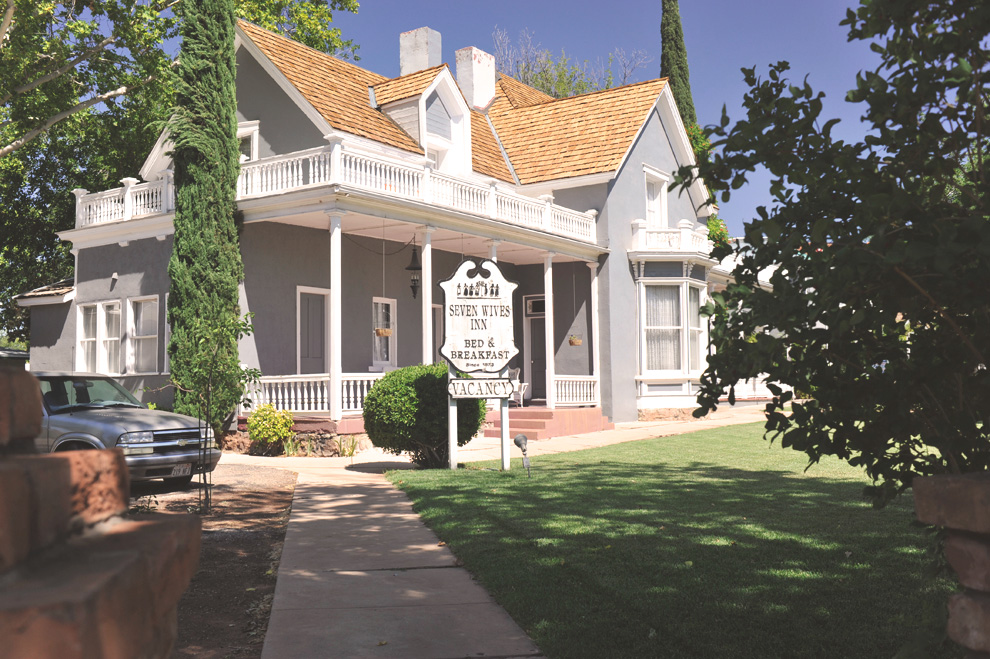
some of the places i’ve slept

inn1inn2

inn4inn4

inn5inn6

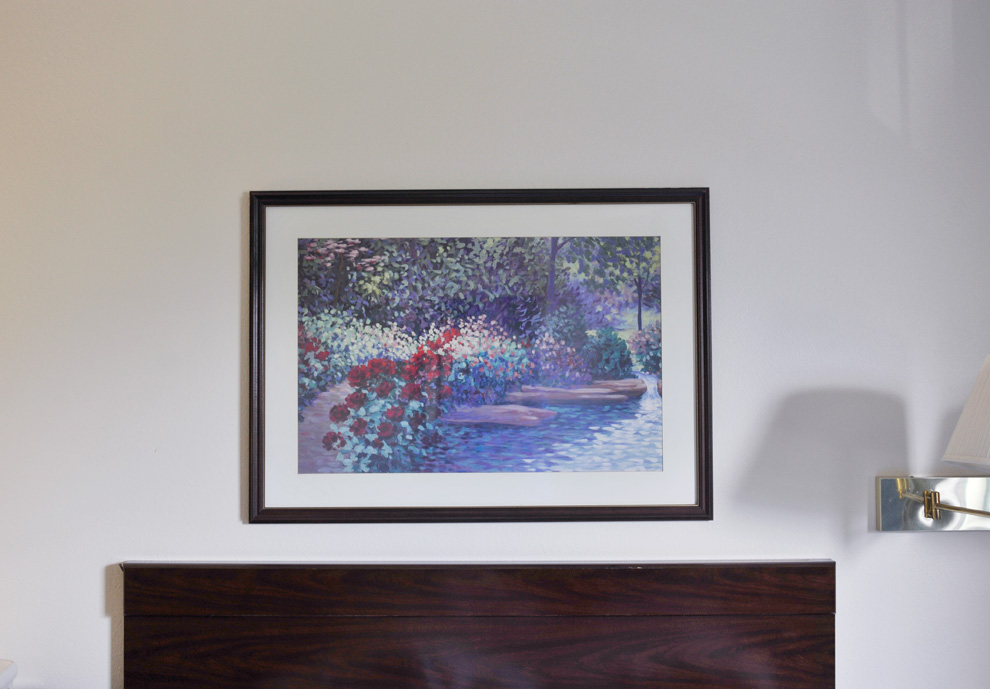
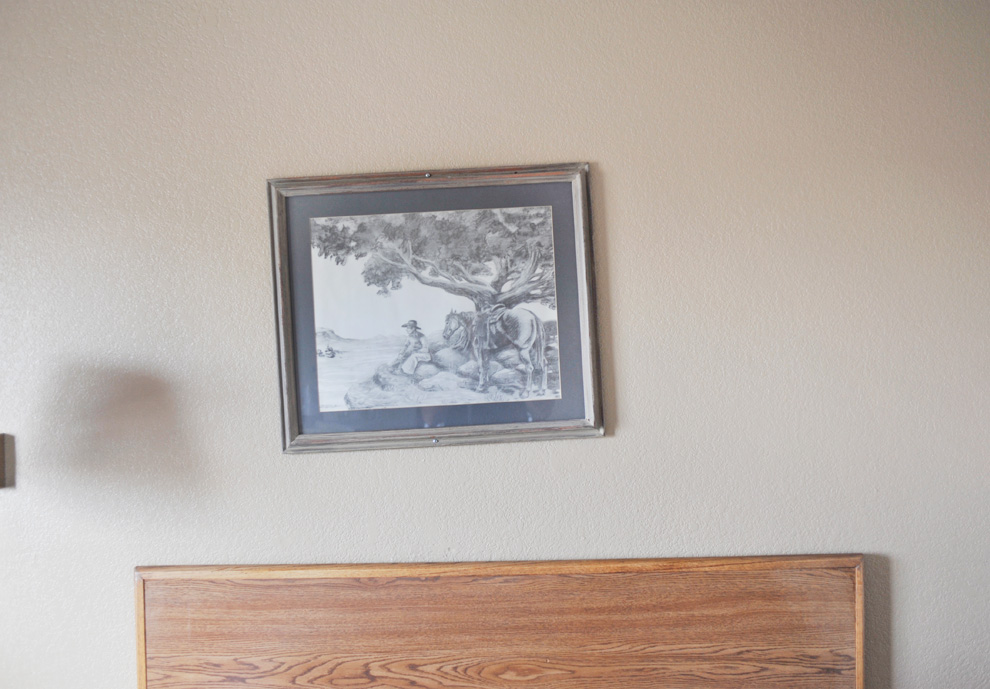
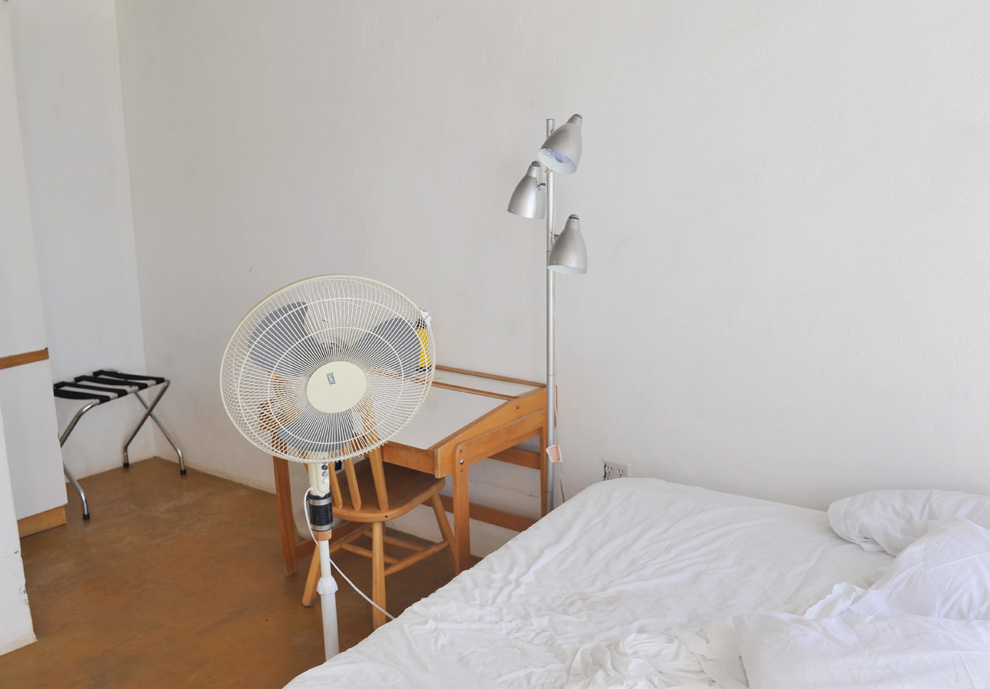
(clockwise from top-left): Suburban Extended Stay, Midvale, Utah; Super 8 Motel, Las Cruces, NM; The Dixie Inn, St. George, Utah; El Paso West Travelodge, El Paso, Texas; Arcosanti, Mayer, Arizona; Mission Valley Resort, San Diego, California

20090814 Tags: kinne, photography, utah | No Comments »

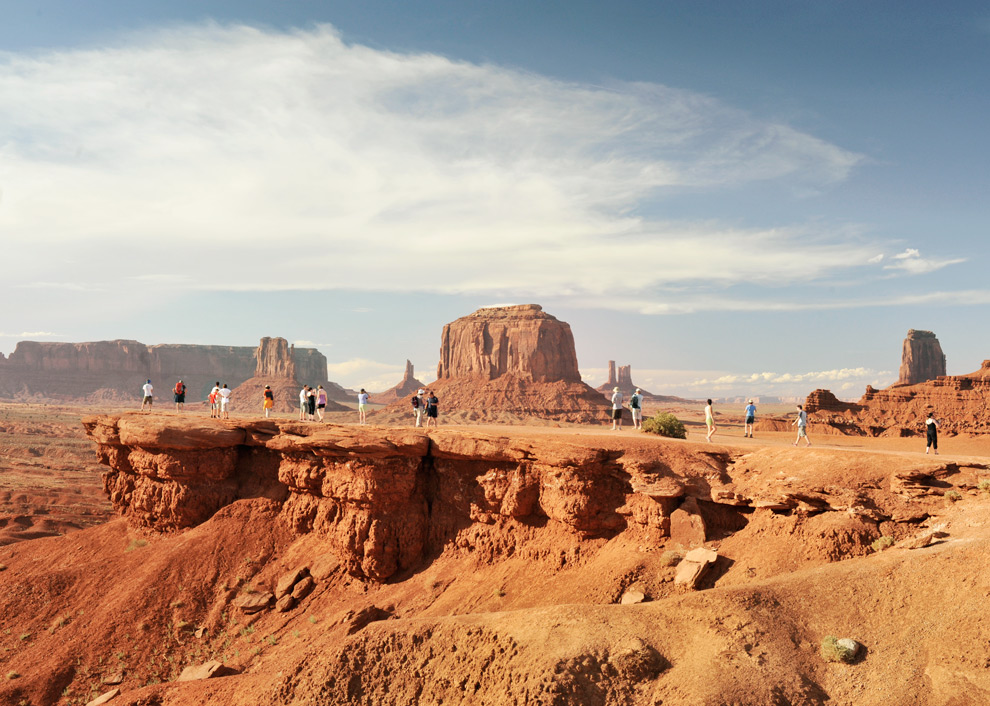
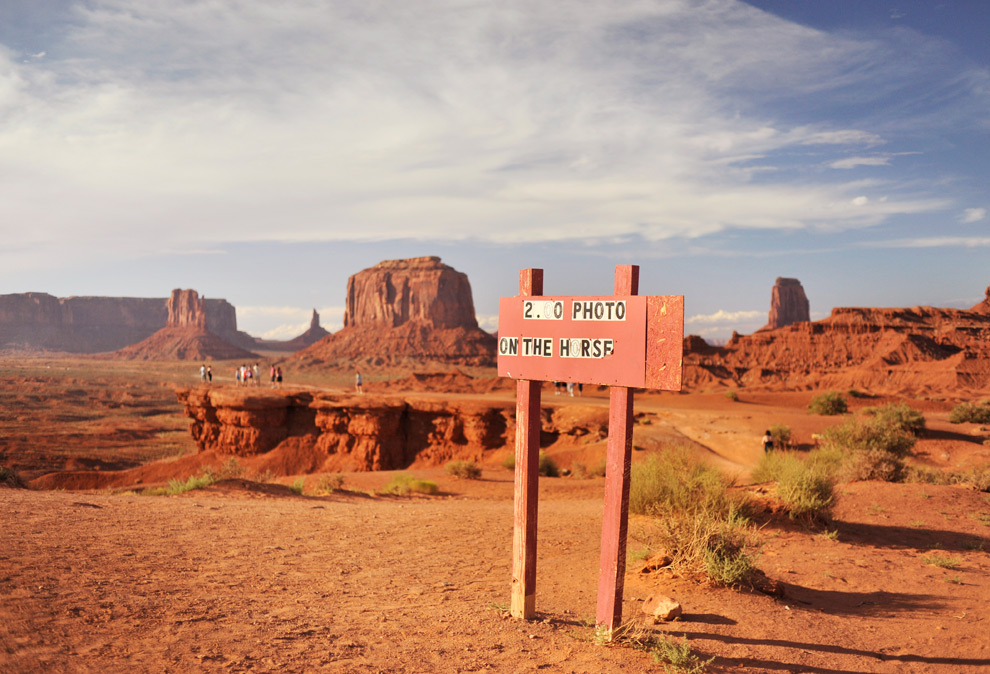
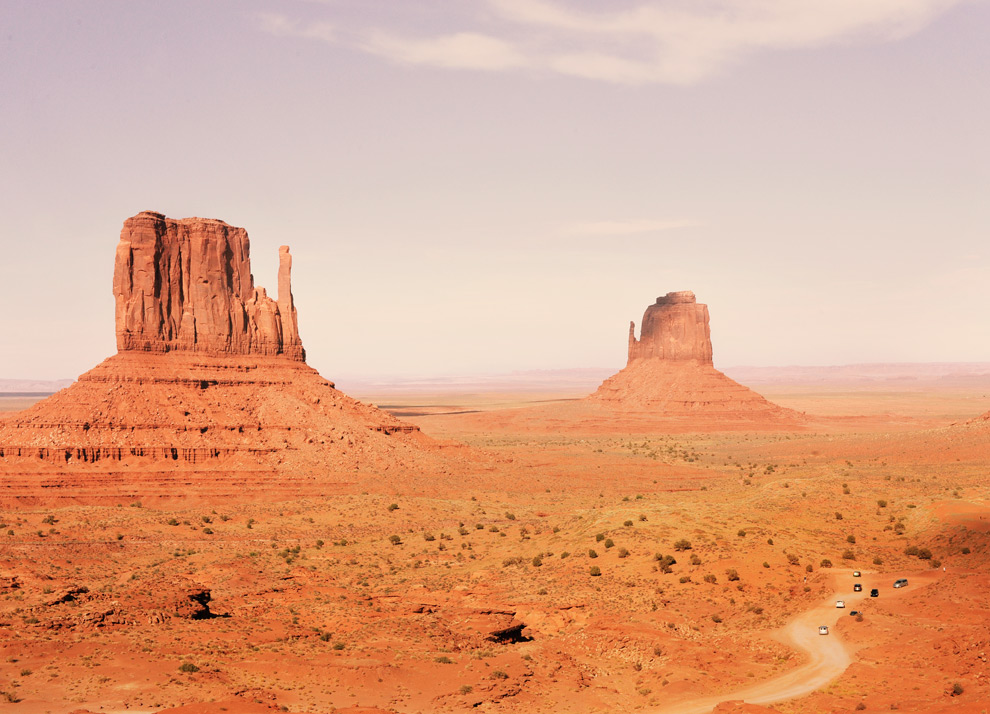
movies you saw when you were little

mv01
mv02
mv03
From point of interest stop 4 on the Monument Valley Driving Tour, “John Ford Point“

20090814 Tags: kinne, mexico, writing | No Comments »

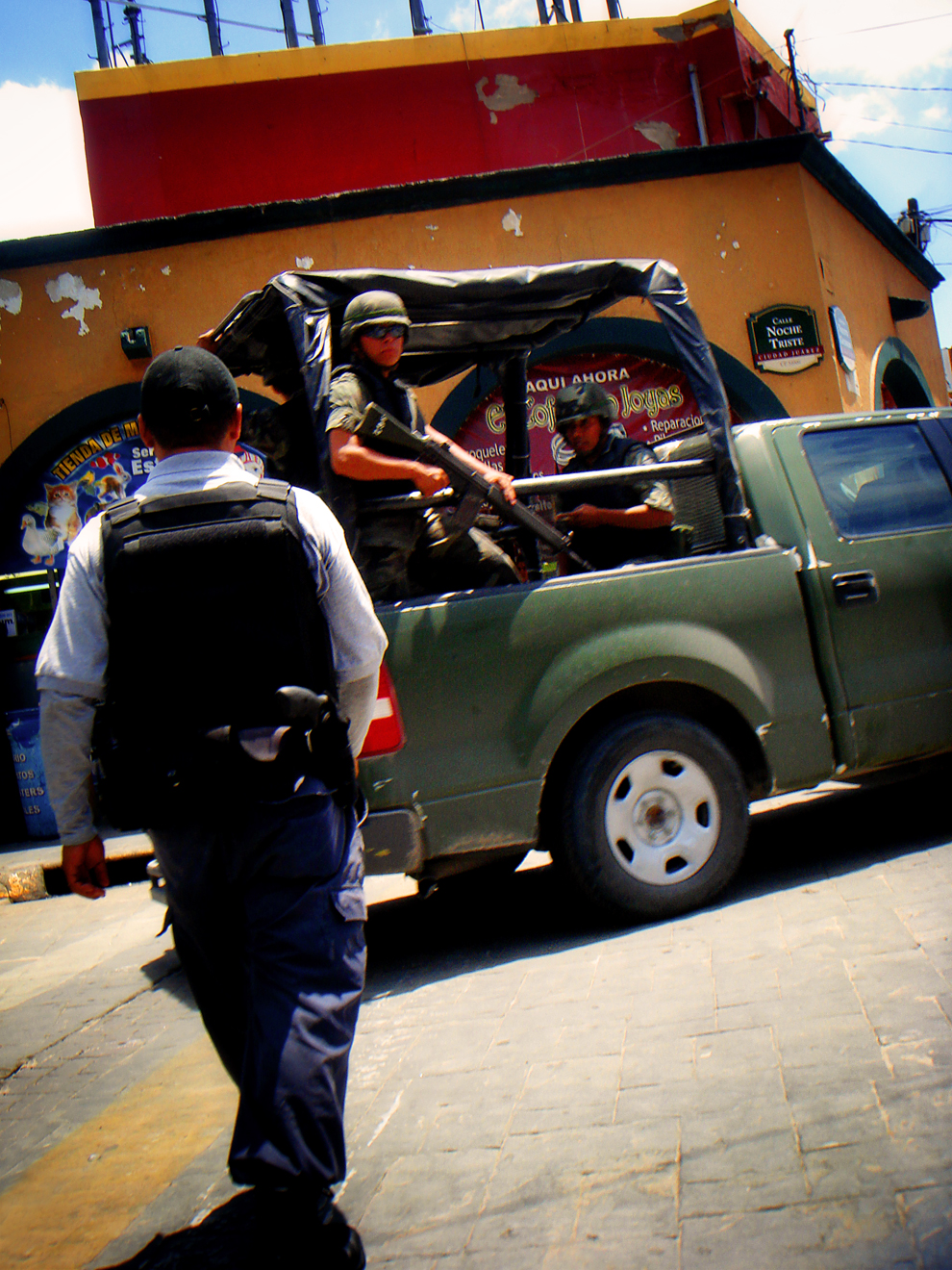
calle noche triste

dsc066472
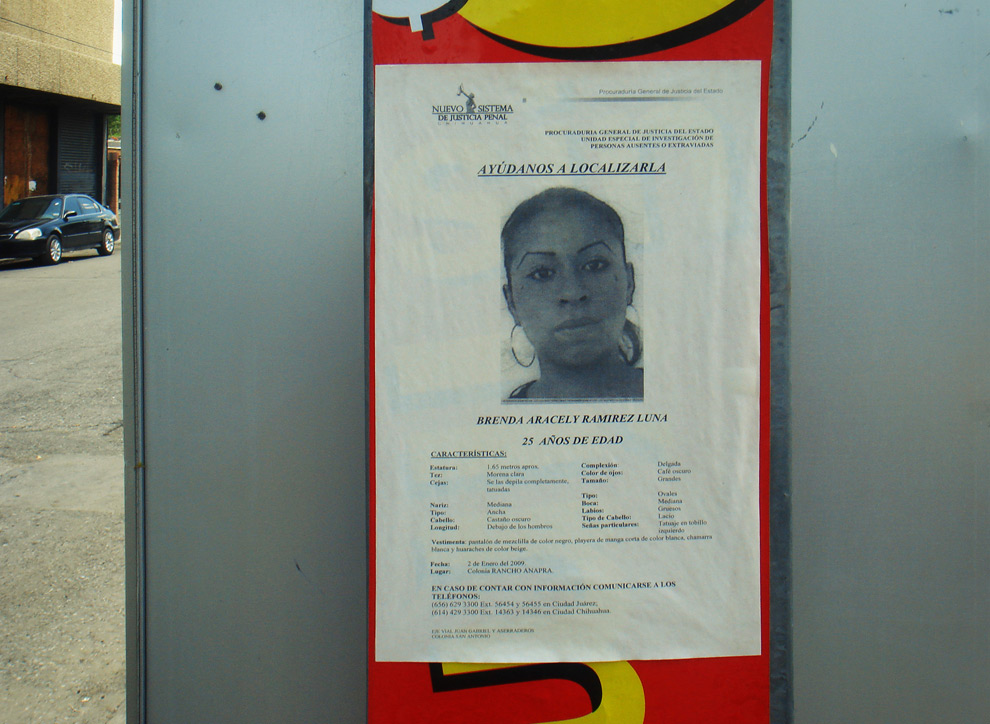
In Juarez they don’t even bother trying to keep an official tally of missing women anymore. Once you start getting into the thousands it’s futile for an overworked (and incompetent, corrupt, complicit) local law enforcement system to record so contemptible a number that in the end only serves to underscore the enormity of their own failures. It’s easier just to count the bodies. Which, according to Amnesty International, since 1993 now number over 400. Typically workers in the maquiladoras, the victims are a mix of local and South American immigrants, universally poor, and their bodies are found weeks and months later abandoned in the desert, oftentimes tortured and sexually desecrated.


That in and of itself is profoundly depressing. What is also truly disconsolate is how through its sheer ubiquity, great evil becomes banal. Street after street of yellowed missing persons posters shatter the fragile veneer that there is controlled order to this place and lead to the realization that all is not right, that the strong do prey on the weak, and that the powerless have no recourse. It’s not apathy so much as acceptance – a resigned shrug that this is just part of the urban space here.


The urban space is contested on multiple fronts. After the third open-top humvee, complete with six-man coterie armed with fully automatic assault rifles rolls by you become aware that the streets are being reappropriated as a staging ground in a long running, low-level civil war between the state and the federal police. After spotting the fifth hummer (complete with mounted anti-armor .50 cal gun) parked in front of a taco stand outside Plaza Benito Juarez, the novelty of being able to walk over a bridge and in the span of five minutes be immersed in two very different realities began to fade.


But don’t get me wrong, I think Juarez is still a worthwhile place to visit. Probably not in a let’s drink tequila and buy prescription drugs recreational kind of way, but rather in a bleak, let’s honestly see how the border space between two asymmetrical nations is constructed and how do we as Americans respond to that way. Juarez is not Mexico and El Paso is not America. They are more complex, global nodes. A nomadic, aterritorial space, symbiotic in nature, and, while arbitrarily split, maintains a cultural porosity. Here is where the aspirations of a whole class of people wash up against an increasingly inward-looking first world barrier. To be a consumer in America is to be a part of this system of NAFTA accommodating, cheap-goods-producing maquiladora factories. And however loathsome it may be, this is its reality.


Here’s the setting: 4pm at the Mercado Juarez, the enclosed market in the city center, the best place to hone your haggling skills if you’re looking for leather goods or turquoise jewelry. That in all honesty is also the best place to immediately be pegged as a gringo tourist and get taken for a ride for stuff that’s actually pretty cheap looking and that you probably wouldn’t even look twice at if you weren’t in Mexico, but that’s beside the point. It’s a fun place, or at least it was. This is the exchange between Mauricio (who’s trying to charge me way more than I can afford -$20- for a wallet). He tells me I’m the first person in the market that day. I ask him why no Americans are coming to Juarez anymore.


Mauricio: “They think it’s dangerous here.”


Me: “Well, isn’t it, a lot of people have died.”


Mauricio: “Yeah, amigo, it’s dangerous for us, but not for you.”


I bought two wallets and walked back over.


juarez

2009083 Tags: kinne, new mexico, photography, research, writing | 5 Comments »

lightning field and tourism


When you go to The Lightning Field, you have plenty of time to think about The Lightning Field, not only because the field certainly provokes and warrants rumination, but because 24 uninterrupted hours at the site are one of many conditions of admittance. The first of which included me being dropped off at a spartanly decorous log cabin in western central New Mexico, 45 minutes from the nearest town of Quemado (pop. 1500), accompanied by four strangers, with the promise that a truck would return the next day to take us back. Sans phone, email, internet, and after a week of driving, the overall effect of being without my four-wheeled safety blanket was uncanny. Reduced to walking – if there was any where to walk (which aside from The Lightning Field in the high desert plain, there isn’t), I made for shelter inside the cabin. This is how Walter De Maria intended the site to be experienced. “Isolation is the essence of land art,” he says in his notes from 1980. “It is intended that the work be viewed alone or in the company of a very small number of people, over at least a 24-hour people.” As the truck disappeared behind the rim, the isolation part started to set in.


Before proceeding, a brief description of the work is in order. These are the simple things about Lightning Field. It is constructed of 400 highly polished stainless poles 2-inches in diameter with solid, precision-milled solid tips. The poles are plotted on a rectangular grid array measuring one mile east-west, and one kilometer and six meters north-south. Averaging 20 feet 7 ½ inches, the poles range in height from 15 feet to nearly 27 feet. While at first appearance the ground appears flat, it is actually subtly rippling, which the poles take into account. The ground was meticulously surveyed, “laser surveyed” even, so that the height of the tip of each pole would align. In other words, “the plane of the tips would evenly support an imaginary sheet of glass.” All of this information is right there in De Maria’s own writings, conveniently assembled and waiting next to a corner rocking chair. He goes to great pains to elucidate the facts of the work, the siting and fabrication methods.


Factoid 1: Not surprisingly, in a small town, nearly everyone in Quemado has had some hand in the history of Lightning Field. As a high school kid, Robert Weathers helped build the thing 30 years ago and now serves as the site’s permanent caretaker. He also brought us back to town the next day. And when Cheryl took us out to the site, we talked about her history cleaning and polishing each pole. By all measures it’s an ideal high school gig, you’re outside, pay’s good, etc., but De Maria left exacting standards regulating the type of sand paper and cloth to ensure the light would be properly reflected on the steel. Also you can’t help picking up that most of Quemado’s population think there’s something a little ridiculous that people have been coming out to the desert to see the site for last thirty years. Me: “Do you think it’s funny that people go to all this trouble to come out here and see this?” Her: “Yeah, a little.” The relation of time and human aging is also part of the larger discussion provoked by The Lightning Field and will be picked up again further down.


Factoid 2: A brief description of Quemado. Quemado is located at the intersection of I-60 and Highway 117 toward the middle of New Mexico. It’s ranch country, and the drive there is pretty beautiful. The elevation is 6880 feet and it’s centered just east of the continental divide. The Dia Office (The Dia Foundation owns and manages the work) occupies a white washed adobe building on the main stretch of Quemado next to a local café with excellent iced tea, across the street from a fish restaurant that seems to only be open on “Frydays” and walking distance to a small grocery store with a generous collection of mounted deer heads.


Those are the facts of the work, and by themselves they’re not all that exciting. Ordinarily, one may be inclined to think this on par with a Carl Andre, really? who cares? sculpture. But the point is that De Maria also explicitly warns that “the sum of the facts does not constitute the work or determine its esthetics.” Under normal circumstances I would describe those aesthetics as being amazing and remarkable, etc. But nothing about the circumstances of finding oneself in the middle of New Mexico is very normal. This naturally leads to questions surrounding the notion of a pilgrimage.


Equally important to the facts of the work is the manner in which Lightning Field must be viewed. The Dia Foundation, per De Maria’s wishes, accepts up to six people at the site in any 24-hour period between May 1st and October 31st. That makes a maximum of 1104 people per season. Following that logic, over its thirty year history, up to 33,000 people have seen The Lightning Field. By way of comparison, every day 10,000 people walk under the Sistine Chapel daily; which can’t even touch the 25,000 people who daily make the trek to the Great Smoky Mountains National Park in North Carolina. There’s certainly a lot that could be said about the proportional relationship of visitors to a popular creative work and its relative quality (or perceived worth), but that falls outside the scope of this discussion. I bring quantitative numbers up mainly to emphasize the level of control exerted over the site by Dia. Typically reservations have to be made months in advance, so the low numbers in no way denote a lack of interest. Dia also handles reservations and caretaking of the site, and is careful to point out that by preventing vast numbers of people from visiting, the fee for an overnight stay ($250 per person July and August, $150 other months, $100 students) does not begin to cover maintenance expenses. Clearly, and I would say admirably, De Maria was more concerned with controlling the experience rather than opening the floodgates. He obviously isn’t overly concerned with commercial success, and at the same time this brings up probably antiquated 1977 notions of credibility and “selling out.”


Factoid 3: Walter De Maria studied at Berkeley before heading to New York in the 1960s where he fell in with John Cage and Warhol’s happenings. In addition to success as an artist he was also the drummer with the pre-1965, pre-Nico, Velvet Underground. So, the dude’s cool bona fides are secure.


However, regarding the notion of control, it could be argued – and has been argued by MIT critic John Beardsley – that by so precisely controlling the nature of the experience, that is, by leaving only one specific and approved way of interacting with the field open, De Maria crosses the threshold into authoritarianism. One may think they’re essentially free to do as they choose even once they’re at the cabin, yet you’re also acutely aware that De Maria is pretty clear that if you’re not standing in the cool desert air at five in the morning on the southeast corner of the field to greet the sunrise you’re wasting everyone’s time. In effect by dictating the terms of the dialogue, De Maria is precluding the possibility of any spontaneous individual reaction to the work. Beardsley, in his essay “Art and Authoritarianism: Walter De Maria’s Lightning Field,” argues just that. He sees the directive issued by De Maria and Dia as an affront to the viewer, “suggest(ing) that both artist and patron lack confidence in either the quality of the work or the discernment of the viewer. They are therefore being defensive or condescending, neither posture positively predisposing the viewer to the work.”


After having stayed overnight at The Lightning Field, I would argue Beardsley’s hypothesis is wrong on two points but also right on one. There are a few reasons for this, for one, it’s not that his overall premise is wrong, but he’s not exactly right either. And that gets to the crux of The Lightning Field, it is not an “either/or” situation, but a “both/and” type of place. What I mean by that is the first point, that if anything, De Maria and Dia are too overconfident in the quality of the work. There are a number of hurdles one has to jump through, both in financial draws (this is by far the most I’m spending for accommodations on this trip) and time commitments (after driving to and from Quemado you’re looking at two days) for one piece of work and one has to expect the payoff would warrant the pilgrimage. I think Beardsley would argue that the immense exertion of the pilgrimage itself influences and unduly affects any objective response to the work in some Heisenbergian sense. It’s like a giant arrow pointing at “Art” with a capital “A” saying “you will have a glorious response.” But, I don’t really think that matters much, if the response is specious – which I don’t think it is – it’s still a valid response. This is worlds away from a subway ride to MoMa and 30-90 seconds in front of a Monet. Moreover, the stakes of disappointment are raised so high, that the risk is greater demanding a confidence in the work.


Secondly, regarding issues of condescension, I think the problem here is that for an old hand like Beardsley he would instinctively know how to interact with a creative work and could appreciate it from multiple simultaneous angles. However, I don’t think I really would, (returning to the 30 seconds in front of a Monet), so I don’t see De Maria and Dia as being complicit in a scheme to control my reaction in a negative way, but rather as gentle appreciation for my own openness. It would almost be earnest if it weren’t so powerful. De Maria’s documentation painstakingly describes the years of site inspections and surveying, the tedious testing of materials, failed and successful means of fabrication, and a completely thorough accounting of the method of installation to give the visitor an idea of the sheer amount of work that went into putting 400 poles in the desert. The least he could ask in return is that you give the work your full concentration, something impossible in an attention addling museum.


This can quickly devolve into a broader discussion about the optimal setting for experiencing art, and the somewhat narrower concept of what role the museum as a repository or archive of artistic achievements plays. Land art was certainly a reaction against the confines of the museum, and saw, well, land, as the proper enclosure for art. Be aware though, what the museum also provides is access. Something De Maria is limiting (or protecting). So the question becomes, is this central conceit of curatorial control something of a cheat? For example, would someone’s (mine) experience at the Sistine Chapel have been different if I weren’t jostling for position among literally 8000 Germans in short pants? Yeah, probably. So then shouldn’t all works of art demand isolation to be appreciated? As an architect, these queries hold special power regarding issues of aesthetics and designed space, and as a traveler on the road for an extended period of time, they bring up issues of what it means to be a tourist in America and there’s no denying the role these tangential questions play when discussing The Lightning Field.


To paraphrase the late David Foster Wallace, by their very presence a tourist spoils the previously unspoiled place they came to see. And make no mistake; whether high brow Dia art-traveler or flip-flop-clad Midwesterner, you’re still a tourist. That’s what De Maria understood and what Beardsley unknowingly got right. People aren’t always discerning and can and will consume what they can’t control. And that’s why the harsh arithmetic of 1100 people per year makes sense, any more and only the Beardsley’s would enjoy it while the rest of us spent 30-90 seconds taking the same picture of it. We need De Maria to force us to slow down. In this way De Maria kept it eternal.


Factoid 4: Time doesn’t exist at The Lightning Field. Literally, there are no clocks. But it also exists in a perpetual state of newness. The log cabin is new and old, designed and built by De Maria from recycled timbers scavenged from nearby abandoned homesteader’s lots. There is also a shed full of replacement poles, if one is ever damaged, via wind, lightning, vandalism, etc, it will be polished and replaced. And apparently an army of waiting high-schoolers to come out and re-polish each pole in a tediously precise exercise.


Collectively, those are all the thoughts that occupy one’s mind when arriving at the site. The site itself is ringed by distant mountains around the valley that provide a feeling of enclosure. Aside from the lightning field, there are exactly three man-made objects: the cabin, a windmill, and a low-slung juniper fence. One immediately realizes the isolation, cast away into a sea of subtle browns, greens and a big blue. You’re lost, and have the option of Lightning Field or cabin. I chose the Field.


First seeing it, it’s really not that impressive. Intellectually I know there are poles stretching out for a mile, most of which are now invisible, victims of a mirrored reflection and an overhead sun. The poles nearest to me seem tiny, like insignificant needles overshadowed by the landscape. You could say they’re turned off, full of a charged, kinetic energy, which only begins to be visible as the sun goes down.


There’s a reason the only worn trail at the Lightning Field skirts the edges of the poles without venturing inside. Being among the field, a matter of inches from without to within can create an uncanny sense of discomfort. Tilting one’s head slightly allows a view of 25 poles stretching along a mile, but a slight readjustment one way can render 24 invisible while another alley opens up at a diagonal. The sense of space is so architectural, so clearly defined by two-inch diameter poles, that there is a powerful sense of sheltered space within the field. Real or imagined the poles give off a buzzing hum.


I had spent the evening walking the site, and after a less than inspiring, cloud covered sunset, our coterie met up around the table for cheese enchiladas with beans, tortillas and corn. Architecture is all about forcing interactions, and this is like a super-charged Tschumi-like event that actually works. Dinner with strangers can breed profoundly awkward getting-to-know-you questions (“When did you discover your passion for architecture?”) But overall it was good times, we discussed the art scene in Houston (which was blowing up around the same time De Maria left the East Coast for the desert), and everyone could agree that they would rather live in San Francisco. We retired to our rooms and agreed to meet up early, before sunrise early.


1960s/70s art critic and noted Jackson Pollack fanboy Clement Greenberg dismissed land art as being “theatrical.” This is most true with The Lightning Field, but it in no way invalidates the profoundly impressive performance. It’s also what differentiates The Lightning Field from other great works of land art. Spiral Jetty and Double Negative can exist alone, slowly being submerged by the Great Salt Lake or eroding in silence in the desert, but The Lightning Field needs people, in the same way an orchestra needs an audience. This is implicit when Michael Kimmelman, in The Art of Everyday Life, states that The Lightning Field “works – or it can if you’re open to it.” The immediate corollary would be that the poles don’t work – if you’re not there.


They came alive again at 6:02am, as the sky in the east began to glow. The poles were no longer rendered mute, but were rather building to a crescendo. A chorus of subtle hues, constantly morphing pinks, oranges, blood reds. My back was to the sun, but the field was exploding in front of me. At this point, the poles and landscape were working in perfect harmony playing off of each other. Inextricably linked, everything belonged, I became the interloper, the solitary, ascetic figure in a Friedrich painting, engaged in seemingly profound thought. At 6:14am the sun crested the ridgeline and as if on cue the silence was shattered by screaming and chortling from coyotes inside the valley. By 6:47 the sun was high enough that the poles were again fading, silently waiting for the next group of tourists.


Oh yeah, and no, there wasn’t any lightning.


A final note about photography, it’s frustrating, like “trying to fix a spider web with your fingers” level of frustrating, attempting to capture the subtleties and quickly changing and ever so slight play of light on the poles and landscape with a clumsy camera, and I would say they’re a poor attempt at encompassing the work. That said, I hope they at least give some sense of what it’s like.
20090731 Tags: kinne, new mexico, photography | No Comments »

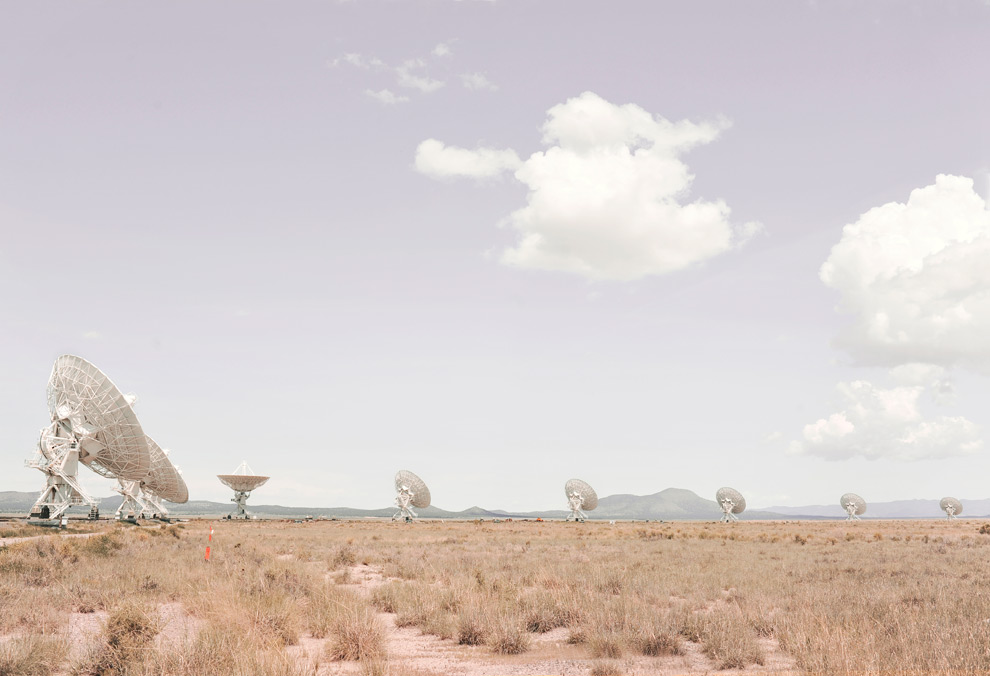
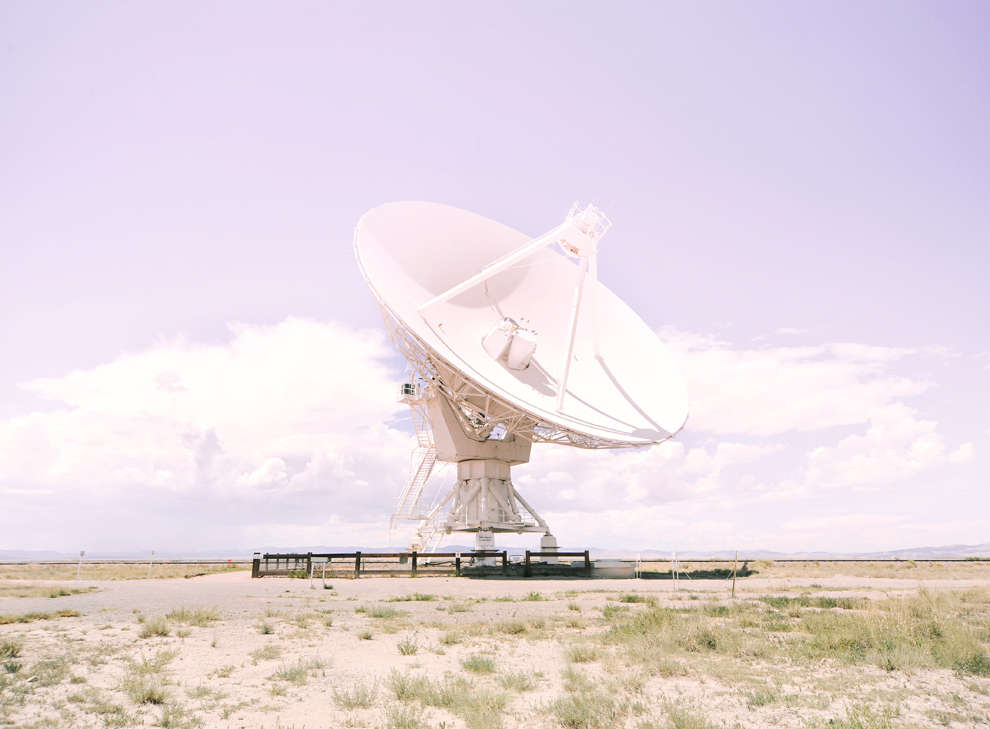
very large array

vla

Or: Weird Shit That In Theory Should Seem Incongruous with the Desert Landscape but is Actually Perfect.


Case in point, the VLA has to exist here. Those things aren’t stationary. The satellites are constantly moving along modified railroad tracks that allow the focus of the array to flux, necessitating a flat landscape to reduce expending energy during their re-arrangements. Secondly, the Plains of San Augustine are flat, but they’re high, the altitude is 7000 ft and helps ensure the clarity of the received solar signals. Lastly, the plains are encircled by a number of mountain ranges that block terrestrial radio signals from interfering with the delicate equipment.
 

Plus the invisible radio waves tethering VLA to distant space anomalies make for a nice compliment to Buzz Aldrin’s visual correlation between the high desert and the “magnificent desolation” of the lunar landscape. But, not surprisingly, Cormac McCarthy provides the strongest portrait of the landscape: “Below them in the paling light smoldered the plains of San Agustin stretching away to the northeast, the earth floating off in a long curve silent under looms of smoke from the underground coal deposits burning there a thousands years. The horses picked their way along the rim with care and the riders cast varied glances out upon that ancient and naked land.”


20090729 Tags: infrastructure, kinne, mexico, photography, research, texas, writing | No Comments »

water and growth

_dsc7600b
“Don’t you find it difficult to live without running water?”


“No.” He said. “You can get used to anything. But it’d be nice for my kids.”


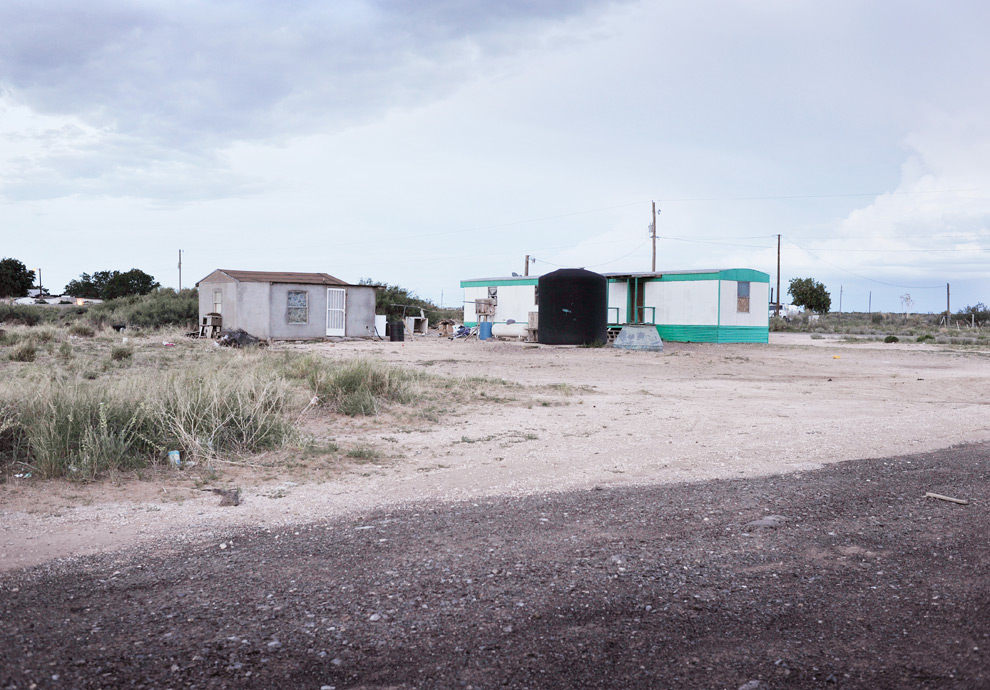
He was short, born in Mexico (as I later found out), sported a well manicured Pancho Villa mustache with a friendly smile underneath. His name was Carlos, and I took his waving as a sign I could resist the urge to jump back in the car and quickly drive the 30 miles back to El Paso. I walked over, and after brief introductions we started talking about life in the Colonias – the unincorporated improvised settlements at the Eastern edge of El Paso city limits – specifically this one, named Dairyland after the nearby dairy farm.


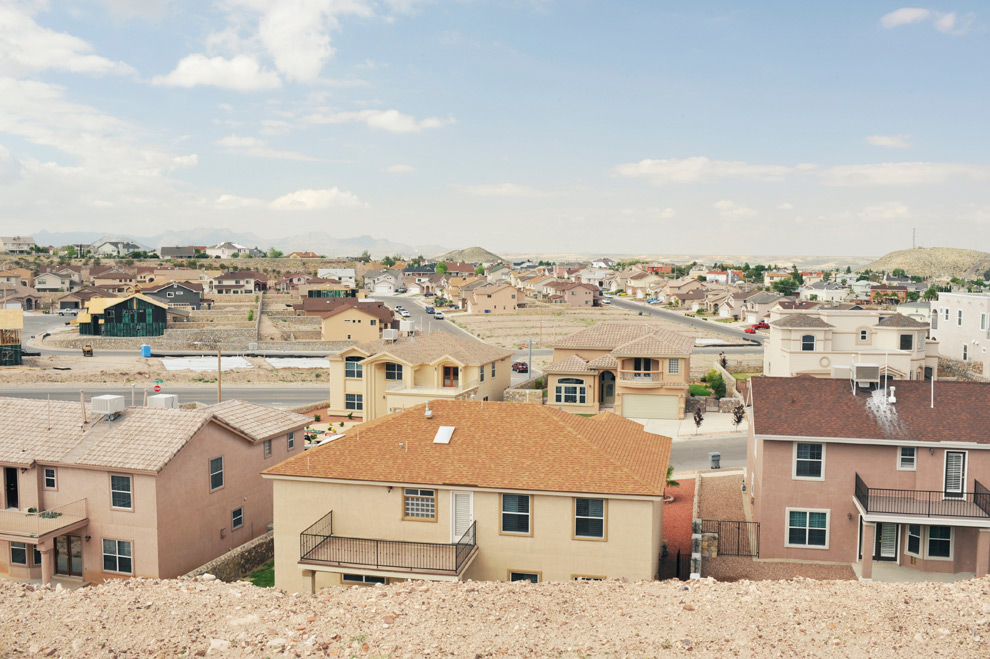
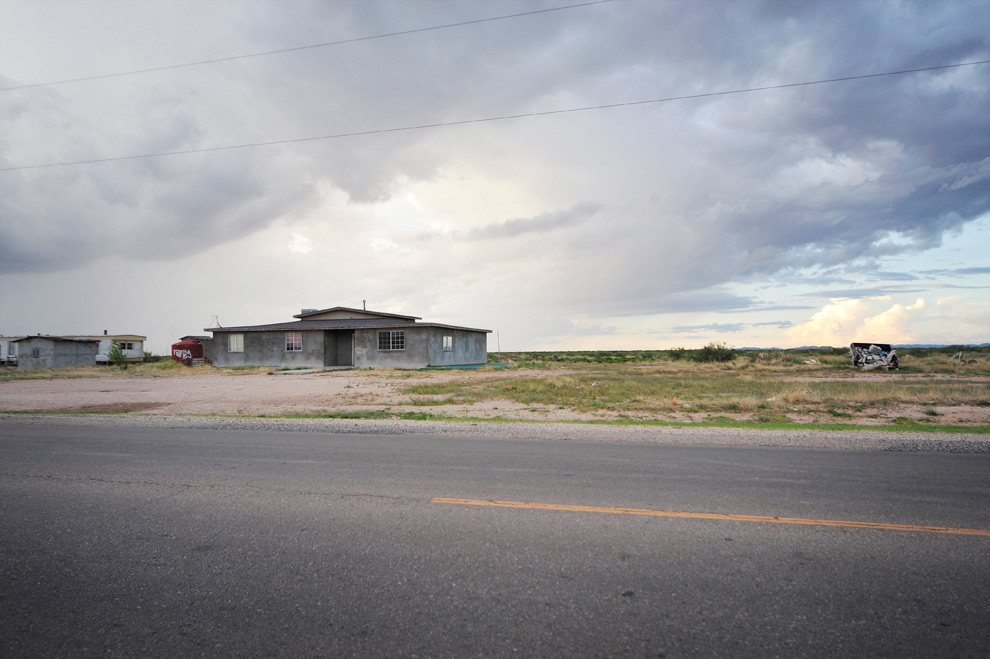
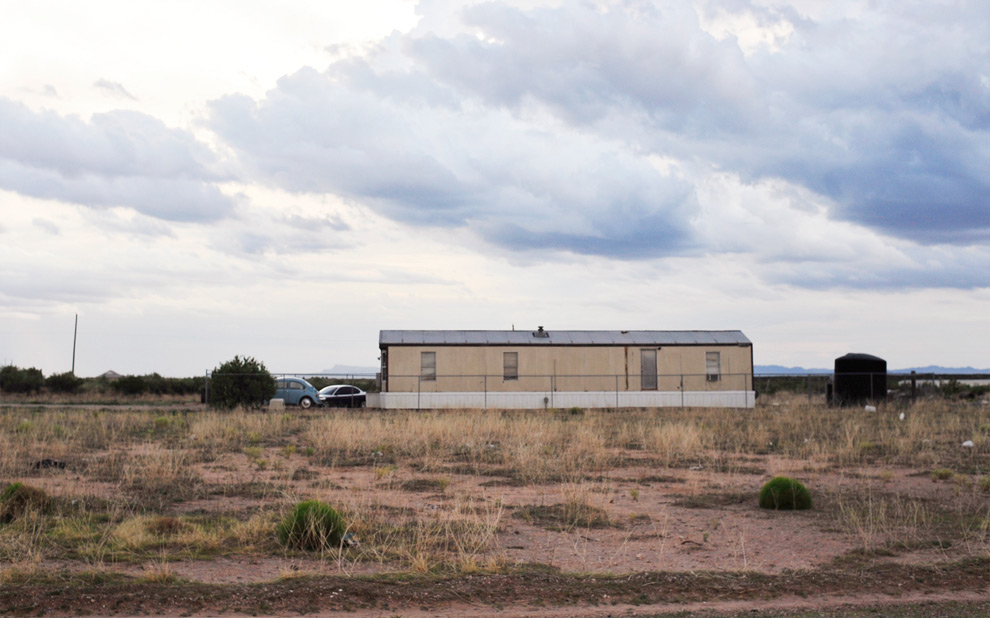
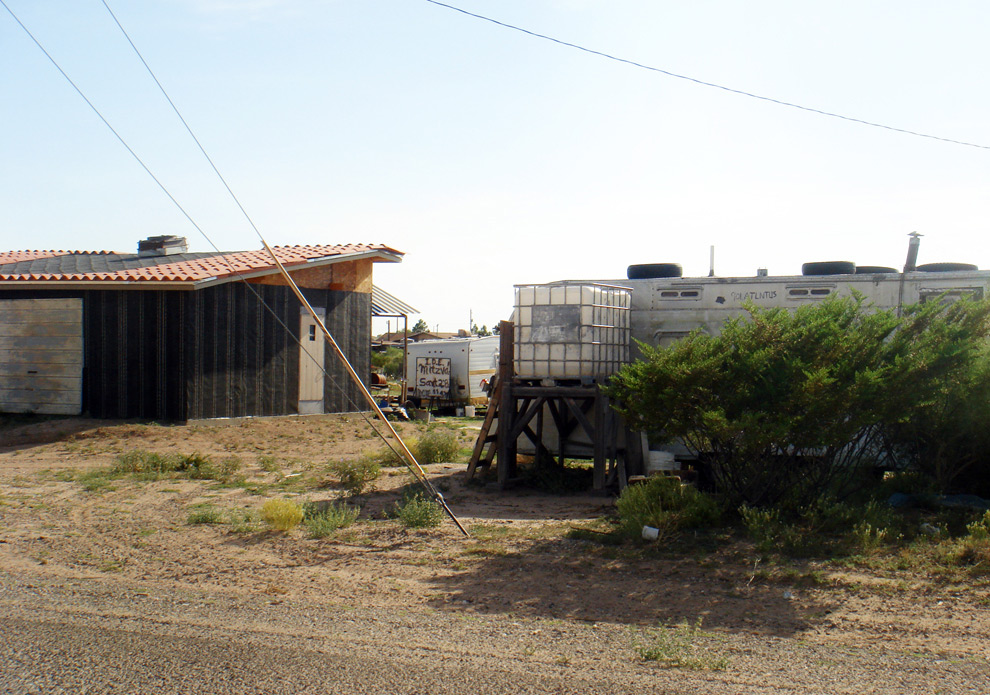
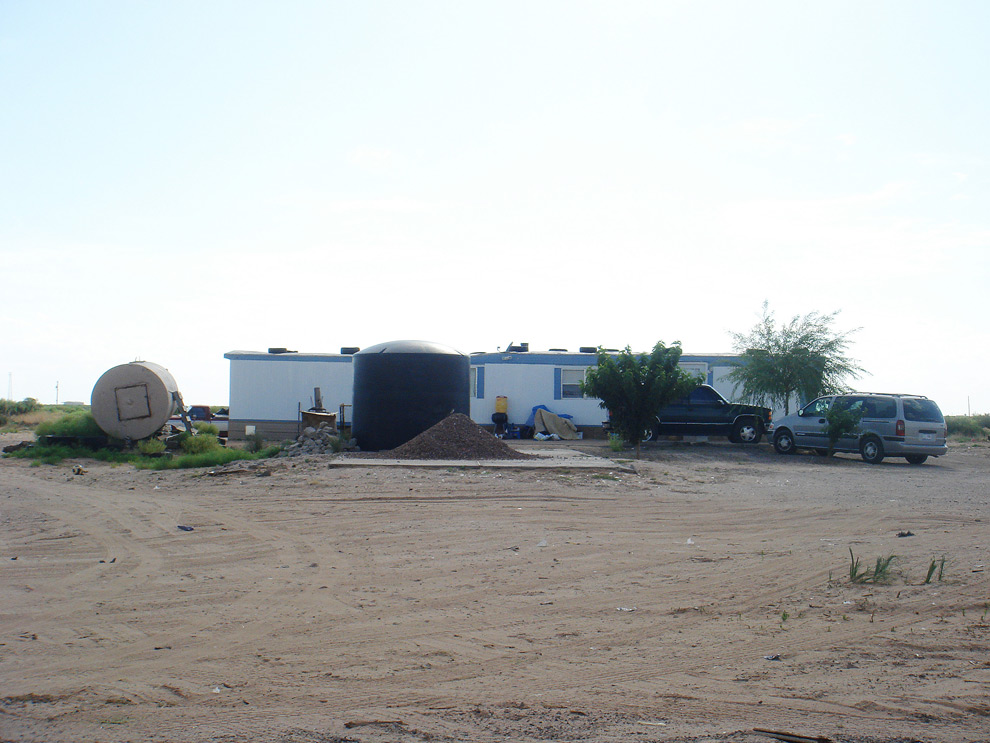
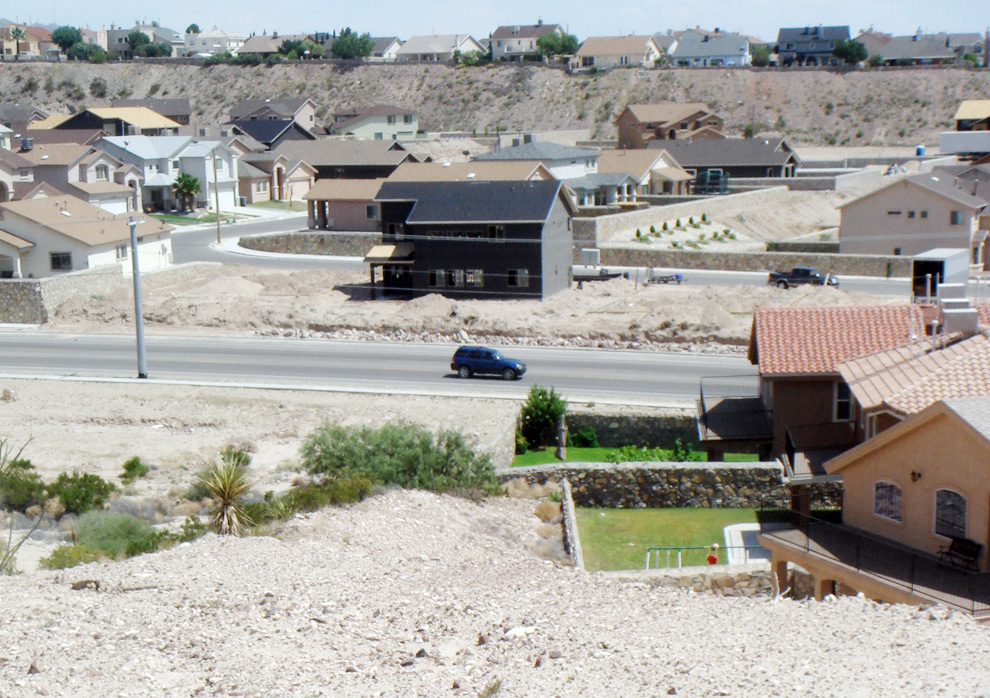
Aging trailers, abandoned crumbling masonry structures, plaster and tin – this is what affordable housing looks like in El Paso County. Priced out of the identical middle class housing developments that are forever encroaching further out into the desert or higher up the Franklin Mountains, where they perch atop artificially created plateaus, the Colonias are individual, jury-rigged and like the rest of the region, they’re expanding. As journalists from the University of California at Berkely found out, 80,000 people in El Paso County live in Colonias, members of the more than 400,000 Texas-wide Colonia residents.


While the homes are temporary, the numerous late model trucks and suv’s attest to the nomadic situation the colonia residents find themselves in. The homes themselves are fast, quickly assembled out of a mix of available materials and limited only by the skill level of the builders (from cinderblock, to balloon framing, to corrugated metal), or the cost of a pre-fabricated trailer; however, it is the vehicles that are permanent and reliable. This is a largely migrant population. This generation has travelled a great distance to attain a small measure of the American Dream, born in Mexico or more rural areas of the southwest, they made the trek to the border region because of the promise of abundant jobs. And the jobs were plentiful – until NAFTA.


_dsc7576


There’s ample debate about the effect of NAFTA on maquiladora growth, with pro-business groups believing NAFTA actually stymied maquiladora growth. However there is no question that the goal of NAFTA was to allow corporations to easily and cheaply create goods in Mexico, and ship them north – duty-free – for assembly. In a cruel twist, the well-paying factory job Carlos crossed over from Mexico to find, and kept for 10 years, left him behind, and jumped the river into Mexico. This is only one link of the chain of exodus that companies are chasing to find the lowest legally allowable hourly wage. While a factory worker in Mexico can expect to earn somewhere in the ballpark of two dollars an hour, a Chinese worker will do the same for less than a dollar an hour. To a multi-national corporation the math is simple, and according to Voice of America news, 170 factories and 100,000 jobs have been lost to China from the Juarez region. For Carlos, rather than follow his job back across the border for a fraction of what he was earning, he has been struggling as a day laborer, helping build middle class homes in the desert around Horizon City, a planned town just north of Dairyland. However, now that is starting to dry up, and oddly enough, in a reverse Depression-era migration pattern he says he’s thinking about leaving for Oklahoma, but he also said he’s proud of his home here. A home in a Colonia is still a home and he worked hard to get it.


The 2000 census put El Paso’s population at 563,000. A U.S. Department of Defense study from July 2009 projects the county’s 2012 population to balloon to 994,000. The El Paso Times stated in their July 20th headline: “El Paso Braces for Spike in Growth.” While some seemed to welcome the implied respectability that a seven figure population affords.
“I can’t wait for us to hit 1 million. I think it will give us the respect we deserve,” native El Pasoan Claudia Solis said. “I just hope we are ready for all the new people. I don’t want us to be in trouble.”


The newspaper seems to know better and implicitly understood the necessity to “brace” before the deluge of growth overwhelms El Paso infrastructure that may be lacking in viability to support the future 1 million El Pasoans and the ceaslessly growing population of over 2 million in Ciudad Juarez.


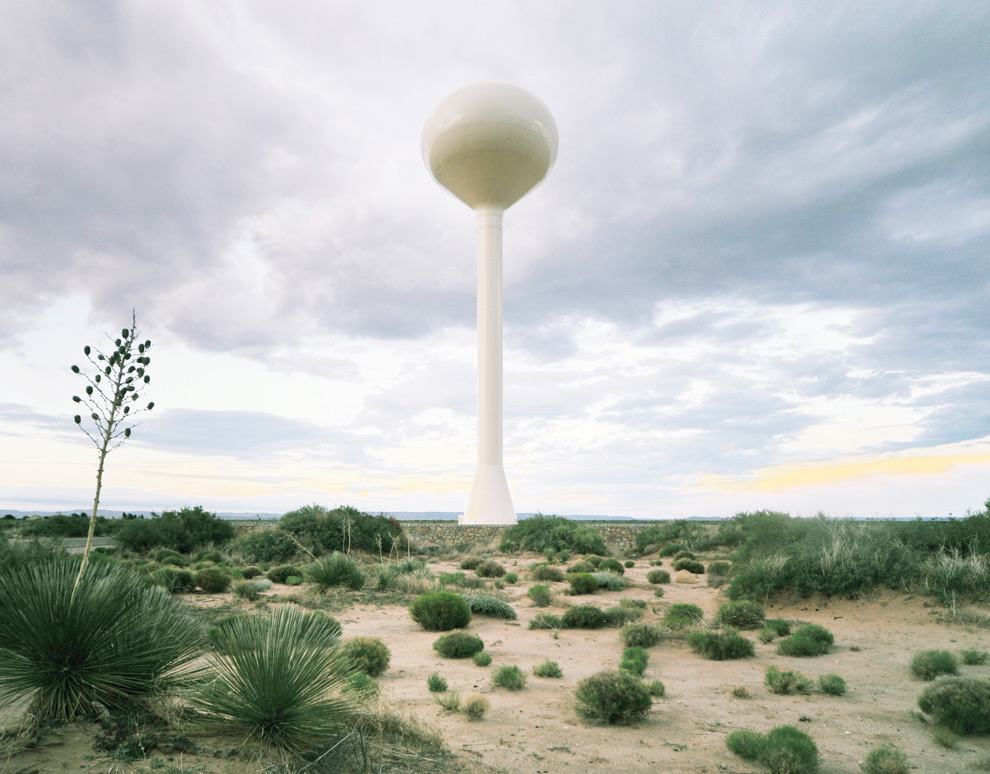
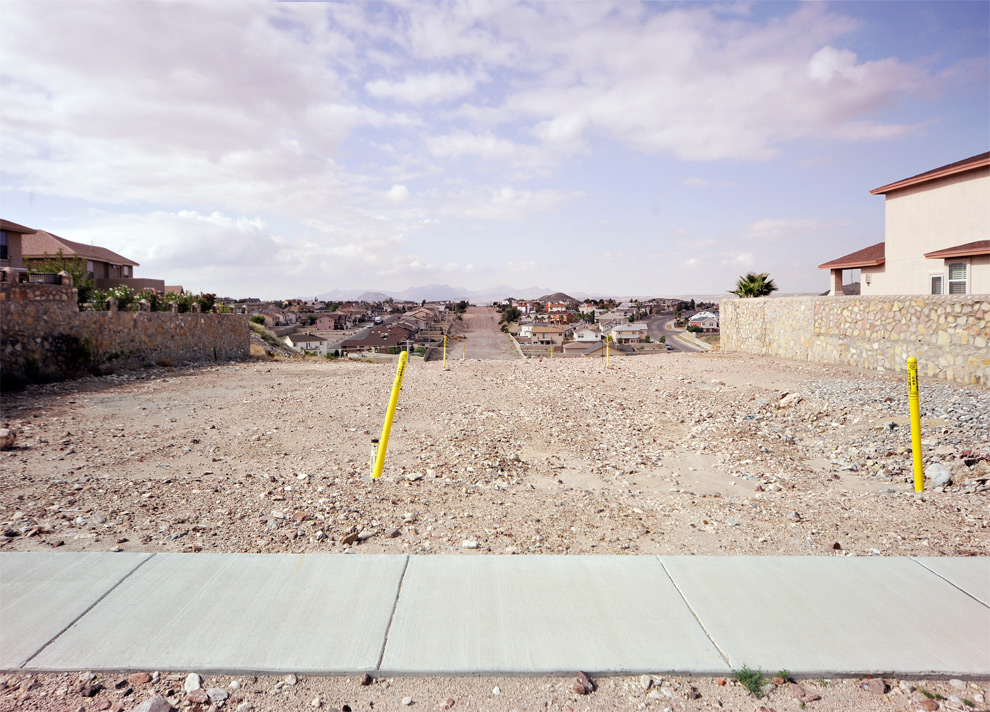
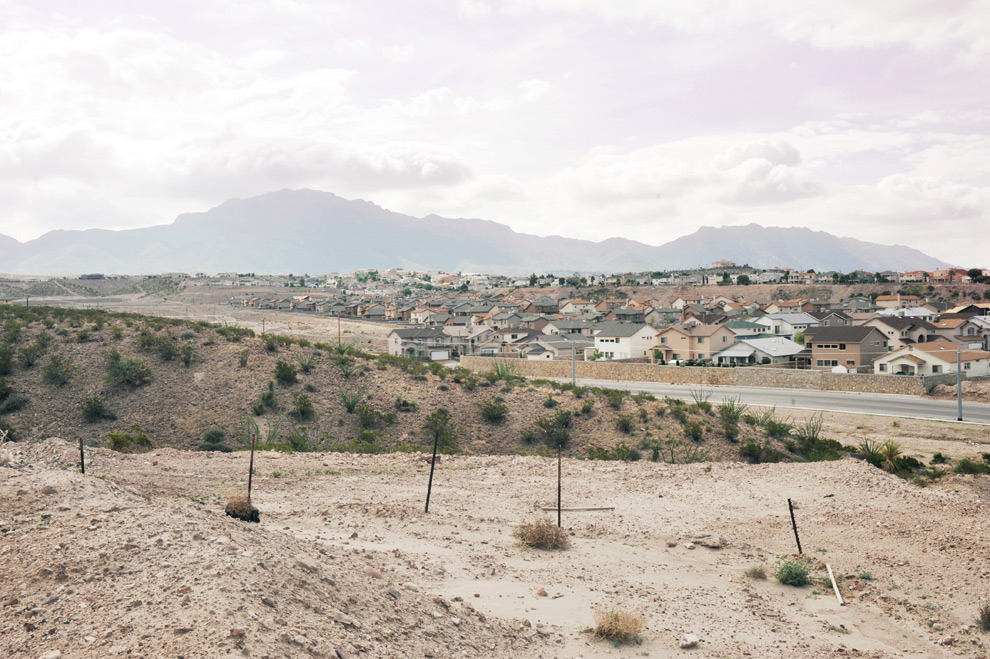
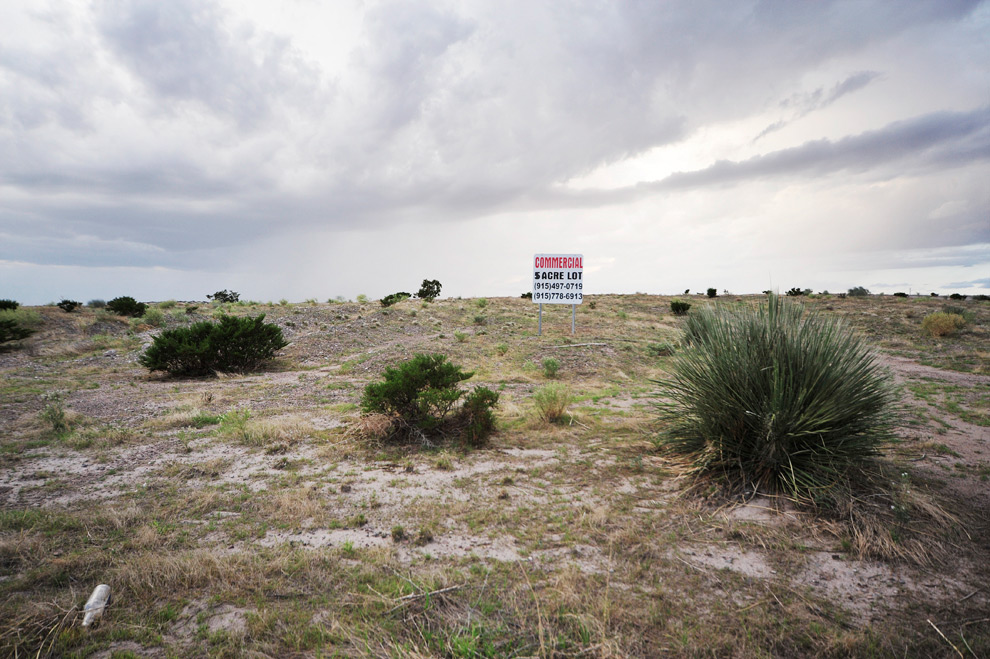
The growth of the Colonias runs in parallel to the growth of the region. This area is already being carved up via dirt roads into proposed subdivisions that are a parody of their West El Paso counterparts. Yet while the west El Paso developments follow along the massive Heizer-esque gas and water line, out here in the Colonias the county has no authority over land use questions. The Texas legislature attempted to control the growth of Colonias by passing “the Colonias bill” in 1995 that required developers to provide basic infrastructure, including water and sewage, as well as utilities on any land sold for Colonias. However, developers were able to easily skirt the law by selling the land as commercial use, explaining the ubiquitous “commercial land for sale” signs that I saw dotting the desert landscape.
Which brings us back to water.


Water to the El Paso/Juarez region is supplied by two main sources, the Hueco Bolson and the Rio Grande River. Both sources are shared by both parties in a tentative partnership – a common theme in the border, what Michael Dear calls a “third nation.” Where issues of hyper-security and segregation between the sister cities also must co-exist in a symbiotic relationship of integration and mutual interdependence. However fragile this arrangement is, it is in no way equal when it comes to water use. Juarez with double the population uses per-capita half the average gallons per day of water as El Paso. There are no green lawns in Juarez. With unprecedented border growth, the Hueco Bolson is predicted to be tapped dry by 2020. El Paso is taking steps to bring water in from the Antelope Valley 80 miles to the East.


People in Dairyland get their water from only one place; a man with a truck comes by every month and fills up their various containers for storing gray water. Adjacent to nearly every home is the industrial black cylinders with thousand gallon capacity that store water. They frequently fill with algae, require constant cleaning, and are inefficient on a cost per dollar equation. Drinking water is another issue, and has to be brought in almost daily from Horizon City. It’s a tedious and often frustrating situation. But like Carlos said, he got used to it. It’s part of the inherent contradiction of the Colonias, he weighed his options, and saw that the opportunity for home ownership outweighed the drawbacks.


So, the heart of the problem is really one of growth and infrastructure. In Juarez, migrants from all over South America are pressing up against the border fence, drawn to the promise of plentiful NAFTA jobs, and after realizing they’d been duped, the jobs went to China, they’re attempting to cross over in the hopes of something better. In El Paso, a low cost of living and the designation of second happiest place in America is creating internal population growth as more latinos start families. Yet this spike in growth is obviously straining the infrastructure of the region. Limiting growth is equated with limiting cultural and economic revitalization in a region desperate for respect. Yet opportunities exist for new solutions outside of trucking in more water from ever greater distances. The border region could become the global leader in sustainable development, water treatment and distribution, rainwater reclamation. Solutions that would give people something to be proud of besides the number of inhabitants –an achievement which shouldn’t really count anyway if 15% of that number is kids that don’t have a flushing toilet.


_dsc7900

_dsc7444
Selling land as being for commercial use allows developers to avoid laws requiring infrastructural support for residential Colonias


_dsc7580
Colonias taking cues from suburban development being parceled via dirt roads.


_dsc7464
_dsc7511
_dsc7512
dsc06614
dsc066091
_dsc7854
Development in west El Paso stretches out into the desert along water and gas lines.


_dsc7905
Current city/desert edge.


dsc06586
Green lawns


dsc06606
Creating a number of drainage issues.

 
« Older Entries
Newer Entries »

COPYRIGHT © 2011 \ JOHN LOCKE \ ALL RIGHTS RESERVED (RSS)

TOP OF PAGE

last update: 201102:1627