JOHN LOCKE, ARCHITECT

  • Featured Work
  • Design Blog           
  • Photography
  • Graphic Design
  • Dept of Urban Betterment

About

Hello. I live in New York and work at The Living. I hold a graduate degree from Columbia University's GSAPP and an undergraduate architecture degree from the University of Texas at Austin. I have more than seven years of professional experience at noted architecture firms, including New York-based Rogers Marvel Architects and SOM. I also tackle freelance graphic and photography work with my partner in crime, the multi-talented Jackie Caradonio at Lion in Oil. In addition, I teach a course, Hacking the Urban Experience, at Columbia. View my CV here: CV(html). Thanks and have a nice day.

Contact

john.h.locke{at}gmail.com
310.735.3333

Architecture Portfolios

Portfolio 2002-2007 (issuu)
Portfolio 2008-2009 (issuu)

HOME / BLOG

writing

20090814 Tags: kinne, mexico, writing | No Comments »

calle noche triste

dsc066472
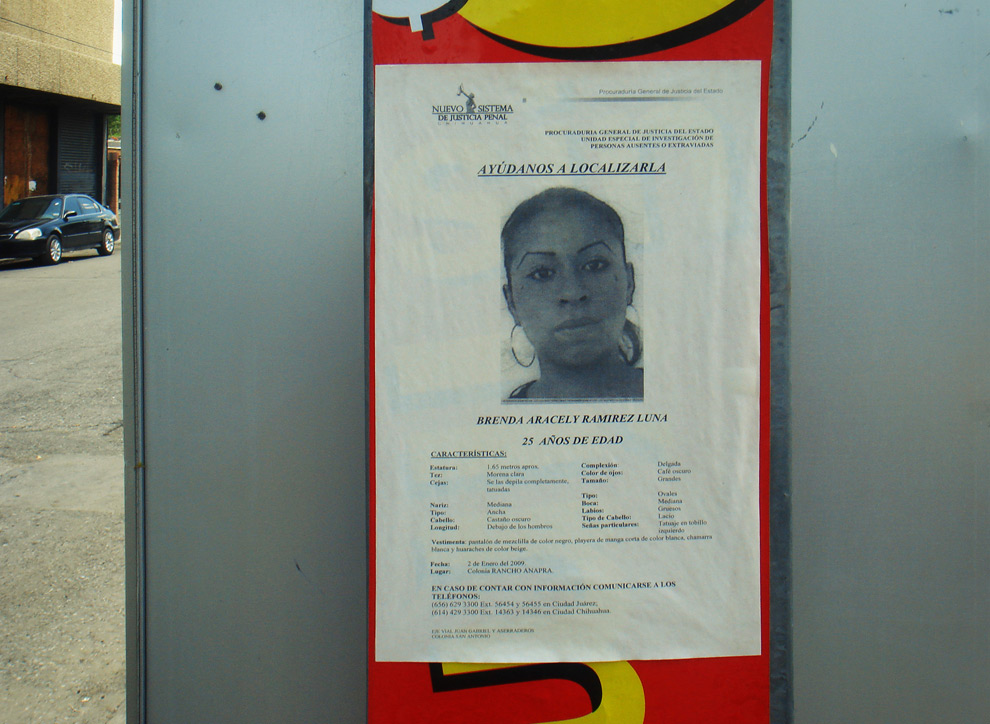
In Juarez they don’t even bother trying to keep an official tally of missing women anymore. Once you start getting into the thousands it’s futile for an overworked (and incompetent, corrupt, complicit) local law enforcement system to record so contemptible a number that in the end only serves to underscore the enormity of their own failures. It’s easier just to count the bodies. Which, according to Amnesty International, since 1993 now number over 400. Typically workers in the maquiladoras, the victims are a mix of local and South American immigrants, universally poor, and their bodies are found weeks and months later abandoned in the desert, oftentimes tortured and sexually desecrated.


That in and of itself is profoundly depressing. What is also truly disconsolate is how through its sheer ubiquity, great evil becomes banal. Street after street of yellowed missing persons posters shatter the fragile veneer that there is controlled order to this place and lead to the realization that all is not right, that the strong do prey on the weak, and that the powerless have no recourse. It’s not apathy so much as acceptance – a resigned shrug that this is just part of the urban space here.


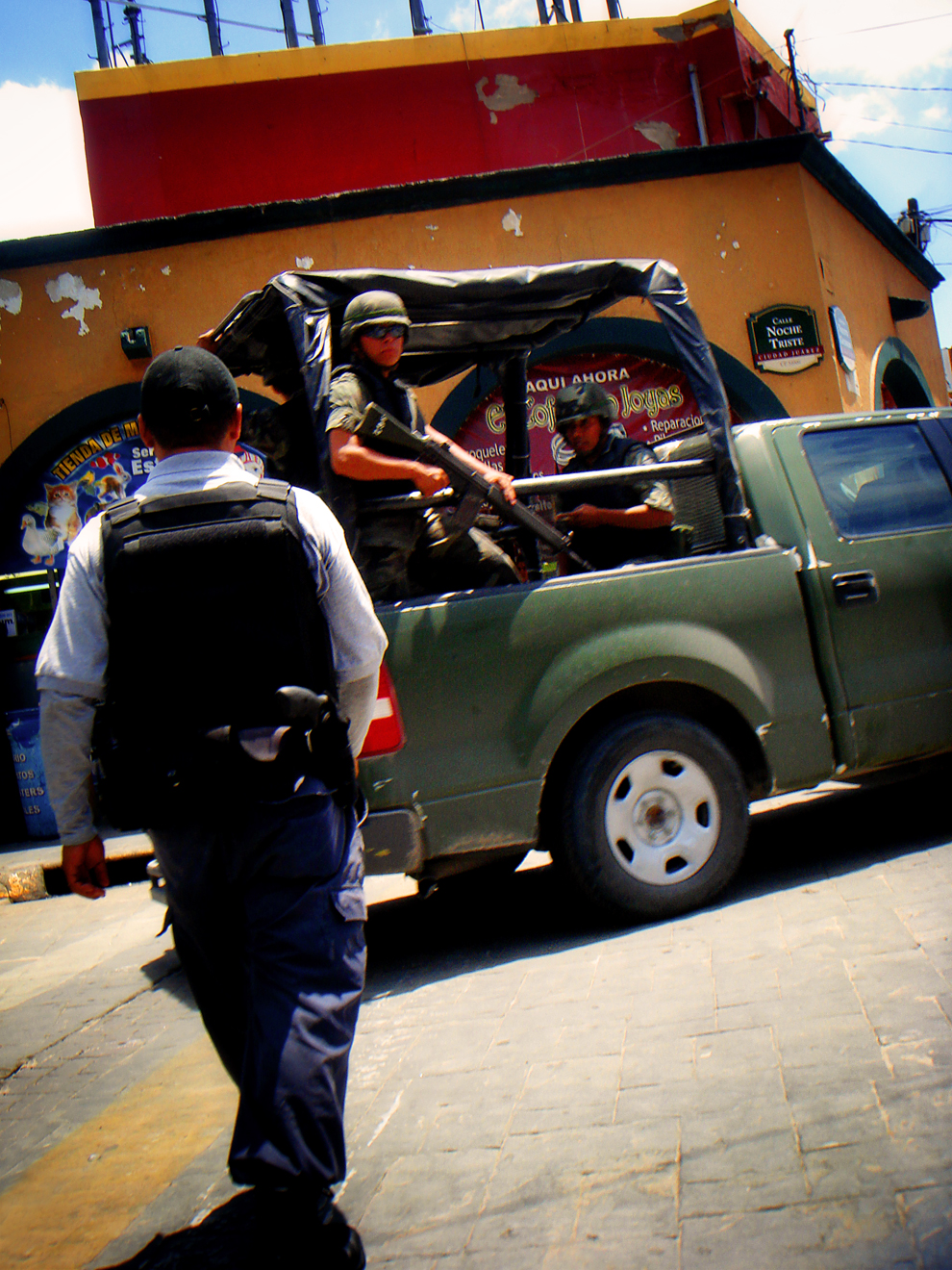
The urban space is contested on multiple fronts. After the third open-top humvee, complete with six-man coterie armed with fully automatic assault rifles rolls by you become aware that the streets are being reappropriated as a staging ground in a long running, low-level civil war between the state and the federal police. After spotting the fifth hummer (complete with mounted anti-armor .50 cal gun) parked in front of a taco stand outside Plaza Benito Juarez, the novelty of being able to walk over a bridge and in the span of five minutes be immersed in two very different realities began to fade.


But don’t get me wrong, I think Juarez is still a worthwhile place to visit. Probably not in a let’s drink tequila and buy prescription drugs recreational kind of way, but rather in a bleak, let’s honestly see how the border space between two asymmetrical nations is constructed and how do we as Americans respond to that way. Juarez is not Mexico and El Paso is not America. They are more complex, global nodes. A nomadic, aterritorial space, symbiotic in nature, and, while arbitrarily split, maintains a cultural porosity. Here is where the aspirations of a whole class of people wash up against an increasingly inward-looking first world barrier. To be a consumer in America is to be a part of this system of NAFTA accommodating, cheap-goods-producing maquiladora factories. And however loathsome it may be, this is its reality.


Here’s the setting: 4pm at the Mercado Juarez, the enclosed market in the city center, the best place to hone your haggling skills if you’re looking for leather goods or turquoise jewelry. That in all honesty is also the best place to immediately be pegged as a gringo tourist and get taken for a ride for stuff that’s actually pretty cheap looking and that you probably wouldn’t even look twice at if you weren’t in Mexico, but that’s beside the point. It’s a fun place, or at least it was. This is the exchange between Mauricio (who’s trying to charge me way more than I can afford -$20- for a wallet). He tells me I’m the first person in the market that day. I ask him why no Americans are coming to Juarez anymore.


Mauricio: “They think it’s dangerous here.”


Me: “Well, isn’t it, a lot of people have died.”


Mauricio: “Yeah, amigo, it’s dangerous for us, but not for you.”


I bought two wallets and walked back over.


juarez

2009083 Tags: kinne, new mexico, photography, research, writing | 5 Comments »

lightning field and tourism


When you go to The Lightning Field, you have plenty of time to think about The Lightning Field, not only because the field certainly provokes and warrants rumination, but because 24 uninterrupted hours at the site are one of many conditions of admittance. The first of which included me being dropped off at a spartanly decorous log cabin in western central New Mexico, 45 minutes from the nearest town of Quemado (pop. 1500), accompanied by four strangers, with the promise that a truck would return the next day to take us back. Sans phone, email, internet, and after a week of driving, the overall effect of being without my four-wheeled safety blanket was uncanny. Reduced to walking – if there was any where to walk (which aside from The Lightning Field in the high desert plain, there isn’t), I made for shelter inside the cabin. This is how Walter De Maria intended the site to be experienced. “Isolation is the essence of land art,” he says in his notes from 1980. “It is intended that the work be viewed alone or in the company of a very small number of people, over at least a 24-hour people.” As the truck disappeared behind the rim, the isolation part started to set in.


Before proceeding, a brief description of the work is in order. These are the simple things about Lightning Field. It is constructed of 400 highly polished stainless poles 2-inches in diameter with solid, precision-milled solid tips. The poles are plotted on a rectangular grid array measuring one mile east-west, and one kilometer and six meters north-south. Averaging 20 feet 7 ½ inches, the poles range in height from 15 feet to nearly 27 feet. While at first appearance the ground appears flat, it is actually subtly rippling, which the poles take into account. The ground was meticulously surveyed, “laser surveyed” even, so that the height of the tip of each pole would align. In other words, “the plane of the tips would evenly support an imaginary sheet of glass.” All of this information is right there in De Maria’s own writings, conveniently assembled and waiting next to a corner rocking chair. He goes to great pains to elucidate the facts of the work, the siting and fabrication methods.


Factoid 1: Not surprisingly, in a small town, nearly everyone in Quemado has had some hand in the history of Lightning Field. As a high school kid, Robert Weathers helped build the thing 30 years ago and now serves as the site’s permanent caretaker. He also brought us back to town the next day. And when Cheryl took us out to the site, we talked about her history cleaning and polishing each pole. By all measures it’s an ideal high school gig, you’re outside, pay’s good, etc., but De Maria left exacting standards regulating the type of sand paper and cloth to ensure the light would be properly reflected on the steel. Also you can’t help picking up that most of Quemado’s population think there’s something a little ridiculous that people have been coming out to the desert to see the site for last thirty years. Me: “Do you think it’s funny that people go to all this trouble to come out here and see this?” Her: “Yeah, a little.” The relation of time and human aging is also part of the larger discussion provoked by The Lightning Field and will be picked up again further down.


Factoid 2: A brief description of Quemado. Quemado is located at the intersection of I-60 and Highway 117 toward the middle of New Mexico. It’s ranch country, and the drive there is pretty beautiful. The elevation is 6880 feet and it’s centered just east of the continental divide. The Dia Office (The Dia Foundation owns and manages the work) occupies a white washed adobe building on the main stretch of Quemado next to a local café with excellent iced tea, across the street from a fish restaurant that seems to only be open on “Frydays” and walking distance to a small grocery store with a generous collection of mounted deer heads.


Those are the facts of the work, and by themselves they’re not all that exciting. Ordinarily, one may be inclined to think this on par with a Carl Andre, really? who cares? sculpture. But the point is that De Maria also explicitly warns that “the sum of the facts does not constitute the work or determine its esthetics.” Under normal circumstances I would describe those aesthetics as being amazing and remarkable, etc. But nothing about the circumstances of finding oneself in the middle of New Mexico is very normal. This naturally leads to questions surrounding the notion of a pilgrimage.


Equally important to the facts of the work is the manner in which Lightning Field must be viewed. The Dia Foundation, per De Maria’s wishes, accepts up to six people at the site in any 24-hour period between May 1st and October 31st. That makes a maximum of 1104 people per season. Following that logic, over its thirty year history, up to 33,000 people have seen The Lightning Field. By way of comparison, every day 10,000 people walk under the Sistine Chapel daily; which can’t even touch the 25,000 people who daily make the trek to the Great Smoky Mountains National Park in North Carolina. There’s certainly a lot that could be said about the proportional relationship of visitors to a popular creative work and its relative quality (or perceived worth), but that falls outside the scope of this discussion. I bring quantitative numbers up mainly to emphasize the level of control exerted over the site by Dia. Typically reservations have to be made months in advance, so the low numbers in no way denote a lack of interest. Dia also handles reservations and caretaking of the site, and is careful to point out that by preventing vast numbers of people from visiting, the fee for an overnight stay ($250 per person July and August, $150 other months, $100 students) does not begin to cover maintenance expenses. Clearly, and I would say admirably, De Maria was more concerned with controlling the experience rather than opening the floodgates. He obviously isn’t overly concerned with commercial success, and at the same time this brings up probably antiquated 1977 notions of credibility and “selling out.”


Factoid 3: Walter De Maria studied at Berkeley before heading to New York in the 1960s where he fell in with John Cage and Warhol’s happenings. In addition to success as an artist he was also the drummer with the pre-1965, pre-Nico, Velvet Underground. So, the dude’s cool bona fides are secure.


However, regarding the notion of control, it could be argued – and has been argued by MIT critic John Beardsley – that by so precisely controlling the nature of the experience, that is, by leaving only one specific and approved way of interacting with the field open, De Maria crosses the threshold into authoritarianism. One may think they’re essentially free to do as they choose even once they’re at the cabin, yet you’re also acutely aware that De Maria is pretty clear that if you’re not standing in the cool desert air at five in the morning on the southeast corner of the field to greet the sunrise you’re wasting everyone’s time. In effect by dictating the terms of the dialogue, De Maria is precluding the possibility of any spontaneous individual reaction to the work. Beardsley, in his essay “Art and Authoritarianism: Walter De Maria’s Lightning Field,” argues just that. He sees the directive issued by De Maria and Dia as an affront to the viewer, “suggest(ing) that both artist and patron lack confidence in either the quality of the work or the discernment of the viewer. They are therefore being defensive or condescending, neither posture positively predisposing the viewer to the work.”


After having stayed overnight at The Lightning Field, I would argue Beardsley’s hypothesis is wrong on two points but also right on one. There are a few reasons for this, for one, it’s not that his overall premise is wrong, but he’s not exactly right either. And that gets to the crux of The Lightning Field, it is not an “either/or” situation, but a “both/and” type of place. What I mean by that is the first point, that if anything, De Maria and Dia are too overconfident in the quality of the work. There are a number of hurdles one has to jump through, both in financial draws (this is by far the most I’m spending for accommodations on this trip) and time commitments (after driving to and from Quemado you’re looking at two days) for one piece of work and one has to expect the payoff would warrant the pilgrimage. I think Beardsley would argue that the immense exertion of the pilgrimage itself influences and unduly affects any objective response to the work in some Heisenbergian sense. It’s like a giant arrow pointing at “Art” with a capital “A” saying “you will have a glorious response.” But, I don’t really think that matters much, if the response is specious – which I don’t think it is – it’s still a valid response. This is worlds away from a subway ride to MoMa and 30-90 seconds in front of a Monet. Moreover, the stakes of disappointment are raised so high, that the risk is greater demanding a confidence in the work.


Secondly, regarding issues of condescension, I think the problem here is that for an old hand like Beardsley he would instinctively know how to interact with a creative work and could appreciate it from multiple simultaneous angles. However, I don’t think I really would, (returning to the 30 seconds in front of a Monet), so I don’t see De Maria and Dia as being complicit in a scheme to control my reaction in a negative way, but rather as gentle appreciation for my own openness. It would almost be earnest if it weren’t so powerful. De Maria’s documentation painstakingly describes the years of site inspections and surveying, the tedious testing of materials, failed and successful means of fabrication, and a completely thorough accounting of the method of installation to give the visitor an idea of the sheer amount of work that went into putting 400 poles in the desert. The least he could ask in return is that you give the work your full concentration, something impossible in an attention addling museum.


This can quickly devolve into a broader discussion about the optimal setting for experiencing art, and the somewhat narrower concept of what role the museum as a repository or archive of artistic achievements plays. Land art was certainly a reaction against the confines of the museum, and saw, well, land, as the proper enclosure for art. Be aware though, what the museum also provides is access. Something De Maria is limiting (or protecting). So the question becomes, is this central conceit of curatorial control something of a cheat? For example, would someone’s (mine) experience at the Sistine Chapel have been different if I weren’t jostling for position among literally 8000 Germans in short pants? Yeah, probably. So then shouldn’t all works of art demand isolation to be appreciated? As an architect, these queries hold special power regarding issues of aesthetics and designed space, and as a traveler on the road for an extended period of time, they bring up issues of what it means to be a tourist in America and there’s no denying the role these tangential questions play when discussing The Lightning Field.


To paraphrase the late David Foster Wallace, by their very presence a tourist spoils the previously unspoiled place they came to see. And make no mistake; whether high brow Dia art-traveler or flip-flop-clad Midwesterner, you’re still a tourist. That’s what De Maria understood and what Beardsley unknowingly got right. People aren’t always discerning and can and will consume what they can’t control. And that’s why the harsh arithmetic of 1100 people per year makes sense, any more and only the Beardsley’s would enjoy it while the rest of us spent 30-90 seconds taking the same picture of it. We need De Maria to force us to slow down. In this way De Maria kept it eternal.


Factoid 4: Time doesn’t exist at The Lightning Field. Literally, there are no clocks. But it also exists in a perpetual state of newness. The log cabin is new and old, designed and built by De Maria from recycled timbers scavenged from nearby abandoned homesteader’s lots. There is also a shed full of replacement poles, if one is ever damaged, via wind, lightning, vandalism, etc, it will be polished and replaced. And apparently an army of waiting high-schoolers to come out and re-polish each pole in a tediously precise exercise.


Collectively, those are all the thoughts that occupy one’s mind when arriving at the site. The site itself is ringed by distant mountains around the valley that provide a feeling of enclosure. Aside from the lightning field, there are exactly three man-made objects: the cabin, a windmill, and a low-slung juniper fence. One immediately realizes the isolation, cast away into a sea of subtle browns, greens and a big blue. You’re lost, and have the option of Lightning Field or cabin. I chose the Field.


First seeing it, it’s really not that impressive. Intellectually I know there are poles stretching out for a mile, most of which are now invisible, victims of a mirrored reflection and an overhead sun. The poles nearest to me seem tiny, like insignificant needles overshadowed by the landscape. You could say they’re turned off, full of a charged, kinetic energy, which only begins to be visible as the sun goes down.


There’s a reason the only worn trail at the Lightning Field skirts the edges of the poles without venturing inside. Being among the field, a matter of inches from without to within can create an uncanny sense of discomfort. Tilting one’s head slightly allows a view of 25 poles stretching along a mile, but a slight readjustment one way can render 24 invisible while another alley opens up at a diagonal. The sense of space is so architectural, so clearly defined by two-inch diameter poles, that there is a powerful sense of sheltered space within the field. Real or imagined the poles give off a buzzing hum.


I had spent the evening walking the site, and after a less than inspiring, cloud covered sunset, our coterie met up around the table for cheese enchiladas with beans, tortillas and corn. Architecture is all about forcing interactions, and this is like a super-charged Tschumi-like event that actually works. Dinner with strangers can breed profoundly awkward getting-to-know-you questions (“When did you discover your passion for architecture?”) But overall it was good times, we discussed the art scene in Houston (which was blowing up around the same time De Maria left the East Coast for the desert), and everyone could agree that they would rather live in San Francisco. We retired to our rooms and agreed to meet up early, before sunrise early.


1960s/70s art critic and noted Jackson Pollack fanboy Clement Greenberg dismissed land art as being “theatrical.” This is most true with The Lightning Field, but it in no way invalidates the profoundly impressive performance. It’s also what differentiates The Lightning Field from other great works of land art. Spiral Jetty and Double Negative can exist alone, slowly being submerged by the Great Salt Lake or eroding in silence in the desert, but The Lightning Field needs people, in the same way an orchestra needs an audience. This is implicit when Michael Kimmelman, in The Art of Everyday Life, states that The Lightning Field “works – or it can if you’re open to it.” The immediate corollary would be that the poles don’t work – if you’re not there.


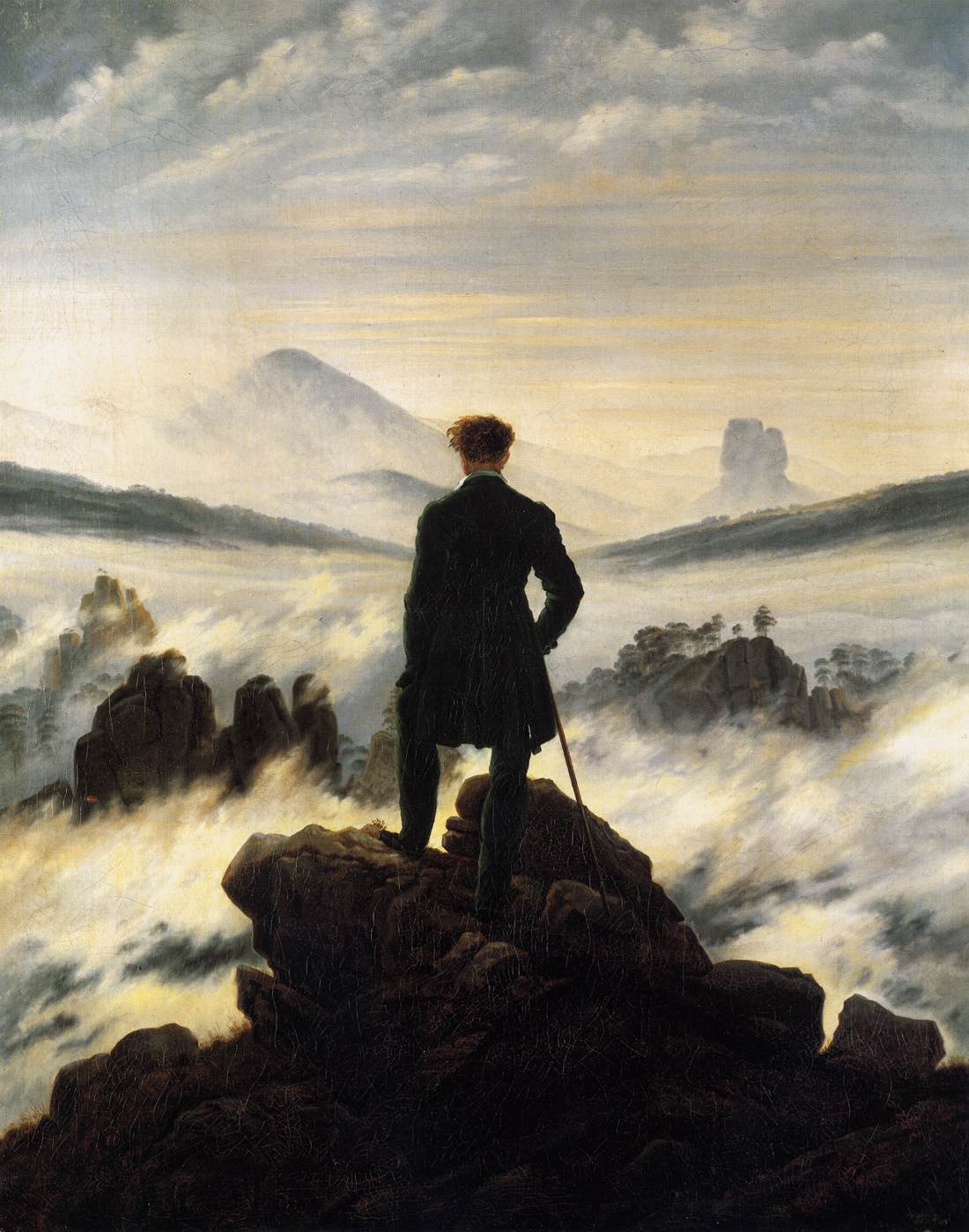
They came alive again at 6:02am, as the sky in the east began to glow. The poles were no longer rendered mute, but were rather building to a crescendo. A chorus of subtle hues, constantly morphing pinks, oranges, blood reds. My back was to the sun, but the field was exploding in front of me. At this point, the poles and landscape were working in perfect harmony playing off of each other. Inextricably linked, everything belonged, I became the interloper, the solitary, ascetic figure in a Friedrich painting, engaged in seemingly profound thought. At 6:14am the sun crested the ridgeline and as if on cue the silence was shattered by screaming and chortling from coyotes inside the valley. By 6:47 the sun was high enough that the poles were again fading, silently waiting for the next group of tourists.


Oh yeah, and no, there wasn’t any lightning.


A final note about photography, it’s frustrating, like “trying to fix a spider web with your fingers” level of frustrating, attempting to capture the subtleties and quickly changing and ever so slight play of light on the poles and landscape with a clumsy camera, and I would say they’re a poor attempt at encompassing the work. That said, I hope they at least give some sense of what it’s like.
20090729 Tags: infrastructure, kinne, mexico, photography, research, texas, writing | No Comments »

water and growth

_dsc7600b
“Don’t you find it difficult to live without running water?”


“No.” He said. “You can get used to anything. But it’d be nice for my kids.”


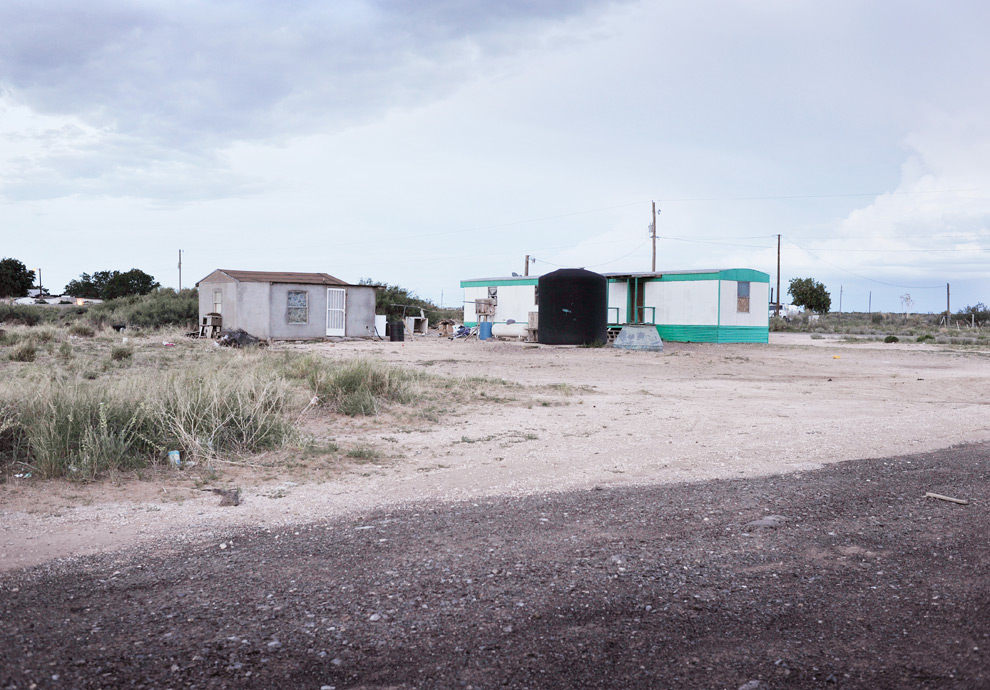
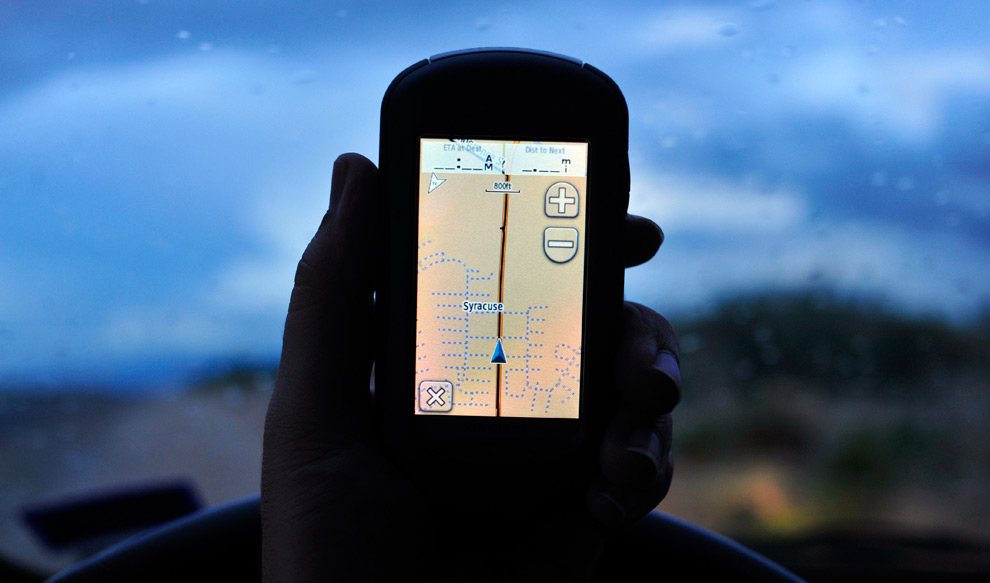
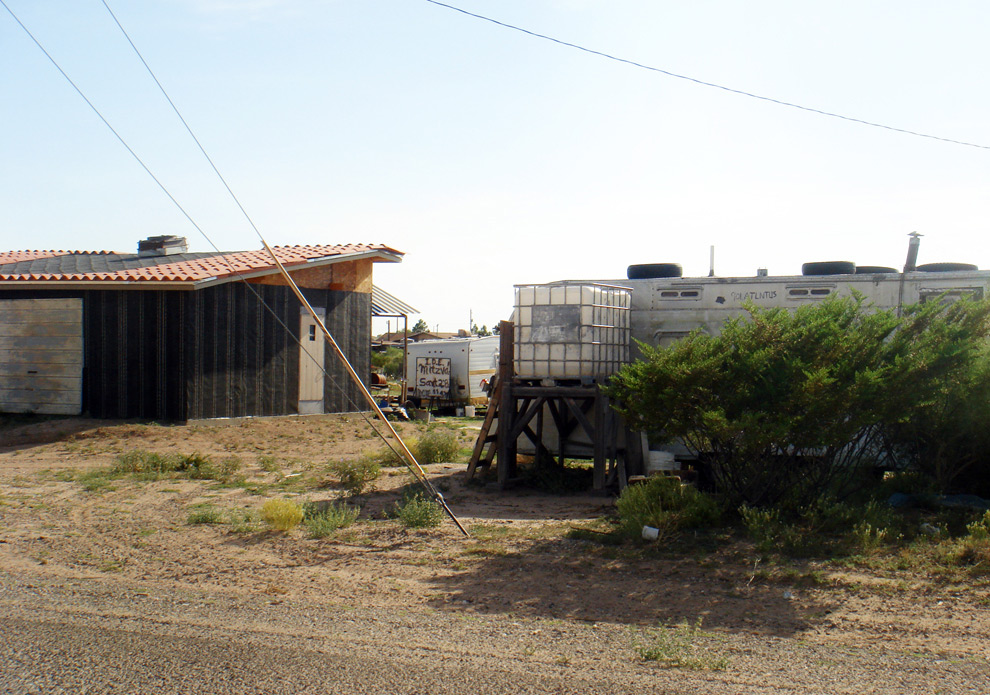
He was short, born in Mexico (as I later found out), sported a well manicured Pancho Villa mustache with a friendly smile underneath. His name was Carlos, and I took his waving as a sign I could resist the urge to jump back in the car and quickly drive the 30 miles back to El Paso. I walked over, and after brief introductions we started talking about life in the Colonias – the unincorporated improvised settlements at the Eastern edge of El Paso city limits – specifically this one, named Dairyland after the nearby dairy farm.


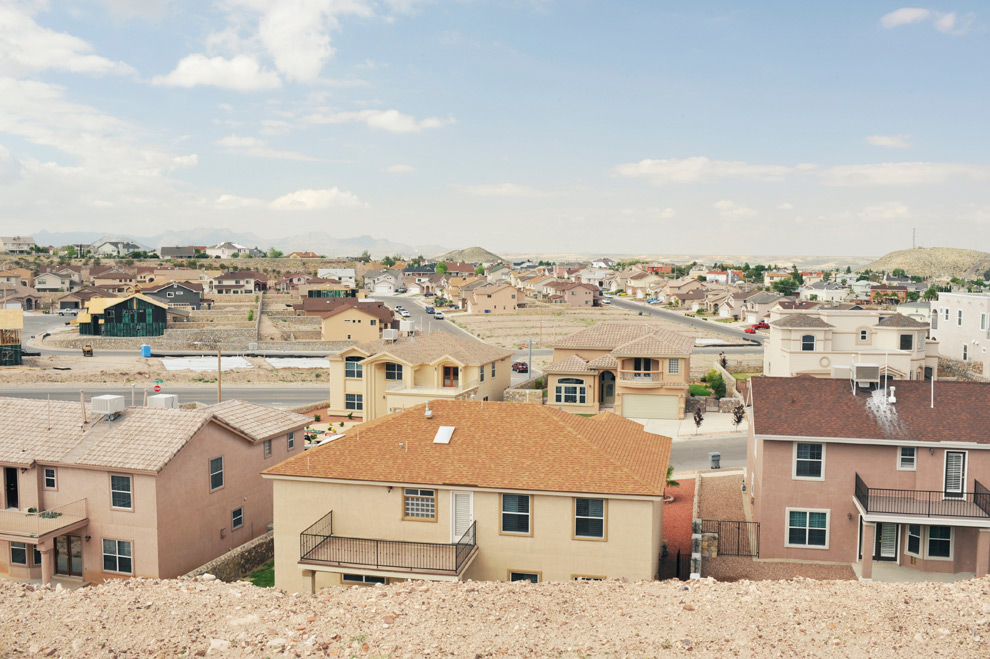
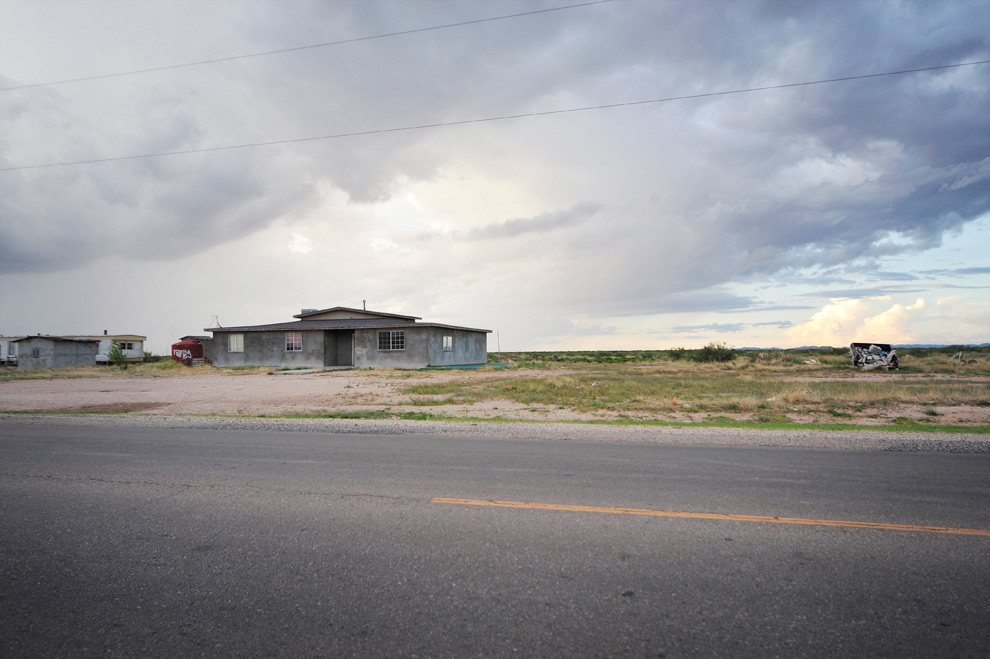
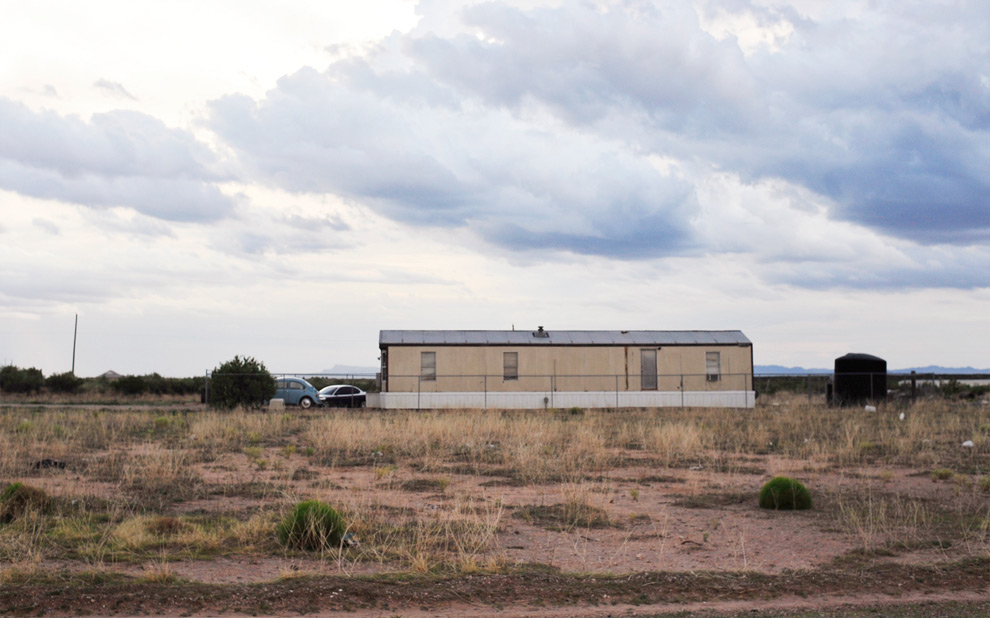
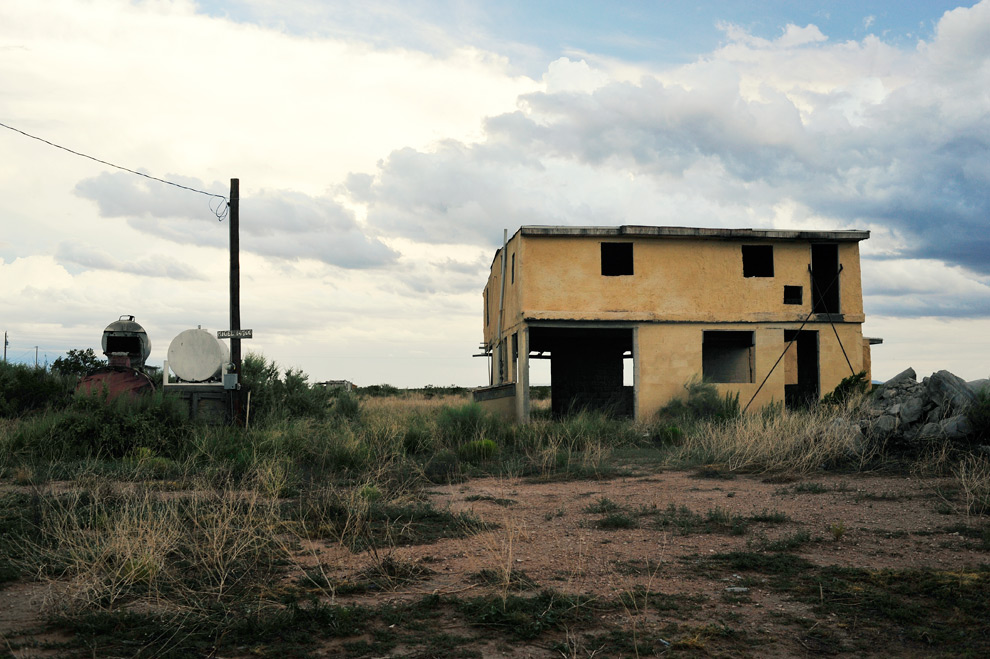
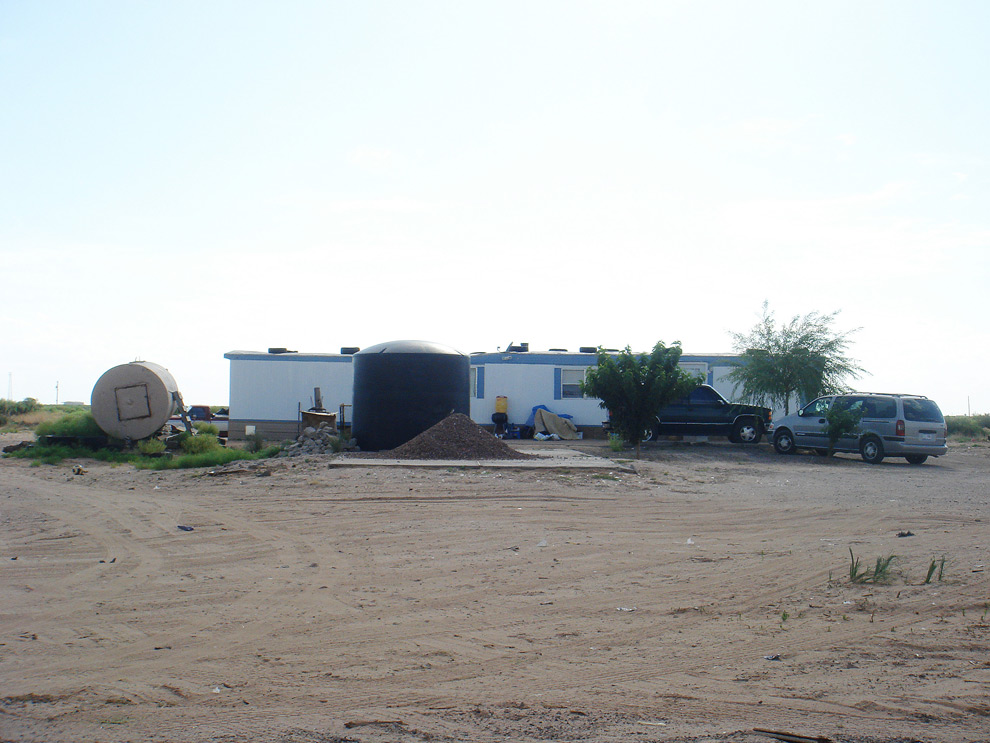
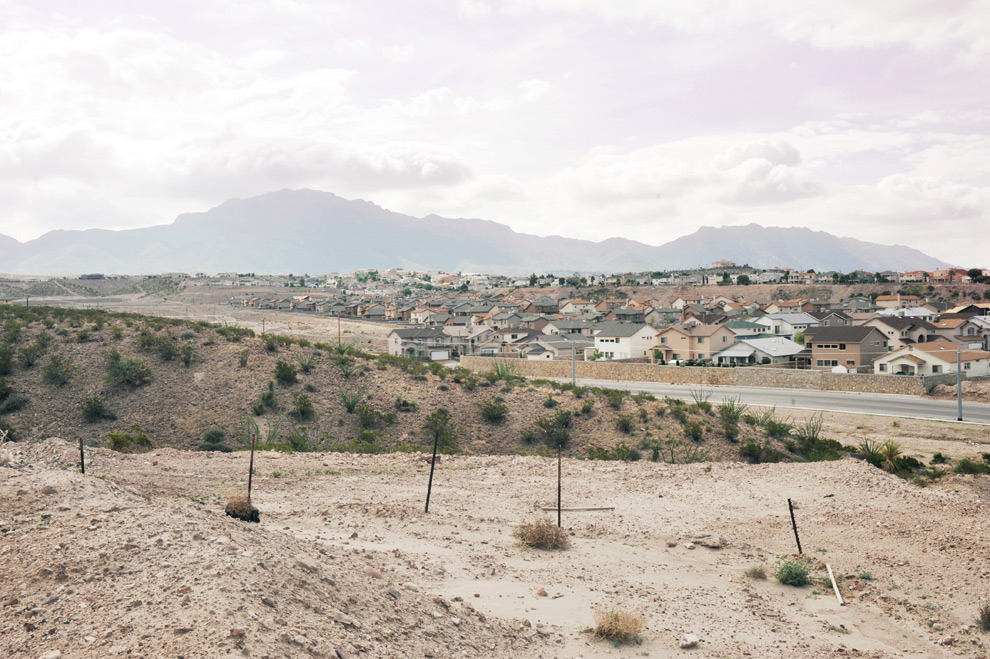
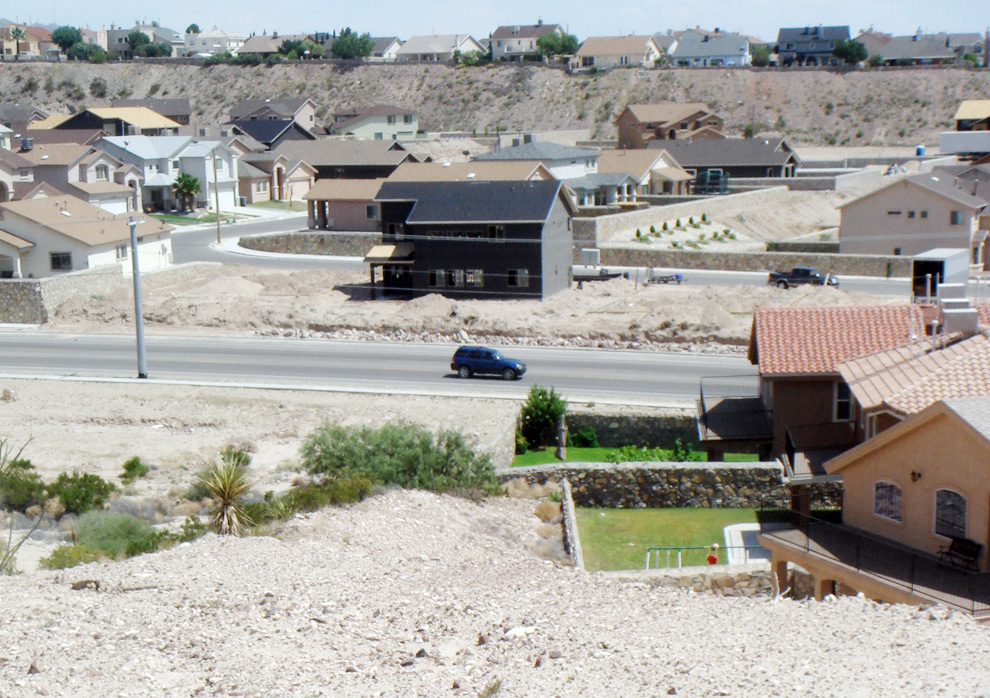
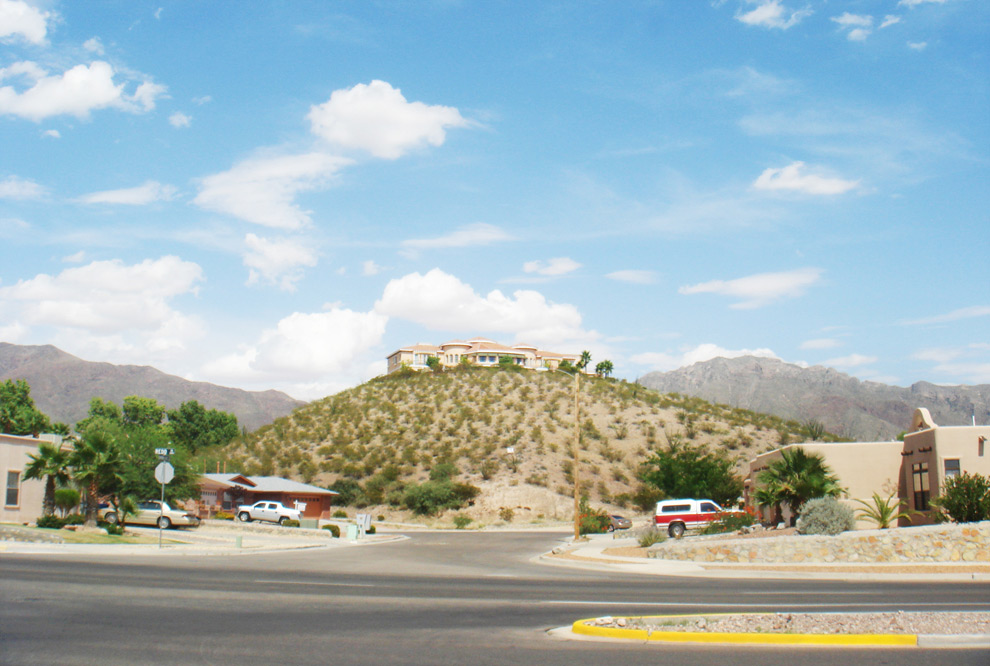
Aging trailers, abandoned crumbling masonry structures, plaster and tin – this is what affordable housing looks like in El Paso County. Priced out of the identical middle class housing developments that are forever encroaching further out into the desert or higher up the Franklin Mountains, where they perch atop artificially created plateaus, the Colonias are individual, jury-rigged and like the rest of the region, they’re expanding. As journalists from the University of California at Berkely found out, 80,000 people in El Paso County live in Colonias, members of the more than 400,000 Texas-wide Colonia residents.


While the homes are temporary, the numerous late model trucks and suv’s attest to the nomadic situation the colonia residents find themselves in. The homes themselves are fast, quickly assembled out of a mix of available materials and limited only by the skill level of the builders (from cinderblock, to balloon framing, to corrugated metal), or the cost of a pre-fabricated trailer; however, it is the vehicles that are permanent and reliable. This is a largely migrant population. This generation has travelled a great distance to attain a small measure of the American Dream, born in Mexico or more rural areas of the southwest, they made the trek to the border region because of the promise of abundant jobs. And the jobs were plentiful – until NAFTA.


_dsc7576


There’s ample debate about the effect of NAFTA on maquiladora growth, with pro-business groups believing NAFTA actually stymied maquiladora growth. However there is no question that the goal of NAFTA was to allow corporations to easily and cheaply create goods in Mexico, and ship them north – duty-free – for assembly. In a cruel twist, the well-paying factory job Carlos crossed over from Mexico to find, and kept for 10 years, left him behind, and jumped the river into Mexico. This is only one link of the chain of exodus that companies are chasing to find the lowest legally allowable hourly wage. While a factory worker in Mexico can expect to earn somewhere in the ballpark of two dollars an hour, a Chinese worker will do the same for less than a dollar an hour. To a multi-national corporation the math is simple, and according to Voice of America news, 170 factories and 100,000 jobs have been lost to China from the Juarez region. For Carlos, rather than follow his job back across the border for a fraction of what he was earning, he has been struggling as a day laborer, helping build middle class homes in the desert around Horizon City, a planned town just north of Dairyland. However, now that is starting to dry up, and oddly enough, in a reverse Depression-era migration pattern he says he’s thinking about leaving for Oklahoma, but he also said he’s proud of his home here. A home in a Colonia is still a home and he worked hard to get it.


The 2000 census put El Paso’s population at 563,000. A U.S. Department of Defense study from July 2009 projects the county’s 2012 population to balloon to 994,000. The El Paso Times stated in their July 20th headline: “El Paso Braces for Spike in Growth.” While some seemed to welcome the implied respectability that a seven figure population affords.
“I can’t wait for us to hit 1 million. I think it will give us the respect we deserve,” native El Pasoan Claudia Solis said. “I just hope we are ready for all the new people. I don’t want us to be in trouble.”


The newspaper seems to know better and implicitly understood the necessity to “brace” before the deluge of growth overwhelms El Paso infrastructure that may be lacking in viability to support the future 1 million El Pasoans and the ceaslessly growing population of over 2 million in Ciudad Juarez.


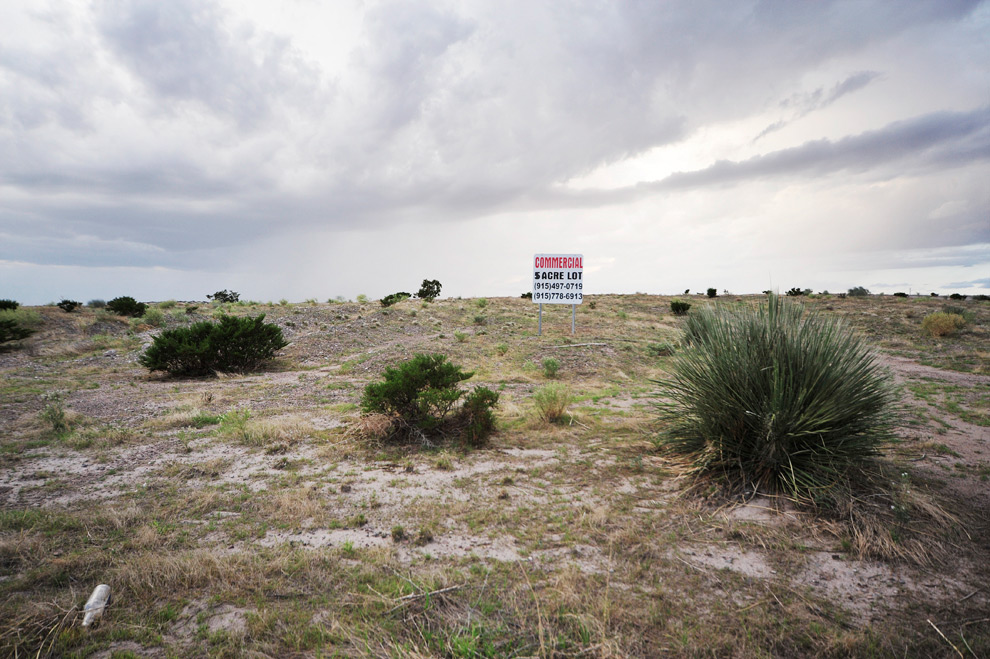
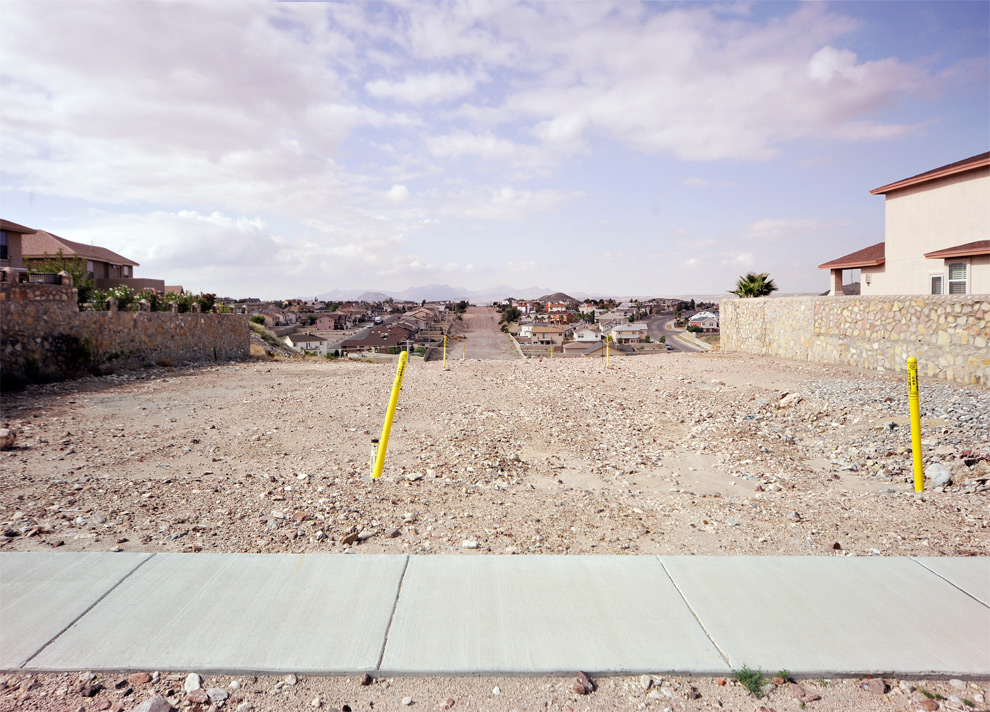
The growth of the Colonias runs in parallel to the growth of the region. This area is already being carved up via dirt roads into proposed subdivisions that are a parody of their West El Paso counterparts. Yet while the west El Paso developments follow along the massive Heizer-esque gas and water line, out here in the Colonias the county has no authority over land use questions. The Texas legislature attempted to control the growth of Colonias by passing “the Colonias bill” in 1995 that required developers to provide basic infrastructure, including water and sewage, as well as utilities on any land sold for Colonias. However, developers were able to easily skirt the law by selling the land as commercial use, explaining the ubiquitous “commercial land for sale” signs that I saw dotting the desert landscape.
Which brings us back to water.


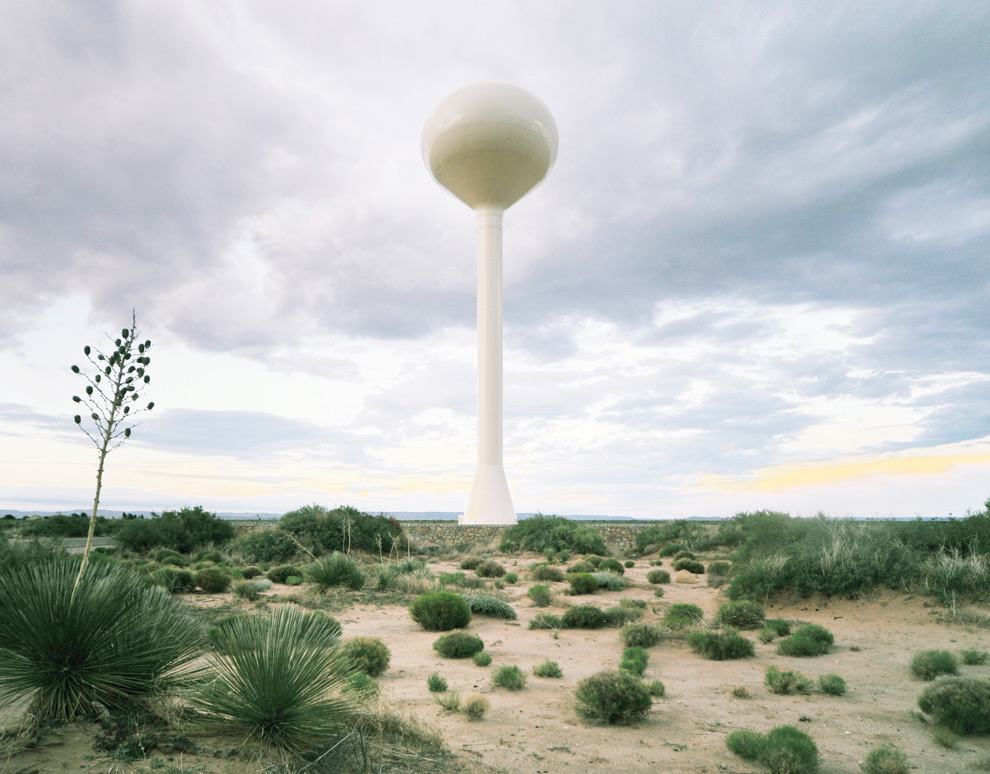
Water to the El Paso/Juarez region is supplied by two main sources, the Hueco Bolson and the Rio Grande River. Both sources are shared by both parties in a tentative partnership – a common theme in the border, what Michael Dear calls a “third nation.” Where issues of hyper-security and segregation between the sister cities also must co-exist in a symbiotic relationship of integration and mutual interdependence. However fragile this arrangement is, it is in no way equal when it comes to water use. Juarez with double the population uses per-capita half the average gallons per day of water as El Paso. There are no green lawns in Juarez. With unprecedented border growth, the Hueco Bolson is predicted to be tapped dry by 2020. El Paso is taking steps to bring water in from the Antelope Valley 80 miles to the East.


People in Dairyland get their water from only one place; a man with a truck comes by every month and fills up their various containers for storing gray water. Adjacent to nearly every home is the industrial black cylinders with thousand gallon capacity that store water. They frequently fill with algae, require constant cleaning, and are inefficient on a cost per dollar equation. Drinking water is another issue, and has to be brought in almost daily from Horizon City. It’s a tedious and often frustrating situation. But like Carlos said, he got used to it. It’s part of the inherent contradiction of the Colonias, he weighed his options, and saw that the opportunity for home ownership outweighed the drawbacks.


So, the heart of the problem is really one of growth and infrastructure. In Juarez, migrants from all over South America are pressing up against the border fence, drawn to the promise of plentiful NAFTA jobs, and after realizing they’d been duped, the jobs went to China, they’re attempting to cross over in the hopes of something better. In El Paso, a low cost of living and the designation of second happiest place in America is creating internal population growth as more latinos start families. Yet this spike in growth is obviously straining the infrastructure of the region. Limiting growth is equated with limiting cultural and economic revitalization in a region desperate for respect. Yet opportunities exist for new solutions outside of trucking in more water from ever greater distances. The border region could become the global leader in sustainable development, water treatment and distribution, rainwater reclamation. Solutions that would give people something to be proud of besides the number of inhabitants –an achievement which shouldn’t really count anyway if 15% of that number is kids that don’t have a flushing toilet.


_dsc7900

_dsc7444
Selling land as being for commercial use allows developers to avoid laws requiring infrastructural support for residential Colonias


_dsc7580
Colonias taking cues from suburban development being parceled via dirt roads.


_dsc7464
_dsc7511
_dsc7512
dsc06614
dsc066091
_dsc7854
Development in west El Paso stretches out into the desert along water and gas lines.


_dsc7905
Current city/desert edge.


dsc06586
Green lawns


dsc06606
Creating a number of drainage issues.

 
20090521 Tags: gsapp, kinne, research, school, writing | 2 Comments »

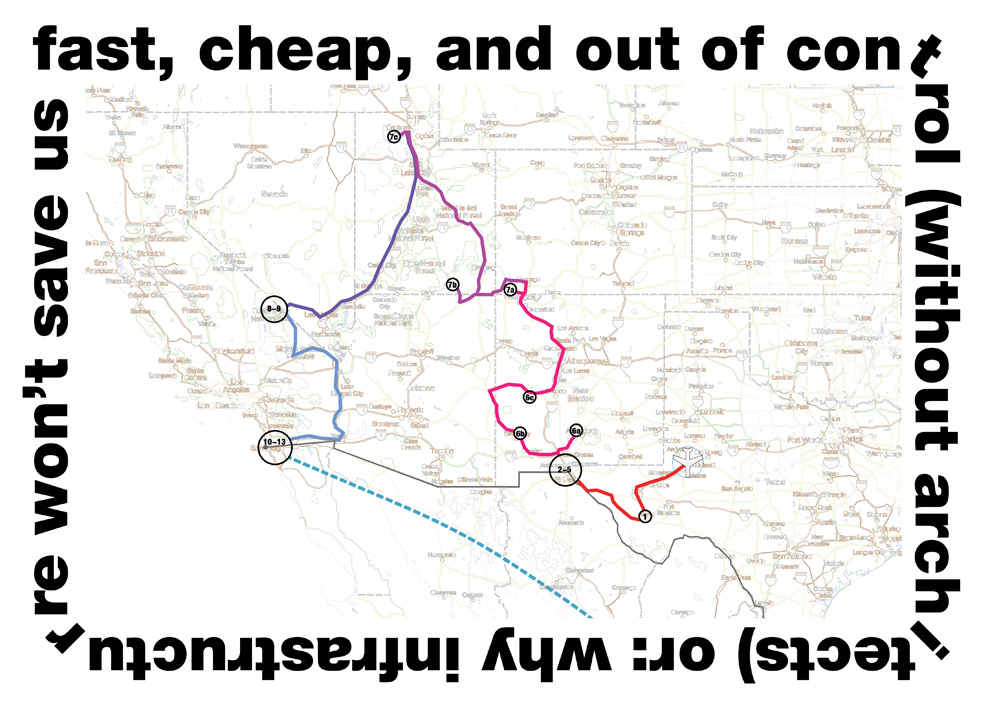
fast, cheap, and out of control (without architects) or: why infrastructure won’t save us

kinne-card
My proposal for a post-graduate Kinne travelling fellowship was accepted. Not only does it further delay the inevitable job search, but it affords me the means to visit what I consider to be some of the most interesting territory in the world – the American Southwest and the US-Mexico Border area. It’s an area I’m familiar with having lived in California and Texas, with frequent detours into Mexico, but it’ll feel good to re-visit with a more critical eye. Dean Wigley also seemed to particularly relish reading the title at graduation, giving extra emphasis to “won’t.” Download the entire pdf proposal here. See Abstract below:


The bureaucratic, welfare-state housing policy approaches from the mid-twentieth century have unquestionably failed, but what comes next? The urbanization of the developing world has lent this question a desperate sense of urgency, and while central planners slowly test solutions, it is squatters­—lacking developer or nation-state support—who have created a living laboratory of multiple failures and successes. Where the experiments become truly interesting is along the nearly 2,000-mile-length border of Mexico and the United States­—­the most asymmetrical border in the world. A nomadic, aterritorial space that is neither American nor Mexican, symbiotic in nature, and, while arbitrarily physically split, maintains a cultural porosity. Here is where the aspirations of a whole class of people wash up against an increasingly inward-looking first world barrier. What are the delicate political systems of control that allow this ecosystem to experience unparalleled growth? How does the built environment respond to these systems? What hidden systems can be extracted from a firsthand look at vast informal settlements, which in turn provide a framework for precise applications in architecture, technology and urbanism? Most importantly, this proposal is not merely about the collection of research data, but rather the formulation of a constructed argument regarding alternative future potentials of the built environment based on uncovered models existing within the border region.


The research will be completed through three mutually supportive phases. The first involves an intensive, first-hand documentation of the urban development in the two largest transnational border areas in the Western Hemisphere: El Paso/Juarez and San Diego/Tijuana. The research will be supported by an investigative journalist, a political science professor and the Juarez Department of Urban Planning. Secondly, a self-guided road trip will be taken through the southwestern desert to document historically how, without architects, ecologically sustainable structures have survived through the ages. This notion will be further developed by exploring responses ranging from artists Donald Judd and Robert Smithson to the self-sustaining Anasazi cliff dwellings at Mesa Verde and the U.S. missile testing ground at White Sands, New Mexico. Lastly, guided by a local Mexico City Architect, I will explore the “Tijuana-ification” of Latin America, with a study of the successes and failures of implementing an informal urban growth model, free of infrastructural support, into a metro area of 22 million people.

 
Newer Entries »

COPYRIGHT © 2011 \ JOHN LOCKE \ ALL RIGHTS RESERVED (RSS)

TOP OF PAGE

last update: 201102:1627