Yona Friedman: The Spatial City in the Realm of Sixties Radicalism
In the late 1950’s, architectural discourse was searching for a cohesive style. The paternalism of the modern movement had fallen out of vogue as scarcities of the war years gave way to a post-1945 consumer culture infused with exuberant displays of abundance. Rather than follow into the realm of pop and hi-tech that characterized the Archigram group and other techno-utopians, Yona Friedman chose to work within the “spatial urbanism” of the French avant-garde. Friedman sought a greater integration of architectural design and engineering experimentation as well as a dramatic reassessment of the role of the architect. By analyzing the work of Yona Friedman — specifically the Spatial City Project — within the context of the modern movement’s decline in relation to the emergence of radical architecture of the 1960’s, an increasingly relevant contemporary architecture emerges, one that seeks to effect social change by realigning standard urban living conditions within a capitalist framework.
Like his contemporary Buckminster Fuller, many of Friedman’s values were shaped by his experiences during World War II. In exile as an illegal emigrant, it was while living in Bucharest that Friedman began to define the core theoretical tenets of his architectural philosophy, a philosophy built on a holistic view that sees the world as a single construct comprised of indivisible amalgamations. In Friedman’s words: “A house alone does not exist.” (Friedman, 2) All actions — one country invading another, a Jewish man forced from his home into a new country — create reactions. Friedman believed the world is formed by the common realities we share with our neighbors. Our shared realities produce constructions and destructions that have far-reaching repercussions, a network of systems that vastly exceeds the grasp of a singular architect. How could an architect plan and design for an inhabitant whose needs are constantly in flux? Changes can be drastic, fast, and dirty, impossible for an architect to foresee. This is the world for which Friedman defined his terms. Hopelessly outdated definitions, such as the architect as “creator” and the inhabitant as “user,” were no longer valid. Technology was opening new possibilities and new choices in response to change, and a realignment of the artist-spectator relationship. (Friedman, 12) The user — the inhabitant — would become the creator of his or her own built object. Thus was born the basis for Friedman’s 1958 manifesto, L’Architecture Mobile, and his relocation to Paris.
The title itself, The Mobile Architecture, gives away his central conceit. This wasn’t a proposition for walking, moving buildings, but rather an architectural network that allows for the unpredictable social movements of its inhabitants. While the mass migration of populations during the war years formed the core of Friedman’s architectural theories, the pervasive scarcity of resources and housing in Europe led him to investigate a number of building-technology innovations using mobile, prefabricated elements. As millions were left homeless by war, Friedman developed a simple, prefabricated system, seen in his projects Panel Chains (1945) and Movable Boxes (1949), that could be easily configured into multiple housing options. (Richter, 45) The urgent necessity for housing for displaced peoples was made all the more apparent from Friedman’s own experiences in Haifa, Israel. Israel at the time was a new state witnessing the daily arrival of thousands of refugees who quickly found themselves lacking proper housing. His early projects were formed by chains of curving panels that could serve as both wall and roof pieces and were envisioned as cheap to manufacture, simple to transport and infinitely variable. Here again, the needs of the inhabitants were paramount in Friedman’s mind. (Friedman, 9) Form was largely undefined and primarily a by-product of cost-to-square-footage ratios of possible housing units.
Architecture became the means of emancipation, an ideal Friedman held close to his heart. It was precisely this reading of mobile architecture that led Friedman to split from the 10th International Congress of Modern Architecture (CIAM) at Dubrovnik in 1956. Participants at the Congress were taking “mobile architecture” to mean mobile dwellings and considered Friedman’s universalist approach to a reconfigurable “social mobility” to be anti-modernism. These debates led Friedman to leave CIAM and form his own Mobile Architecture Study Group in 1958. (Ley, 67) Adapting architecture to the changes occurring in modern life was an issue that held biographical resonance for Friedman. In Pro Domo, he describes living through the winter of 1945 in abandoned buildings in a half-demolished Budapest. Architectural form could be simplified to the barest of essentials when such basic necessities as networks for delivering water, electricity and heating are lacking. A functioning city is not the material buildings, but rather the infrastructural utility network and system of streets. The architect’s first responsibility is to ensure that these systems are in place, and this should precede all other formal proposals. Today, as a new generation grapples with the need to evolve the existing urban infrastructural network into smart electricity grids and ubiquitous broadband networks, Friedman’s argument for the primacy of infrastructure becomes all the more urgent. (Friedman, 10)
Again like Fuller, the scientific charting of material efficiencies became a primary driver of form. But Friedman largely avoided the traps of Fuller’s early housing experiments, which were largely deterministic and displayed a near fetishistic preoccupation with volume-to-surface efficiency. (Baldwin, 94) While both men saw a reappraisal of the way we live as the answer to many of society’s ills, it was Fuller, the “artist-scientist,” who believed he could shape the world through his own sheer force of will. The heroic vision of the lone architect as master builder was a standard trope of modernist dogma. Fuller was tweaking this formula, while still relegating the end user to the standard, subservient role. The inhabitant was still the receptor of a higher level of knowledge passed down from the creator-architect. Fuller believed the end user lacked the necessary expertise, while Friedman conceded only that the user may be below the technical level of the master-builder. He saw the possibility of development through a “trial and error“ method, with decisions left to the user-creator; the architect sets the stage for this development. The architect’s traditional role was too slow to enact meaningful social change. Speed and efficiency dominated the urban landscape, and a new infrastructure would have to allow for improvisation and expandability. (Friedman)
Friedman’s first attempt at articulating this new, rapidly deployed infrastructure was the Ville Spatiale project, which was comprised of a massive, multistory, inhabitable, rectilinear space frame supported by slender vertical piles. The voids within the space frame allow for habitable modular forms with an average area of 25-35 m2. Conversely, the form within the voids is left entirely to the wishes of the user. The space frame would contain all the necessary ducts, including wiring and piping. As Friedman describes in the La Ville Spatiale:
“Critical for the Ville Spatial is what I call the ‘spatial infrastructure.’ This infrastructure forms the fixed element of the city. The mobile elements consist of walls, base-surfaces and dividing walls which make the individual division of the space possible. All elements which come into direct contact with the users are mobile, in contrast to the infrastructure, which is used collectively and remains fixed.”
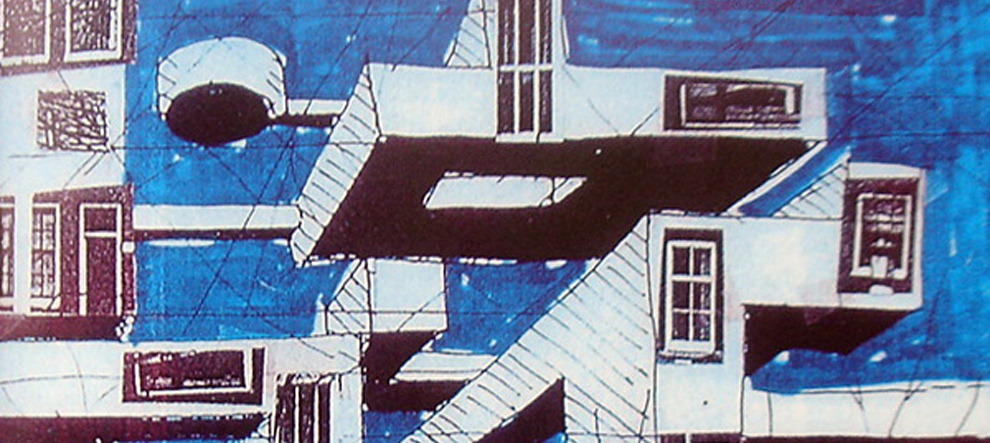
Friedman provides borderline-surreal collages and sketches of vast, hovering grids existing above the 19th century housing arrondissements of Paris. The relation to the existing city is left vague, the only contact points being the slender vertical pilotis that touch down at random points in the city. The Spatial City forms what Friedman would call an “artificial topography” — a grid suspended in space, forming a new geographical landscape through the use of an indeterminately expanding homogenous network. (Friedman, 56) Critic Reyner Banham would identify the insistence on the spatial grid as a trait shared by many of the French spatial urbanists and saw it as something of a conceit. Banham, focusing mainly on the group’s visual qualities, found the slender supports of the space frames to be bordering on the realm of the abstract, as the physical grid was light enough to mark a minimal aesthetic that seemed to dematerialize. (Banham, 220)
The conception of infrastructure as emancipatory structure and means of freedom is strongly rooted in Lefebvre’s urban notion of “appropriation.” A situation in which space is inherently dominated by the state, but the state’s power can be diffused by appropriations of the street by civilian actors. Both Lefebvre and Friedman understood society as a constant struggle between individual liberty – loosened through Mobile Architecture – and institutional constraints. Yet Lefebvre saw a system of control that led to class stratification while Friedman saw a means to empower the end-user. Lefebvre is quoted as dismissing what he saw as Friedman’s overtly simplistic solution, “To suggest, as Friedman does, that we can be liberated through nomadism, through the presence of a habitat in the pure state, created with metal supports and corrugated steel (a giant erector set) is ridiculous.” (Busbea, 67)
Friedman presented the Spatial City in a series of drawings that are intentionally vague, leading critics to brand them as overly simplistic. Like the architecture itself, the drawings are quick and improvised. They were a contradiction of sorts — Friedman was admittedly using industrial, ready-made materials, yet displayed no desire to explore details of how those materials came together. Friedman was rejecting the highly articulated details used by modernist architects as well as Fuller’s machine-like, precise drawings. The implication is that Friedman’s drawings, in attempting to avoid any preconceived notion of aesthetics, play up the project strengths, its indefinable disorder. Friedman uses the central concept of mobile architecture – the user is the creator – as a tabula rasa argument against any notion of precision. However, he is also hamstrung, in that he, the architect, is setting the proposal in motion. Friedman wants to propose a real project, but disregard the details of implementation. He obliquely refers to this when he states that, “my drawings try to express eventual strengths, a disorder which pleased me. I do, after all, have my personal peculiar ‘taste.’ But the principle of ‘spatial city’ is that which says that ‘anything goes.’” (Friedman, 56) The simplified style of Friedman’s drawings also foreshadowed his later interest in illustration and animated films. (Busbea, 64)
Friedman’s goal was to enable the inhabitant to become master of his or her own design. Process becomes the paramount driver of creation, while the final result remains an amorphous ideal. In this way, Friedman sought to codify the unpredictable nature of human behavior. In his holistic world view, the erratic nature of each user’s individual actions is allowed to disintegrate the false nature of central planning. (Ley, 204) However, a central contradiction is found within Friedman’s system of Mobile Architecture. Friedman, the architect, still designs the framework — the system — into which the user is granted a somewhat specious level of freedom. Any semblance of authoritarianism was banished from his vision by proposing a mobile structural space frame that could accommodate any configuration and making the user the ultimate arbiter of how that configuration terminates. Yet, as with many megastructural projects, there is an underlying element of megalomania. Friedman was calling not only for the creation of an entirely new multistory space frame grid that would result in infrastructure on a scale previously unseen in any urban city, but also for the radical spatial realignment of Paris. The city, which is left to its own entropic devices, exists in a separate reality below the grid. For a nomad like Friedman, the notion of a new architecture disconnected from the city below – cities complete with their attendant issues of petty politics, famine, and social inequality – had to hold a certain level of comfort. The Spatial City can exist in the same form anywhere – in Spatial Paris, Spatial Tunis and Monegasque Venice, and always provide a sense of home in a mutually hospitable environment. Friedman’s sincere evocations that “the best of the worlds is the one where anything can happen… You are free! You have the right to your own utopia.” (Friedman) are particularly powerful coming from someone displaced by the horrors of the mid-20th century. It was only later, in his agricultural city projects for UNESCO and the UN, that the 20th century city as an impediment to meaningful change is taken to its logical extreme. In these projects the mobile architecture creates a new, spontaneous city aggregation, completely removed from any existing urban center.
While on one hand, Friedman encourages architects to become less self-important and subordinate their skills to the necessities of the client, he himself was a relentless and masterful self-promoter. Throughout the 1960’s he was a tireless lecturer, visiting schools worldwide between teaching stints in France and Israel, while also amassing a large volume of written work. In this way, his ideas began to resonate with a new generation of architects who came of age in the postwar boom years. The qualities of Mobile Architecture that made it so amorphous and open-ended were the same qualities that allowed it permeate through so many projects of subsequent generations. Or, as Friedman put it, he always tries “to generalize ideas. This allows them to be interpreted in as many ways as possible.” (Friedman, 56)
Many contemporaneous projects while superficially similar were grouped with the Spatial City but lacked the same politics and nuanced architectural philosophy. Constant Anton Nieuwenhuys’s New Bablyon for instance, shared Friedman’s vision of a massive city on stilts with the existing traffic vectors remaining on the ground level. Similar to Friedman, Constant also saw automated industrial manufacturing creating a surplus of leisure, however New Babylon differed in that it was a city that encircled the globe and one in which the city itself reached a level of automation that directed the social life of its inhabitants. Again, the living environments could be shifted at will, and daily life revolved around leisure and desire. Friedman certainly attempted to banish any notion of authoritarian management from his projects and would have rejected New Babylon as being decidedly dystopian in character. (Gold, 261)
Beginning in 1960, Friedman’s work became widely published in Japan and inspired the approach of the Japanese Metabolists, specifically the shift in Kenzo Tange’s megastructural developments of the early 1960’s. Tange presented his utopian project for Tokyo Bay at the 1959 CIAM Team 10 conference at Otterloo. Banham referred to the project as “the megastructure movement’s major masterpiece.” (Banham) The Tokyo Bay Project, however, varied sharply from Friedman’s convictions regarding the primary role of the user and was indebted more to the International Style-inspired utopian schemes of Le Corbusier. Soon after, however, Tange’s work displayed a distinct shift that put it at odds with the conventional Modernism of his previous output. His Yamanashi Communications Centre of 1963-67 trended towards a flexible pattern that could accommodate growth and change within an indeterminate pattern. (Sharp)
Also no stranger to Mobile Architecture, Archigram was certainly inspired by Friedman when they developed the Walking City project as well as the Plug-in City. Friedman is quick to point out the influence he sees his work having on Archigram and other architects of the 1960’s. “Archigram literally borrowed my idea. …The young architects of the sixties reacted very positively to the ideas I exhibited in Mobile Architecture. I have never considered their projects to be plagiarism, but I have found in them a source of satisfaction.” (Friedman, 32) Like Friedman, they were deeply skeptical of modernism, only sincere when declaring that the “pre-packaged frozen lunch is more important than Palladio.” (Avgitidou) However, their provocations were rooted in the impracticality of their propositions. The bold, iconographic value of their projects was essentially an ironic commentary on consumer culture from a group of graduates raised on television. The metal, bug-like mega-structures of Walking City, which would carry their inhabitants within the mobile Metropolis to new, more promising locations, could be seen as the dystopian analog to Friedman’s solution for displaced populations. It is only within the technological confines of the Walking City insects that the inhabitants are provided a safe respite in an unsafe world. Friedman’s primary consideration was the intentions of his work’s occupants. Archigram took this notion further, declaring that pop culture — what their inhabitants watched, read, and bought — was the primary driver of their work. Friedman was not completely immune to the power of mass culture for communication. Throughout his Mobile Architecture plans, he grappled with the interface that inhabitants would use to shape his dwelling. He conceded in his “trial and error” method that the inhabitant would have to attain a certain level of training to shape his own space and would require a manual or set of instructions to reach this level. During the 1960’s, Friedman’s manual took the form of a comic book, with panels that he himself created, recalling the pop-inspired comic form of Amazing Archigram 4. (Friedman, 139)
The events of May 1968 dominate most discussion of the French avant-garde, a time when the urban space itself was politicized to a great degree, and leads to an assumption that the radical architecture being produced in France of the 1960’s was itself politically radical. However, Friedman would be considered politically conservative, and like many of the other French architects of his generation, he rejected the term “utopia” because of the connotations to socialism. French society of the Cold War attempted to weave a path between the totalitarianism of the communist bloc and the American capitalist model. Friedman’s Spatial City, with its inherent built-in freedom for the user, was then a realignment of technological progress away from a purely profit-driven model and toward individual freedom’s within a collective society, thus creating an amalgamation of politics, leisure, culture, and technology. (Busbea, 7) Friedman subverted the motto of 1968 “under the pavement: the beach,” by disregarding the street and its related city through the elevation of his work to the free space above Paris.
While the Archigram group was embracing pop culture, the French avant-garde, of which Yona Friedman found himself the de-facto leader, displayed an absolute mistrust of mass culture while putting their faith in the power of technology. As Friedman’s work evolved, he shifted from his sketched, improvisational renderings to a Buckminster Fulleresque array of charts and graphs. There is an important distinction to make in that Fuller’s charts aped the look and methods of science and engineering, he was struggling for scientific credibility. Friedman on the other hand, was constantly paring his charts down to their barest essentials, creating schematic cartoons for didactic ends. Mathematical and social theories were distilled to simplified two dimensional cartoons and stick figures with simple text bubbles complete with lines and arrows that indicated movement. The purpose of these basic expressions were to convey to the general public in the most direct way possible his theories of mobility and urbanism. (Busbea, 68)
Friedman’s ideogram was the logical progression from the manual, to the comic, to the diagram. It was only after a teaching stint at MIT that Friedman took his ideograms one step further through the use of technology in the Flatwriter project of 1969. Here, choice was relegated to the most objective of entities – the computer.
Modern architecture had designed for the idealized, modern man, and the projects of the 1950s were undertaken according to the perceived desires of this non-existent user. Friedman thought differently, “The majority of architects designing housing today do not work for millionaires, but for millions of individuals who will work or live in the architects’ project. The architect cannot ascertain their preferences and, therefore, should not presume to choose for them. He should, instead, devise methods of promoting choice among the users themselves.”
One of Friedman’s core beliefs was that there is no single house. All houses are connected –socially and economically – new construction affects all previous constructions by altering the delicate equilibrium existing in urban systems. It is this set of interrelationships that is too complex, and undemocratic for a solitary architect to manage. Friedman wanted each user to become the master of his own creation, but what will the repercussions of one new building have on the way of life on the general public. The foreknowledge of these possible results, whether they be approved or denied, allows the individual and the group to exercise a popular vote for or against any project. (Friedman, 129) The Flatwriter project allows the user, through a simple computer interface, to input their future housing preferences. Preferences which would then be reconciled with the data of the existing constraints and produce a mediated response factoring in pragmatic issues such as how much space needs to remain unoccupied for solar exposure, cost of construction, prior claimed spaces, etc. Technological innovations coupled with user preferences become the driving force for the urban environment. (Busbea, 68)
Friedman does not make any explicit references to the range of technological urban experiments going on at MIT at the time, where John Negroponte and the Architecture Machine Group were also redefining the role of the architect in a complex urban environment. Negroponte believed that architects were a detriment to urban expansion, as they lacked the necessary speed and adaptability that modern life demanded. Rather, Negroponte saw the built environment as being guided by a series of ethical architectural machines. Machines that were more objective and could analyze and respond to data faster than any human. (Gere, 128) Ostensibly, the user is in control of the system as they are the ones generating the data, but the implications of a surveillance society owe more to Constant than Friedman, who preferred to give the user an immediate means of controlling their own environment.
The notion of a game, even one as sophisticated as that which Friedman envisioned in Flatwriter, complete with a dual meaning both to define the spatial city but also alert the user to the consequences of their actions, owes much to Fuller’s World Game Institute. Fuller, ever seeking to do more with less, saw his philosophy put into practical application through world diplomacy, by showing that international cooperation and the sharing of limited resources would benefit the greatest number of people and create a harmonious environment in which war would be rendered obsolete. This theory was played out in Fuller’s idea of the World Game Institute, a game of strategic moves conceived as a counterpoint to the war games of the Cold War planners. Played on Fuller’s Dymaxion Map (where all nations had equal representation), the game simulated the global distribution of surplus food, outbreaks of disease, and polluting industry. It goes without saying that the only winning strategy involves a system of international cooperation. (Fuller, 137) Ultimately, Fuller believed his game would be facilitated by computers and played officially by United Nations delegates. Again, while Fuller had grand ambitions of facilitating a global reallocation of resources and priorities, Friedman’s ambitions were scaled down to the level of the individual user.
In a world where the existing urban environment becomes a prisoner of sorts to its own aging infrastructure, Friedman’s notions of quickly composing and re-composing the Spatial City in response to future events seems increasingly relevant. And Friedman’s radical reimagining of the role of the architect, rooted in modesty and a sincere desire for change in keeping with the possibilities afforded by technological advancements, continues to provide new possibilities for a profession that suffers from a dearth of bold ideas.
Bibliography
1. Avgitidou, Dr. Angeliki. “The Future is So Bright, I Gotta Wear Shades.” Stimulus Magazine. http://www.stimulusrespond.com/extras/Avgitidou.pdf
2. Baldwin, J. BuckyWorks: Buckminster Fuller’s Ideas Today. John Wiley: New York, 1996.
3. Banham, Reyner. Megastructure: Urban futures of the recent past. Harper & Row Publishers, New York, 1976.
4. Busbea, Larry. Topologies: The Urban Utopia in France, 1960-1970. The MIT Press, Cambridge, 2007.
5. Friedman, Yona. Pro Domo. Actar, 2006.
6. Yona Friedman, “The Flatwriter: Choice by Computer,” Progressive Architecture. March,1971.
7. Fuller, Buckminster. Critical Path. St. Martins Press: New York, 1982.
8. Gere, Charlie. Digital Culture. Reaktion Books, 2002
9. Gold, John. The Practice of Modernism: Modern architects and urban transformation 1954-1972. Routledge, 2007
10. Ley, Sabrina. Megastructure Reloaded. Hatje Cantz, 2008.
11. Sharp, Dennis. “Kenzo Tange.” The Architectural Review. May, 2005.